


























Views
Downloads



Ready Repetition/Parallelism Worksheet | Grade 10 English II
Paste this activity's link or code into your existing LMS (Google Classroom, Canvas, Teams, Schoology, Moodle, etc.).
Students can open and work on the activity right away, with no student login required.
You'll still be able to track student progress and results from your teacher account.
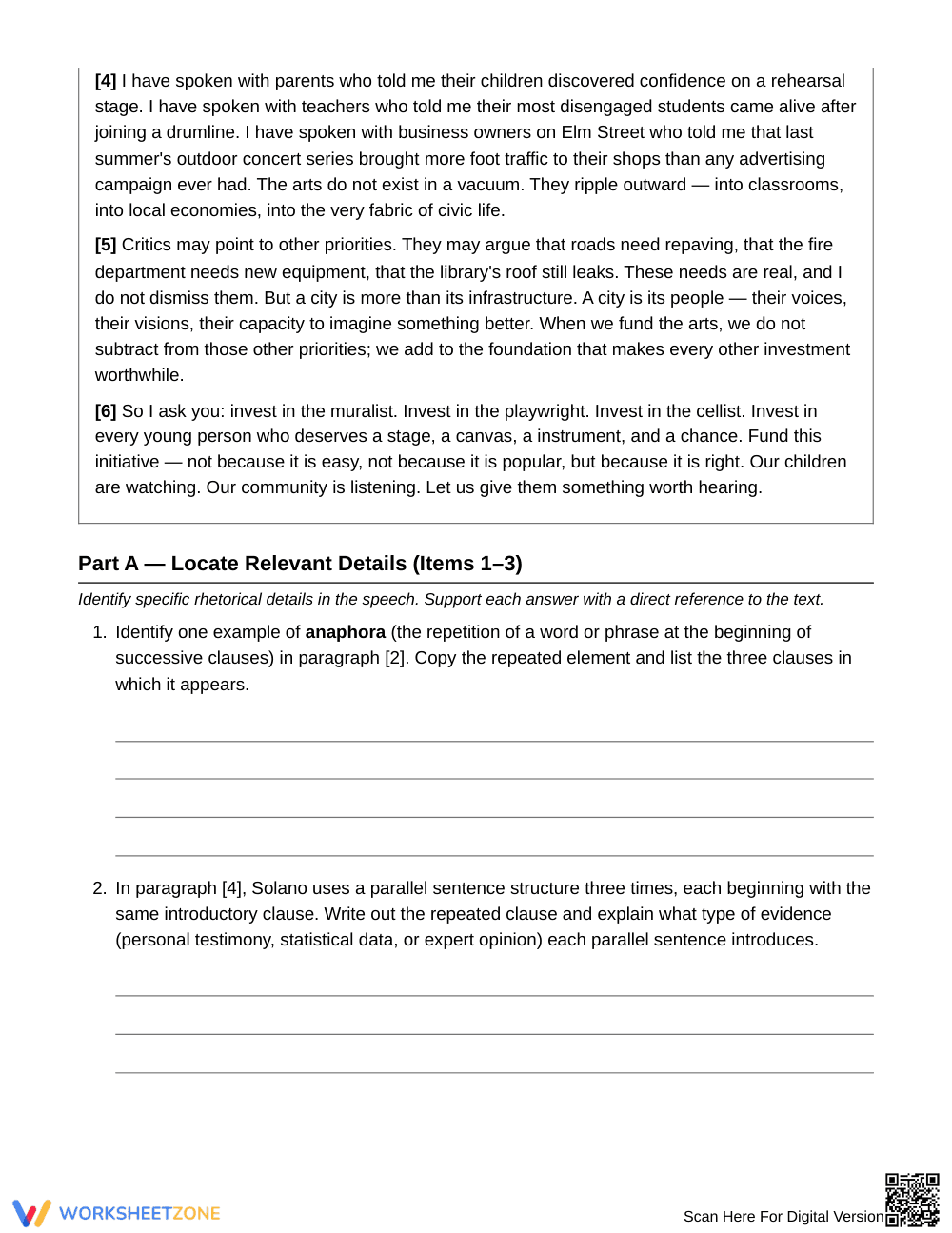
This Grade 10 English II worksheet trains students to analyze how authors use repetition and parallelism to build persuasion. Working through an original civic speech across six pages, students examine syntactical patterns, identify rhetorical appeals, and defend interpretive claims, mastering analysis skills aligned to standard RI.9-10.6.
At a Glance
- Grade: 10 · Subject: English II
- Standard:
RI.9-10.6— Analyze how an author uses rhetoric and syntax to advance point of view- Skill Focus: Analyze Repetition and Parallelism
- Format: 6 pages · 12 problems · Answer key included · PDF
- Best For: Rhetorical analysis practice and assessment prep
- Time: 45–60 minutes
What's Inside
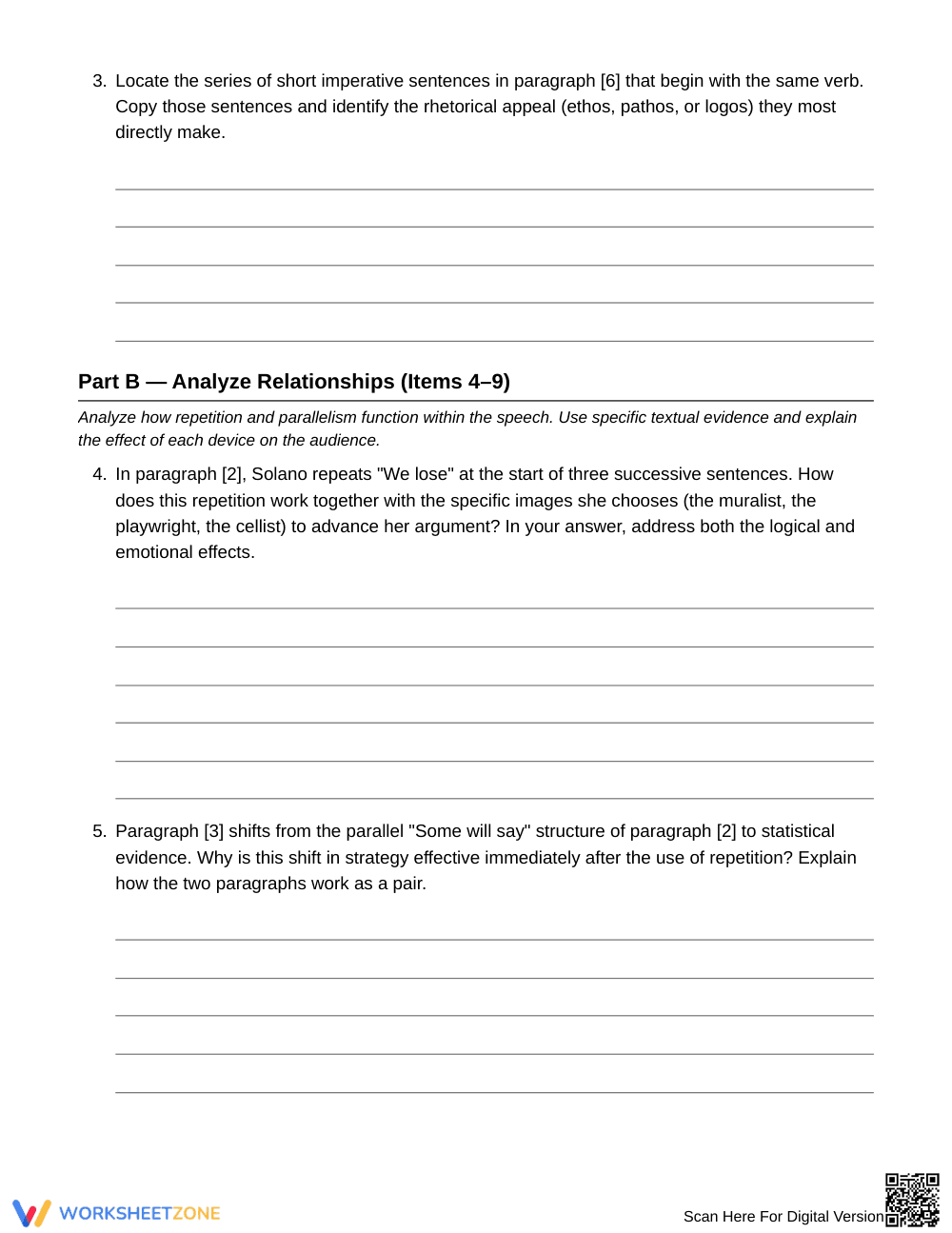
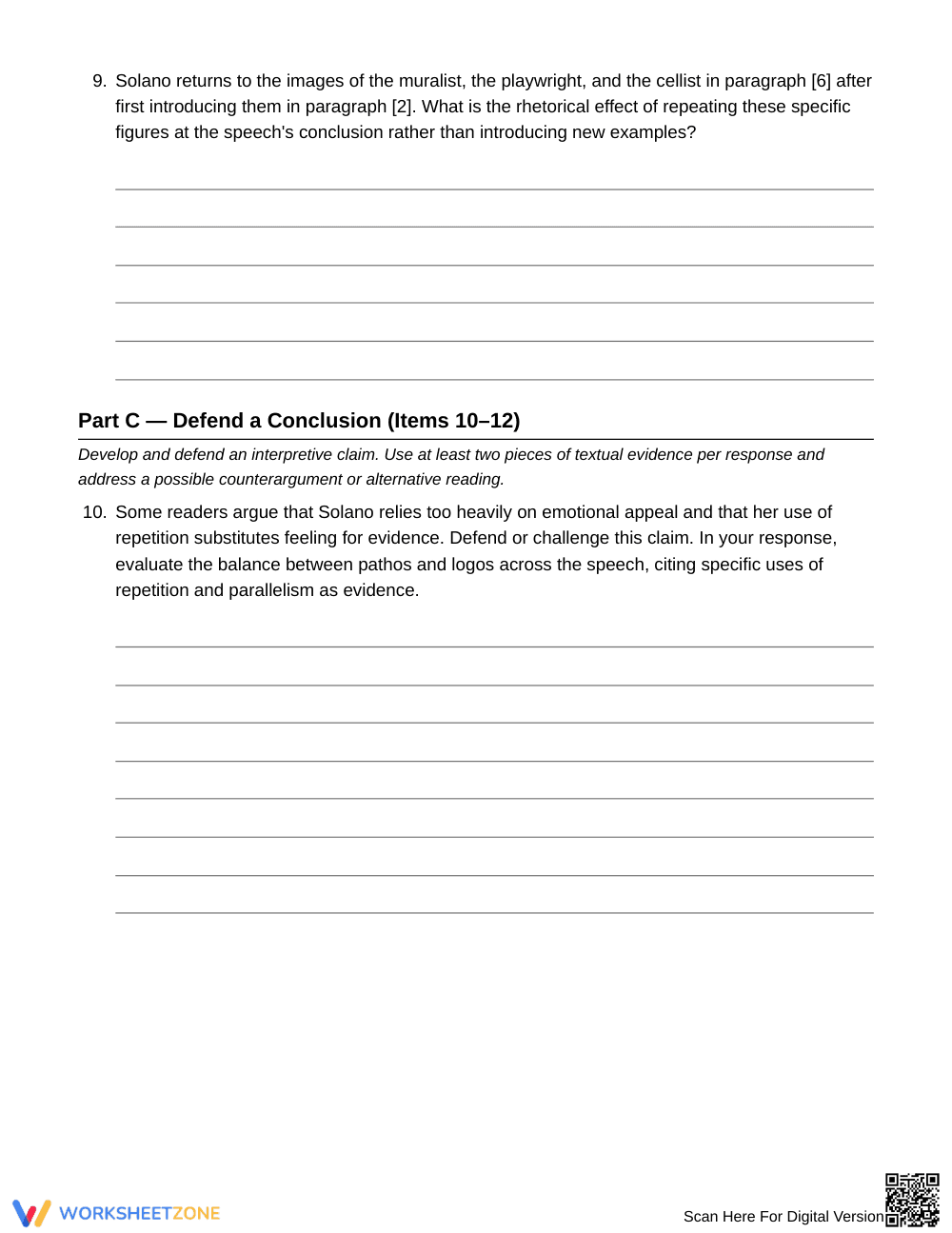
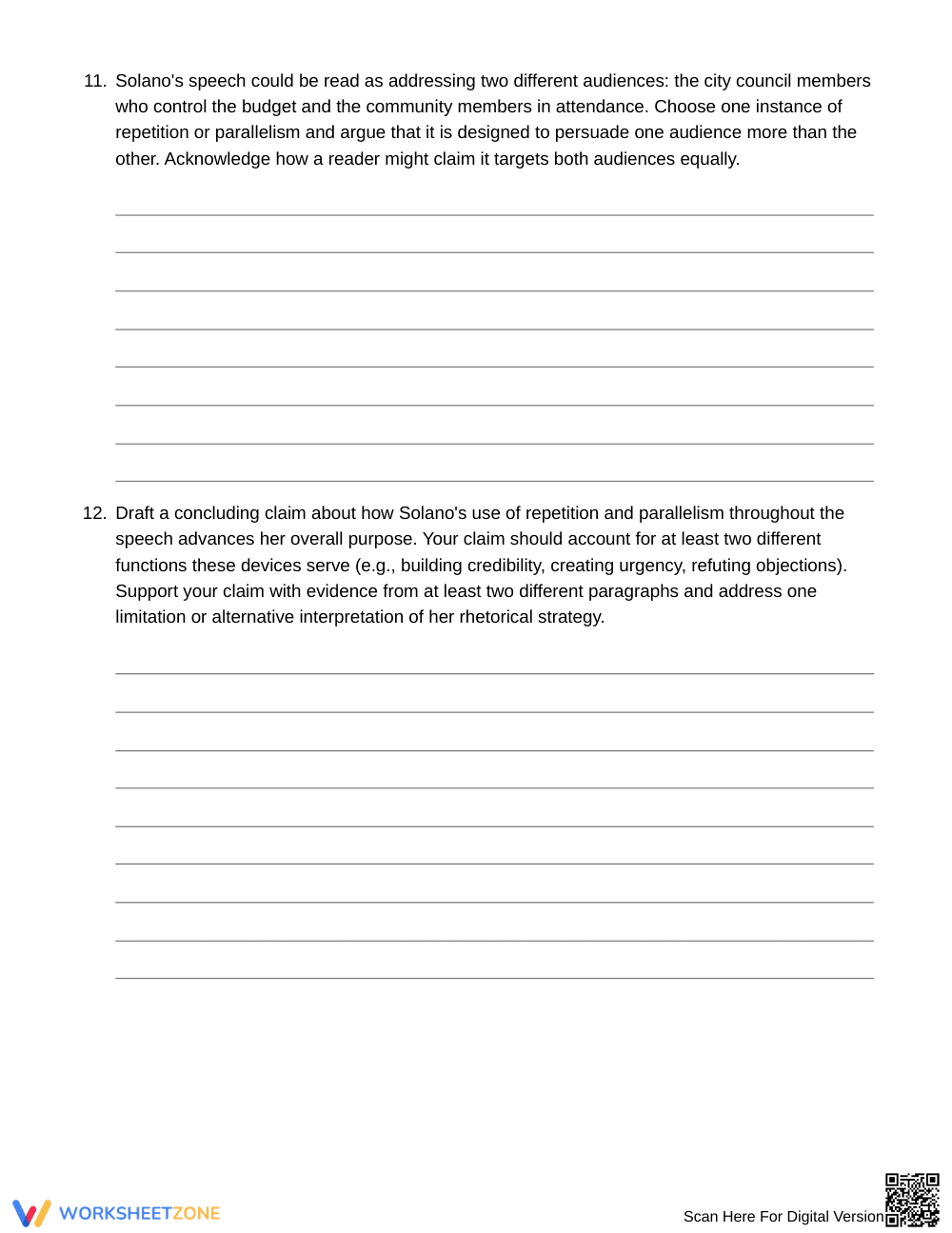
The packet opens with key terms defining repetition, parallelism, and rhetorical appeals. Students read "A Stage for Every Story," a fictional municipal council speech, before completing 12 text-dependent tasks across three sections. A thorough five-page answer key provides complete model responses and textual evidence.
Skill Progression
- Guided practice (Items 1–3): Students locate specific instances of anaphora, repeated introductory clauses, and parallel verbs in designated paragraphs.
- Supported practice (Items 4–9): Intermediate prompts guide students to analyze how structural shifts and sentence rhythm reinforce rhetorical appeals.
- Independent practice (Items 10–12): Students write analytical arguments evaluating appeal balance, audience targeting, and overarching purpose.
This gradual-release structure moves students smoothly from identification to multi-paragraph analytical critique.
Standards Alignment
This resource aligns with `RI.9-10.6`: Determine an author's purpose and analyze how rhetoric advances that point of view. It also supports `RI.9-10.1` by requiring textual evidence for all claims. Both standard codes can be copied directly into lesson plans, IEP goals, or district curriculum mapping tools.
How to Use It
Use this worksheet after direct instruction on rhetorical appeals during a 50-minute block. Have students read the speech together, then complete Part A in pairs before tackling Parts B and C independently. Check Item 6 during practice to confirm students understand parallel sentence variations.
Who It's For
This resource is built for tenth-grade English II students developing close-reading skills. Provide paragraph chunking for students needing extra scaffolding. Pair this worksheet directly with a direct instruction lesson on rhetorical devices or speeches like Martin Luther King Jr.'s "I Have a Dream."
According to Fisher & Frey (2014), gradual release of responsibility frameworks significantly improve adolescent reading comprehension when instructional tasks systematically bridge guided modeling, supported inquiry, and independent justification. This Grade 10 English II worksheet embodies that research-based design under standard RI.9-10.6, which asks secondary students to analyze how authors use rhetoric to advance point of view. By structuring 12 tasks across three progressive stages—from locating anaphora in specific sentences to evaluating the balance between emotional and logical appeals—the resource ensures learners develop rigorous syntactical awareness. High school students do not simply identify devices; they evaluate how repetitive phrasing and parallel structures function within civic speech contexts. Instructors receive detailed diagnostic data across 6 pages, confirming whether tenth-grade readers can independently analyze syntactic choices and justify evidence-based conclusions in complex non-fiction informational texts.


