




























Views
Downloads




Ready Redshift Records Worksheet | Grade 12 Earth Science

Paste this activity's link or code into your existing LMS (Google Classroom, Canvas, Teams, Schoology, Moodle, etc.).
Students can open and work on the activity right away, with no student login required.
You'll still be able to track student progress and results from your teacher account.
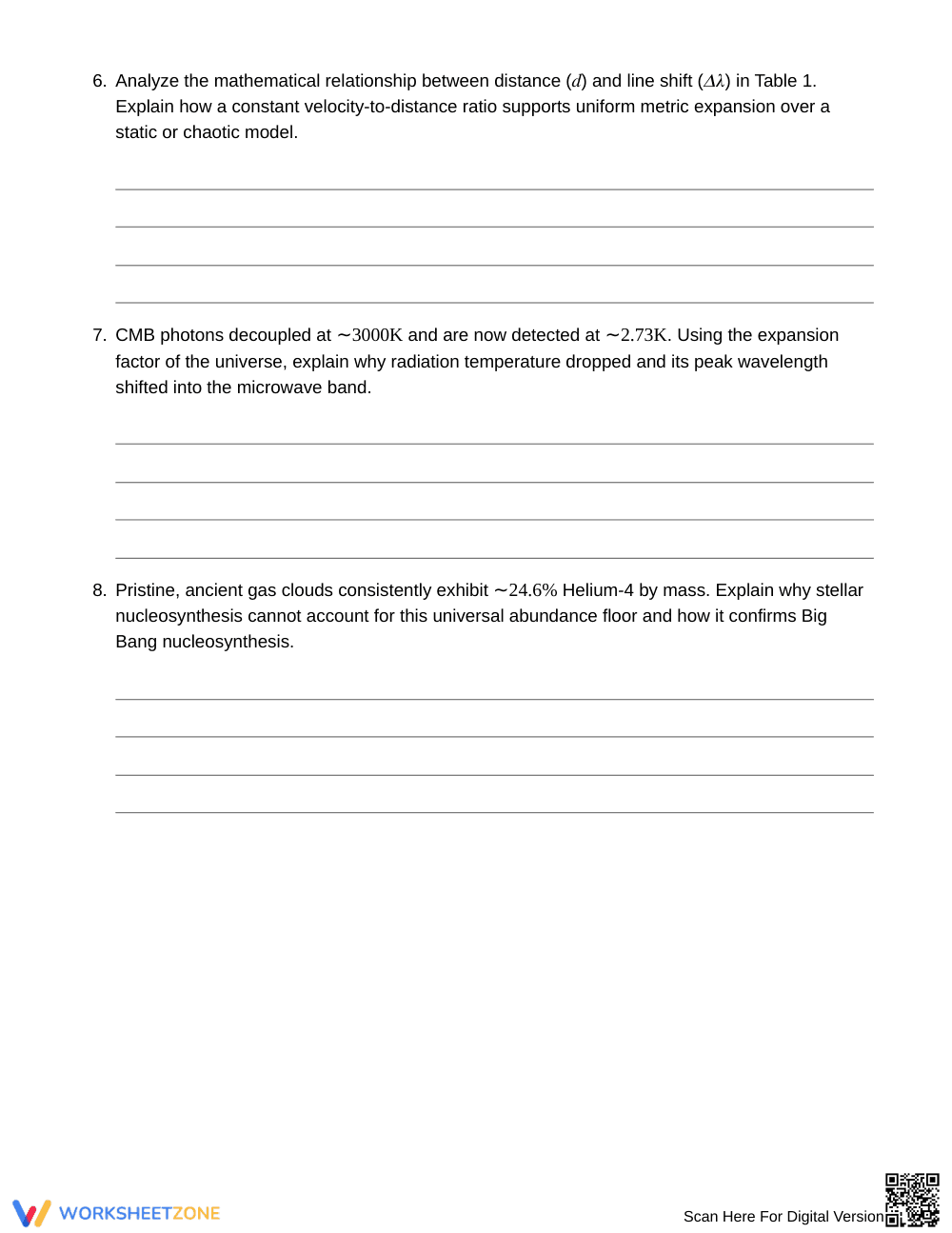
This Grade 12 Earth and space science worksheet equips students to interpret redshift-and-distance records to evaluate empirical evidence for universal expansion. High school astronomers extract spectroscopic wavelength data, compute recession velocities using the Hubble law, and contrast Big Bang nucleosynthesis predictions with steady-state cosmological models across ten rigorous, quantitatively grounded analytical problems.
At a Glance
- Grade: 12 · Subject: Earth & Space Science
- Standard: Analyze spectroscopic and cosmological data to model universal metric expansion
- Skill Focus: Interpret Redshift-and-Distance Records
- Format: 5 pages · 10 problems · Answer key included · PDF
- Best For: Advanced astrophysics data analysis
- Time: 45–60 minutes
This 5-page instructional resource contains two complete scientific datasets, ten analytical tasks, and a comprehensive 2-page worked answer key. Students reference formula boxes containing constants and equations before working through spectroscopic tables of five field galaxies and empirical cosmological baseline measurements, including cosmic microwave background temperatures and primordial helium-4 fractions.
Skill Progression
- Guided practice (Problems 1–2): Students extract foundational baseline values directly from tables with structured variable prompts, isolating rest wavelengths, observed line shifts, and empirical radiation values.
- Supported practice (Problems 3–8): Learners calculate redshift factors, recession velocities, and Hubble constant ratios using scaffolded formulas while modeling metric space expansion and primordial light-element ratios.
- Independent practice (Problems 9–10): Students synthesize astrophysics concepts independently to identify physical limitations in non-relativistic approximations and distinguish local peculiar motions from deep cosmological expansion.
This sequence reinforces student autonomy through a structured gradual-release model moving systematically from I Do to We Do and You Do.
Standards Alignment
This lesson aligns with national Earth and space science standards requiring high school students to construct explanations based on astronomical spectra, cosmic background radiation, and galactic motion. A supporting standard connects mathematical modeling of wave propagation to cosmological frames. Both standard codes can be copied directly into lesson plans, IEP goals, or district curriculum mapping tools.
How to Use It
Deploy this worksheet after direct instruction on astronomical spectroscopy and Hubble's law as a core partner investigation, or assign it during exam review to solidify quantitative astrophysics skills. As a formative assessment checkpoint, observe whether students confuse metric expansion of intergalactic space with physical velocity through space in Problem 5. Completion takes 45 to 60 minutes.
Who It's For
This assignment targets Grade 12 Earth science, astronomy, and physics learners. To differentiate, provide struggling students with pre-calculated fractional conversions, while tasking advanced learners with deriving relativistic corrections. Pair this worksheet naturally with an interactive galactic spectra simulator or cosmological expansion lecture.
Empirical analysis of astronomical spectra requires students to interpret redshift-and-distance records by connecting quantitative spectroscopic shifts directly to universal metric expansion. According to research on structured disciplinary literacy from Fisher & Frey (2014), gradual-release instructional architectures significantly enhance student competence in complex STEM tasks by bridging direct data extraction with high-order theoretical synthesis. This 10-problem Grade 12 Earth and space science resource implements that framework through authentic galactic datasets and cosmological benchmarks. Students examine absorption lines from distant galaxies, calculate non-relativistic velocities using the Hubble law, evaluate the thermal decay of cosmic microwave background radiation, and articulate why primordial helium abundances necessitate a hot Big Bang model. Grounded in quantitative problem solving and conceptual differentiation, this standards-aligned instructional package builds critical thinking and computational proficiency, ensuring upper-level secondary students establish mastery over observational astrophysics before transitioning into undergraduate physical science coursework.


