




























Views
Downloads




Ready Orbital Data Worksheet | Grade 12 Earth/Space Science

Paste this activity's link or code into your existing LMS (Google Classroom, Canvas, Teams, Schoology, Moodle, etc.).
Students can open and work on the activity right away, with no student login required.
You'll still be able to track student progress and results from your teacher account.
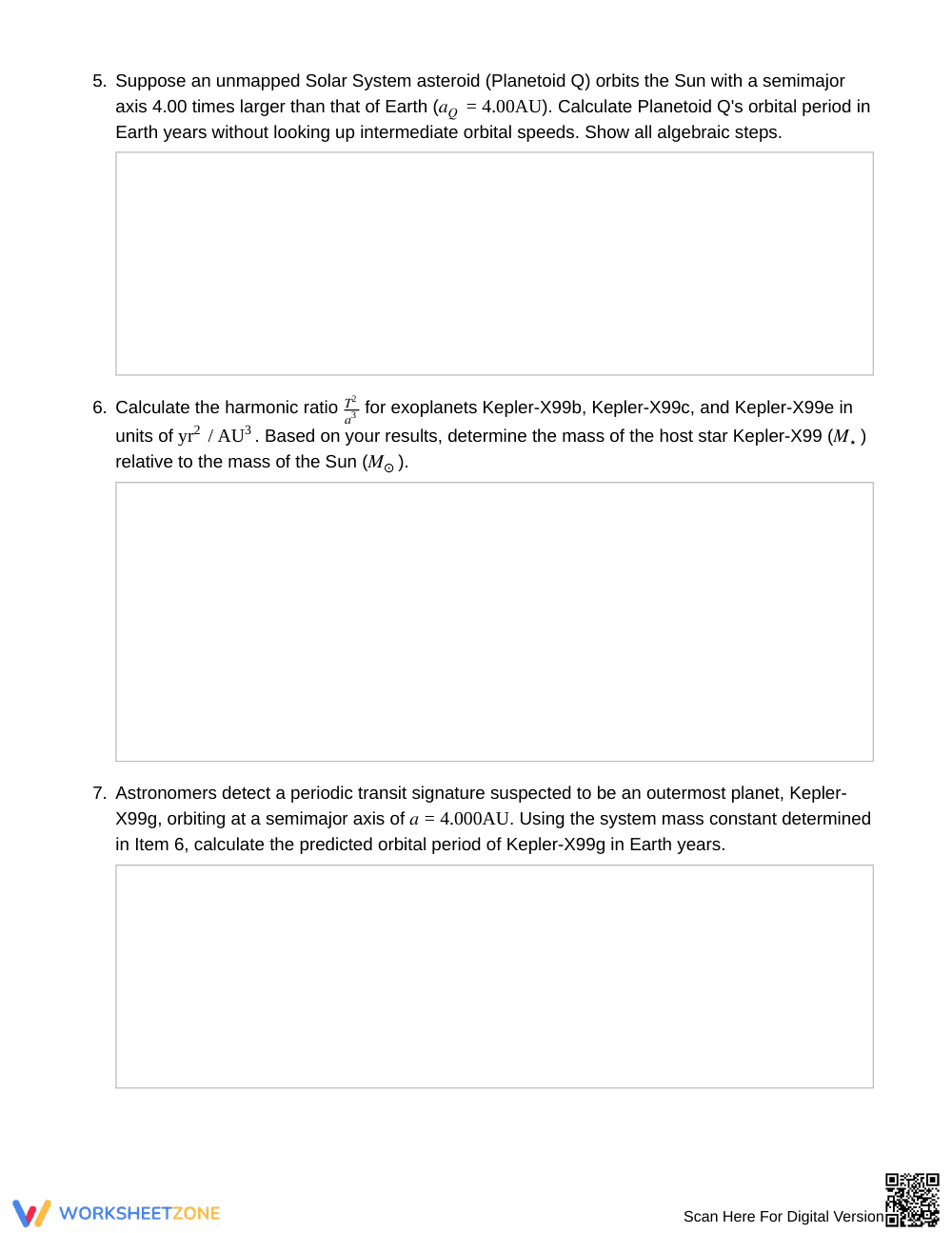
This orbital motion worksheet equips Grade 12 students to interpret period and semimajor axis data using Kepler's Third Law. Working with Solar System and exoplanet datasets, learners calculate stellar masses, model orbital speeds, and evaluate survey limitations across 10 structured problems.
At a Glance
- Grade: 12 · Subject: Earth and Space Science
- Standard: Earth and Space Science — Analyze orbital data using Keplerian proportional relationships and harmonic models
- Skill Focus: Interpret Period-and-Semimajor-Axis Data
- Format: 5 pages · 10 problems · Answer key included · PDF
- Best For: Advanced planetary dynamics and data practice
- Time: 45–60 minutes
What's Inside
This 5-page activity features a reference box defining Kepler's Harmonic Law, two observational datasets, and 10 analytical prompts. Dataset 1 presents orbital elements for six Solar System objects, while Dataset 2 supplies synthetic transit and radial velocity data for five exoplanets orbiting HD-94182. A 2-page answer key provides complete algebraic solutions and conceptual explanations.
Skill Progression
- Guided practice (Part A, Problems 1–2): Direct data extraction tasks orient students to tabular parameters, requiring learners to identify semimajor axis, period, eccentricity, and discovery methods with low cognitive demand.
- Supported practice (Part B, Problems 3–8): Proportional modeling tasks guide students to calculate Keplerian ratios, compute host stellar mass, determine orbital resonances, and algebraically derive velocity formulas.
- Independent practice (Part C, Problems 9–10): Open-ended evaluation tasks challenge students to critique transit survey limitations and evaluate multi-body gravitational perturbations.
This sequence mirrors the gradual-release framework, moving students from basic table lookups to complex mathematical modeling and scientific critique.
Standards Alignment
This activity aligns with high school Earth and Space Science standards requiring students to use mathematical representations of Keplerian laws to describe orbital motions. Students apply proportional reasoning to analyze orbital periods and semimajor axes across planetary systems. Both standard codes can be copied directly into lesson plans, IEP goals, or district curriculum mapping tools.
How to Use It
Assign this resource during an orbital mechanics unit directly after direct instruction on Kepler's Third Law. Alternatively, use it as a collaborative partner workshop before introducing gravitational physics. During work time, circulate to verify that students square orbital periods and cube semimajor axes before dividing in Part B. Anticipate 45 to 60 minutes for full completion.
Who It's For
This worksheet serves Grade 12 students in Earth and Space Science, Astronomy, or AP Physics courses requiring quantitative analysis. For students needing scaffolding, provide pre-calculated power tables or calculators with exponent keys. Pair this activity with an orbital simulation lab or a stellar mass reference anchor chart to deepen conceptual understanding.
Rigorous secondary science curricula require students to interpret period and semimajor axis data to master advanced orbital mechanics. Aligning with high school Earth and Space Science standards, this 10-task worksheet structures Keplerian planetary analysis through scaffolded data extraction, mathematical proportional modeling, and critical evaluation of astronomical survey methods. As demonstrated by Fisher & Frey (2014), systematic gradual-release structures enable learners to master demanding quantitative tasks by moving purposefully from direct data isolation to unguided algebraic modeling and scientific critique. By analyzing dual observational datasets of Solar System bodies alongside extrasolar planetary systems, Grade 12 learners develop transferable data literacy and computational proficiency. Students determine host star masses, test Keplerian harmonic constants across stellar environments, and evaluate why transit photometry favors short-period inner planets. This focused instructional tool ensures students build both conceptual fluency and rigorous problem-solving habits necessary for college-level astrophysics and planetary science study.


