




























Views
Downloads



Ready Orbit Inference Worksheet | Grade 12 Earth Science

Paste this activity's link or code into your existing LMS (Google Classroom, Canvas, Teams, Schoology, Moodle, etc.).
Students can open and work on the activity right away, with no student login required.
You'll still be able to track student progress and results from your teacher account.
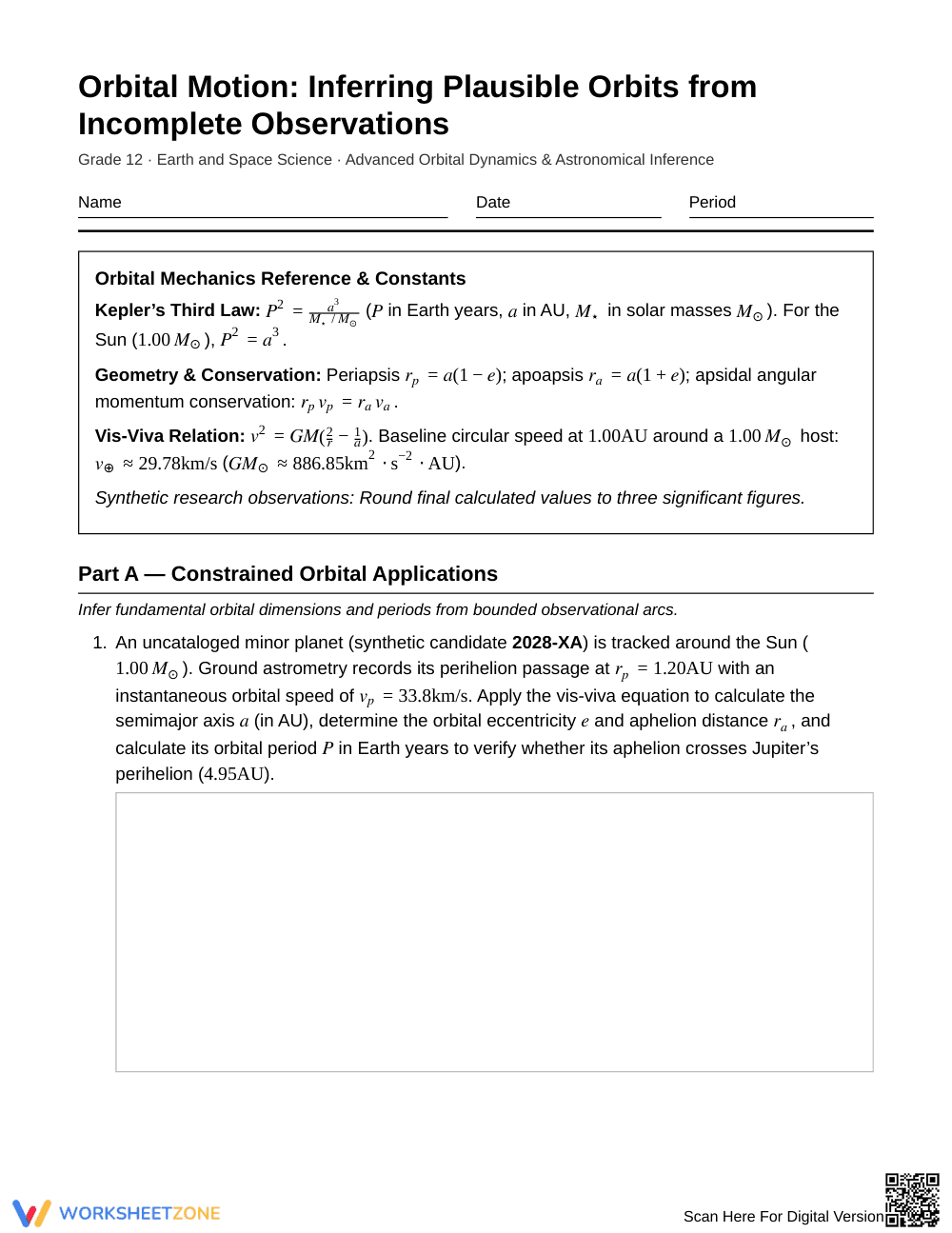
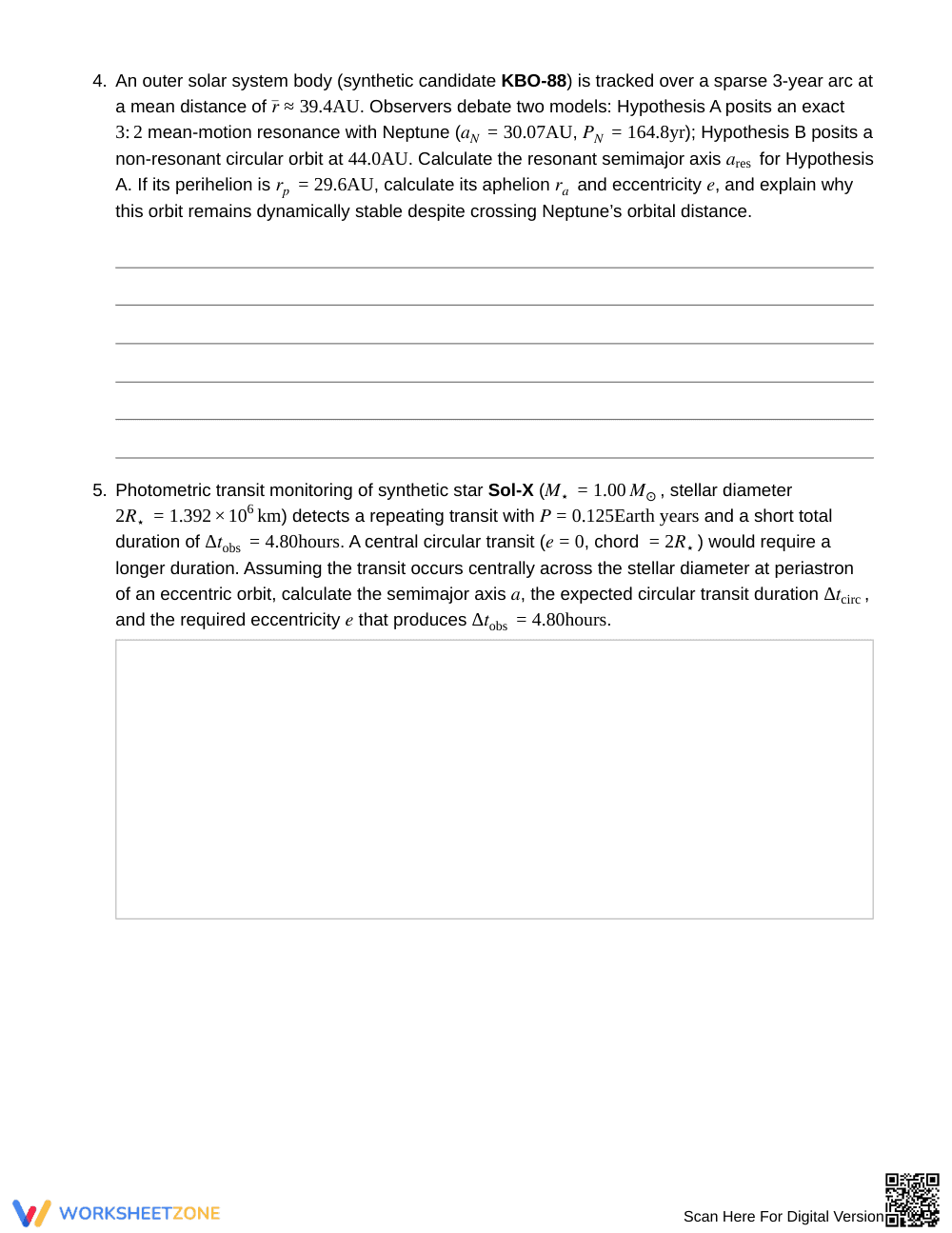
This Grade 12 Earth and space science worksheet equips students to reconstruct complete planetary orbits from sparse observational arcs. High school seniors apply Keplerian geometry and the vis-viva equation to determine orbital eccentricity, calculate semimajor axes, and resolve competing astronomical hypotheses using physical constraints.
At a Glance
- Grade: 12 · Subject: Earth & Space Science
- Standard: Orbital Dynamics — Infer orbital parameters and dynamics from sparse observational data
- Skill Focus: Infer a Plausible Orbit from Incomplete Observations
- Format: 4 pages · 6 problems · Answer key included · PDF
- Best For: Advanced planetary physics and astronomy problem sets
- Time: 60–90 minutes
What's Inside
The 4-page worksheet presents 6 multi-step analytical problems with a full 2-page answer key showing complete mathematical derivations. A reference section provides Kepler’s Third Law, the vis-viva relation, and apsidal conservation equations. Students evaluate astrometric tracking arcs, Doppler radial velocity measurements, and transit durations to determine complete orbital dimensions.
Skill Progression
- Guided practice (Part A, 2 problems): Students apply vis-viva and apsidal equations with structured prompts to calculate semimajor axes, eccentricities, and orbital periods for uncataloged bodies.
- Supported practice (Part B, 3 problems): Learners evaluate competing orbital hypotheses, orbital resonances, and transit durations to eliminate non-viable physical models.
- Independent practice (Part C, 1 problem): Students calculate local escape speeds to classify an inbound object as bound or unbound, then defend its physical origin in an extended scientific response.
This sequence implements the gradual-release model, moving from guided calculations to independent hypothesis evaluation.
Standards Alignment
This worksheet aligns with high school Earth and Space Science expectations for orbital dynamics and gravitational motion. Students analyze mathematical representations of trajectories and predict orbital parameters using Newton’s gravitation and Kepler’s laws. Both standard codes can be copied directly into lesson plans, IEP goals, or district curriculum mapping tools.
How to Use It
Deploy this worksheet after direct instruction on Keplerian mechanics. Assign Part A during class for paired problem-solving, and use Parts B and C as an advanced post-lesson evaluation. As a formative check, observe whether students check if instantaneous speeds exceed escape velocity when classifying trajectories. Completion takes 60 to 90 minutes.
Who It's For
This resource serves Grade 12 Earth and space science, astrophysics, and advanced physics students mastering orbital mechanics. Provide the reference box for standard support, or require honors students to derive parameters without constants. Pair this worksheet with an interactive planetary orbit simulator.
According to Fisher & Frey (2014), structured progression through scaffolded problem-solving frameworks significantly enhances secondary science students' ability to transfer complex mathematical models to authentic analytical tasks. This Grade 12 Earth and space science worksheet operationalizes that instructional model through 6 rigorous analytical tasks focused on the core skill to infer a plausible orbit from incomplete observations. Learners synthesize sparse observational metrics—including radial velocities, transit durations, and astrometric arcs—to determine orbital eccentricity, period, and semimajor axis using the vis-viva equation and Kepler’s laws. By moving systematically from guided orbital calculations to competing-model evaluation and open-ended defended synthesis, the resource deepens conceptual understanding of gravitational mechanics. Educational research demonstrates that engaging high school learners in resolving observational degeneracies directly cultivates empirical reasoning, equipping students with the diagnostic quantitative competencies necessary for university-level astrophysical coursework and standards-based mastery.


