




























Views
Downloads


Ready DNA C‑E‑R Worksheet | Grade 8–12 Science

Paste this activity's link or code into your existing LMS (Google Classroom, Canvas, Teams, Schoology, Moodle, etc.).
Students can open and work on the activity right away, with no student login required.
You'll still be able to track student progress and results from your teacher account.
Students complete this DNA Structure Claim‑Evidence‑Reasoning worksheet to practice constructing concise scientific arguments. By linking observed base‑pair data to the double‑helix model, they demonstrate how evidence supports a claim about DNA composition. The activity builds analytical writing skills essential for high‑school biology.
At a Glance
- Grade: 8–12 · Subject: Science
- Standard:
— Use data to explain DNA base‑pairing patterns (students compare percentages and justify claims)- Skill Focus: short claim‑evidence‑reasoning task supported by information, observations, or data provided on the page
- Format: 3 pages · 25 problems · Answer key included · PDF
- Best For: reinforcing DNA concepts during unit review
- Time: 30–45 minutes
What's Inside
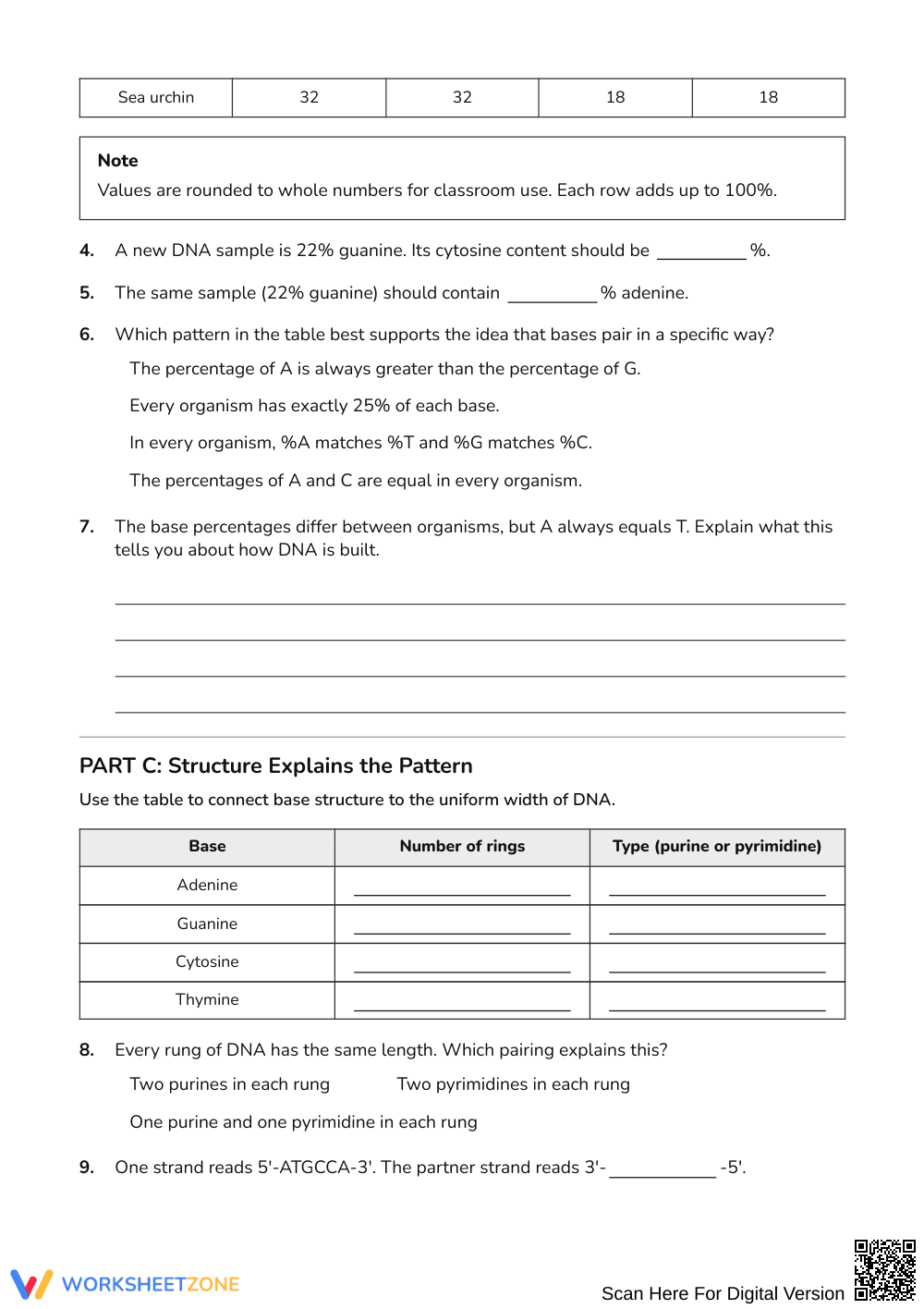
The three‑page packet contains a model‑labeling section, a data‑analysis table, a base‑structure matching activity, and a final claim‑evidence‑reasoning prompt. Each part includes clear instructions, a worked example, and a word bank for key terminology. An answer key spans the same three pages.
Skill Progression
- Guided practice – 8 tasks where students label the DNA model and answer multiple‑choice questions with sentence frames.
- Supported practice – 9 tasks requiring students to read the base‑percentage table, select matching patterns, and write short evidence sentences using a provided word bank.
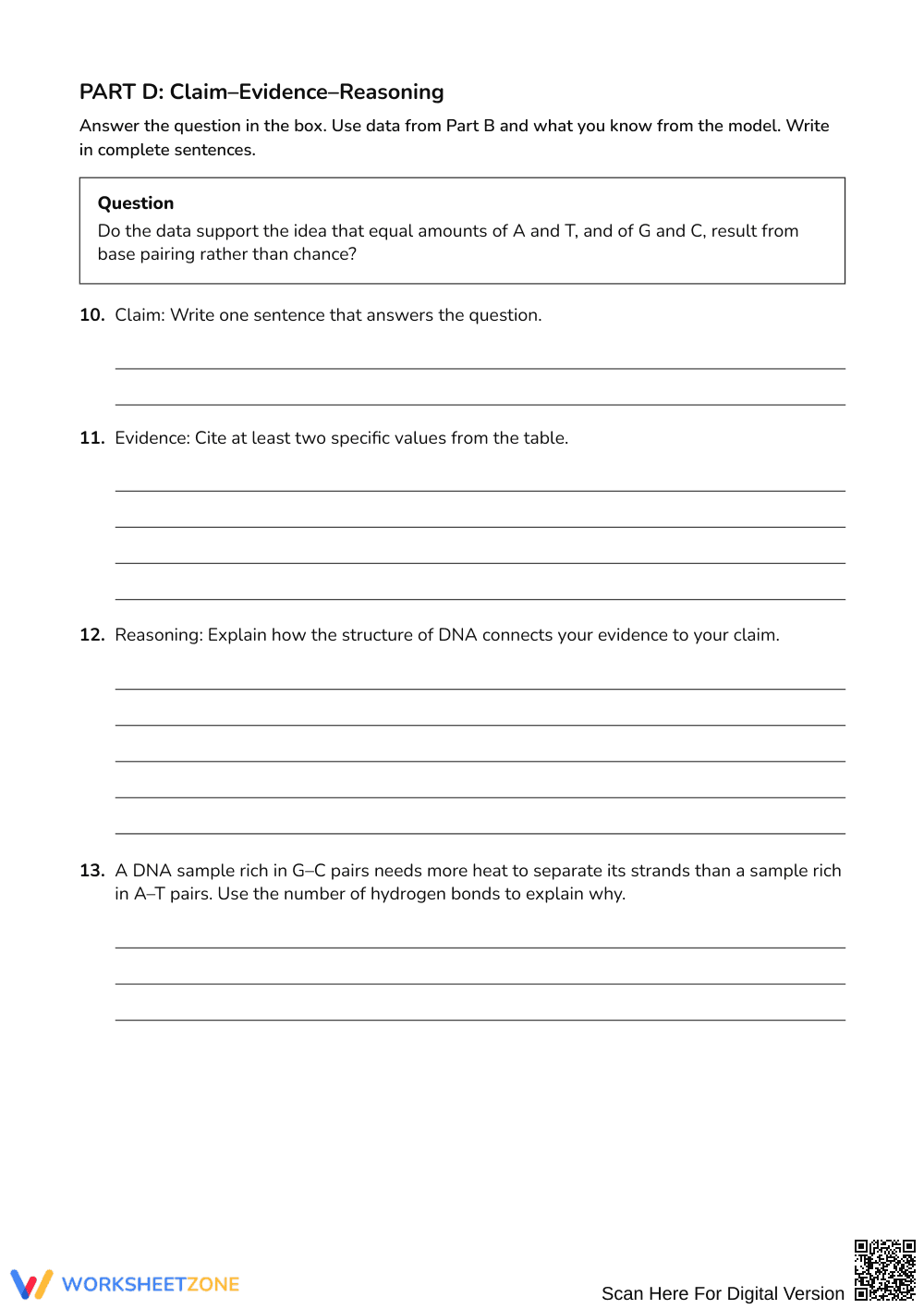
- Independent practice – 8 tasks where students craft a full claim‑evidence‑reasoning paragraph linking the data to the double‑helix structure without scaffolds.
This sequence follows the gradual‑release model: I Do, We Do, You Do.
Standards Alignment
`` Students use evidence to construct scientific explanations of DNA structure, describing how base‑pairing rules generate uniform width. A supporting standard emphasizes interpreting quantitative data to identify patterns in biological systems. Both standard descriptions can be copied directly into lesson plans, IEP goals, or district curriculum mapping tools.
How to Use It
Use the worksheet as a pre‑lab activity to activate prior knowledge about DNA before a hands‑on model‑building session. After the lab, have students complete the claim‑evidence‑reasoning section as a formative assessment; observe whether they correctly cite matching percentages. Each session takes 30–45 minutes.
Who It's For
Designed for 8‑12 grade science students, especially those in biology or genetics units. The worksheet offers built‑in scaffolds for learners who need sentence frames and a word bank, while advanced students can tackle the independent paragraph. Pair it with a digital DNA double‑helix animation or a textbook chapter on nucleic acids for a blended lesson.
Research shows that explicit claim‑evidence‑reasoning practice improves students’ ability to construct scientific arguments (Fisher & Frey, 2014). This worksheet aligns with the science standard that requires learners to use evidence to explain DNA structure, prompting them to compare base‑pair percentages and articulate why A pairs with T and G with C. By integrating a visual model, data table, and structured writing prompt, the activity supports the development of analytical writing and data‑interpretation skills essential for high‑school biology. Teachers can readily embed the task into unit plans, and the included answer key streamlines feedback. The concise format respects classroom time constraints while delivering rigorous practice. Evidence‑based writing also aligns with the NGSS emphasis on constructing explanations from multiple sources, reinforcing connections. Moreover, the progressive scaffolding—from guided labeling to independent paragraph—mirrors the gradual‑release framework proven to boost student autonomy. When students see the direct link between hydrogen‑bond counts and thermal stability, they deepen conceptual understanding, a benefit highlighted in biology education studies.


