




























Views
Downloads

Kindergarten Sequencing — Printable No-Prep Worksheet

Paste this activity's link or code into your existing LMS (Google Classroom, Canvas, Teams, Schoology, Moodle, etc.).
Students can open and work on the activity right away, with no student login required.
You'll still be able to track student progress and results from your teacher account.
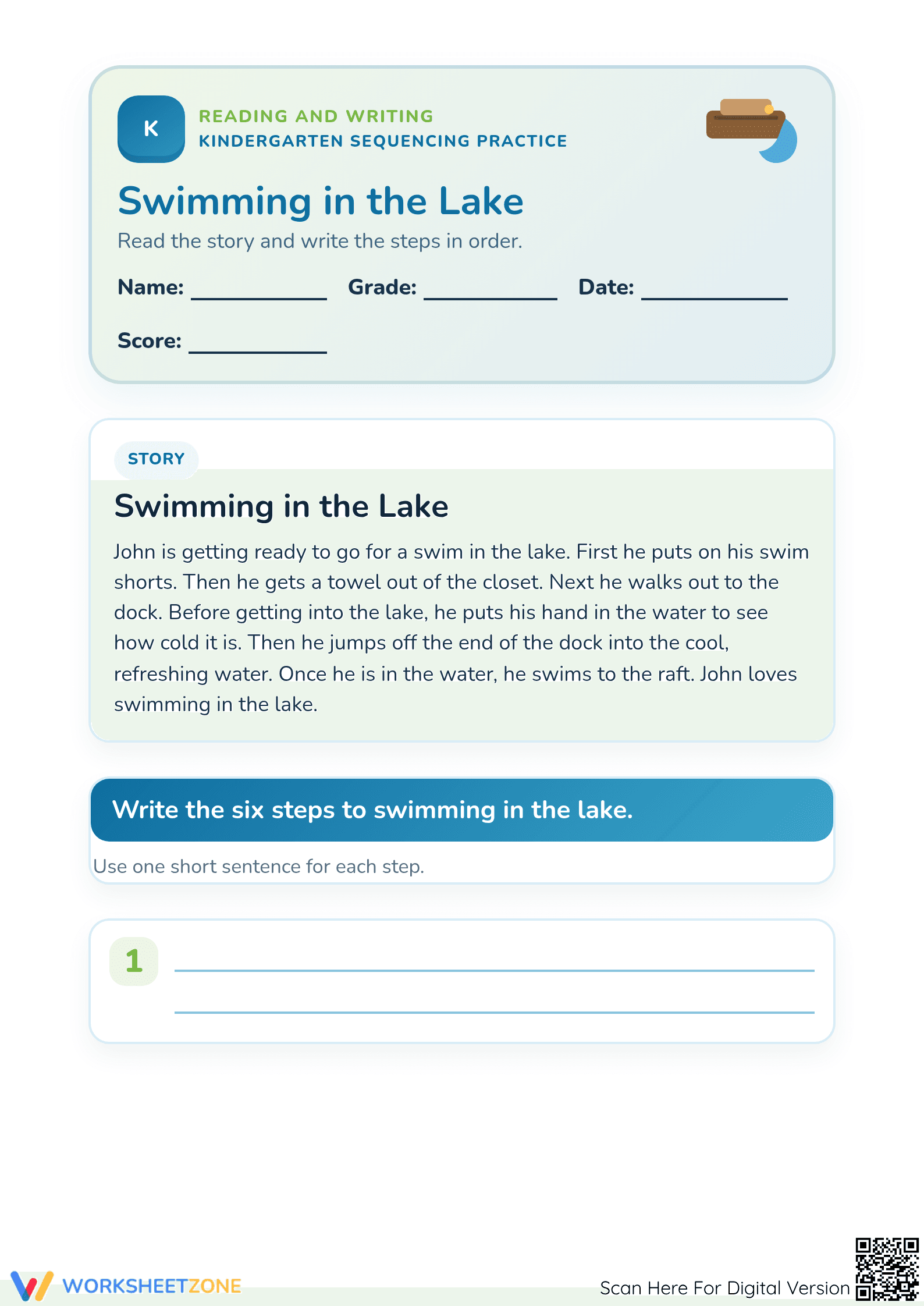
This Kindergarten Reading, Sequencing, and Writing 3 worksheet helps young learners master the essential skill of retelling story events in the correct chronological order. By engaging with a short, relatable narrative about swimming in a lake, students practice identifying key details and organizing them into a logical six-step sequence.
At a Glance
- Grade: Kindergarten · Subject: ELA
- Standard:
CCSS.ELA-LITERACY.RL.K.2— Retell familiar stories, including key details and sequencing events- Skill Focus: Chronological sequencing and narrative retelling
- Format: 2 pages · 6 problems · Answer key included · PDF
- Best For: Independent literacy centers and morning work
- Time: 15–20 minutes
The resource consists of a two-page PDF document featuring a narrative passage followed by a structured response area. The first page presents the "Swimming in the Lake" story, which uses clear transitional words like "First," "Next," and "Then" to support early readers. Students are then prompted to write six short sentences corresponding to the numbered lines provided across both pages to capture the full sequence of the story.
Zero-Prep Workflow
This worksheet is designed for immediate classroom deployment with a total teacher preparation time of less than two minutes. First, print the two pages (30 seconds). Second, distribute the sheets and provide a quick verbal prompt to read the story and identify the sequence (1 minute). Finally, review the work using the provided answer key (5 minutes). This process makes the resource an ideal candidate for emergency substitute plans or quick formative assessments.
Standards Alignment
The primary focus of this activity is CCSS.ELA-LITERACY.RL.K.2, which requires students to retell familiar stories, including key details. By identifying the specific actions John takes to prepare for and enter the lake, students demonstrate their ability to track narrative progression. This standard code can be copied directly into lesson plans, IEP goals, or district curriculum mapping tools.
How to Use It
Deploy this worksheet during the "You Do" phase of a gradual release instructional model after a mini-lesson on sequence signal words. Teachers should observe whether students are utilizing the text-based clues to determine the correct order of operations. Completion usually takes about 15 minutes, making it a perfect exit ticket for a reading block to verify comprehension before students transition to the next activity.
Who It's For
This resource is tailored for Kindergarten students developing early literacy skills, but it also serves as an excellent scaffolded tool for Grade 1 students needing a refresher on narrative structure. It pairs naturally with a classroom anchor chart on transition words or a shared reading session of other sequencing-heavy picture books to reinforce the concept across different texts and contexts.
The RAND AIRS 2024 analysis of foundational literacy practices highlights that the ability to sequence events in a narrative is a critical precursor to higher-order reading comprehension and logical reasoning in early childhood education. This Kindergarten worksheet directly addresses the CCSS.ELA-LITERACY.RL.K.2 standard by requiring students to extract key details from a text and organize them into a chronological retelling. Research by Fisher & Frey (2014) emphasizes that providing structured scaffolds, such as the numbered lines and signal word cues used in this lake-themed activity, helps bridge the gap between decoding and deep story understanding. By focusing on the specific skill of narrative sequencing, this tool ensures that students are not just reading words but are constructing a coherent mental model of the story's progression. This alignment with evidence-based instructional strategies makes it a valuable asset for any Kindergarten ELA curriculum.


