


























Views
Downloads

Grade 1 Reading Tables — Printable No-Prep Worksheet
Paste this activity's link or code into your existing LMS (Google Classroom, Canvas, Teams, Schoology, Moodle, etc.).
Students can open and work on the activity right away, with no student login required.
You'll still be able to track student progress and results from your teacher account.
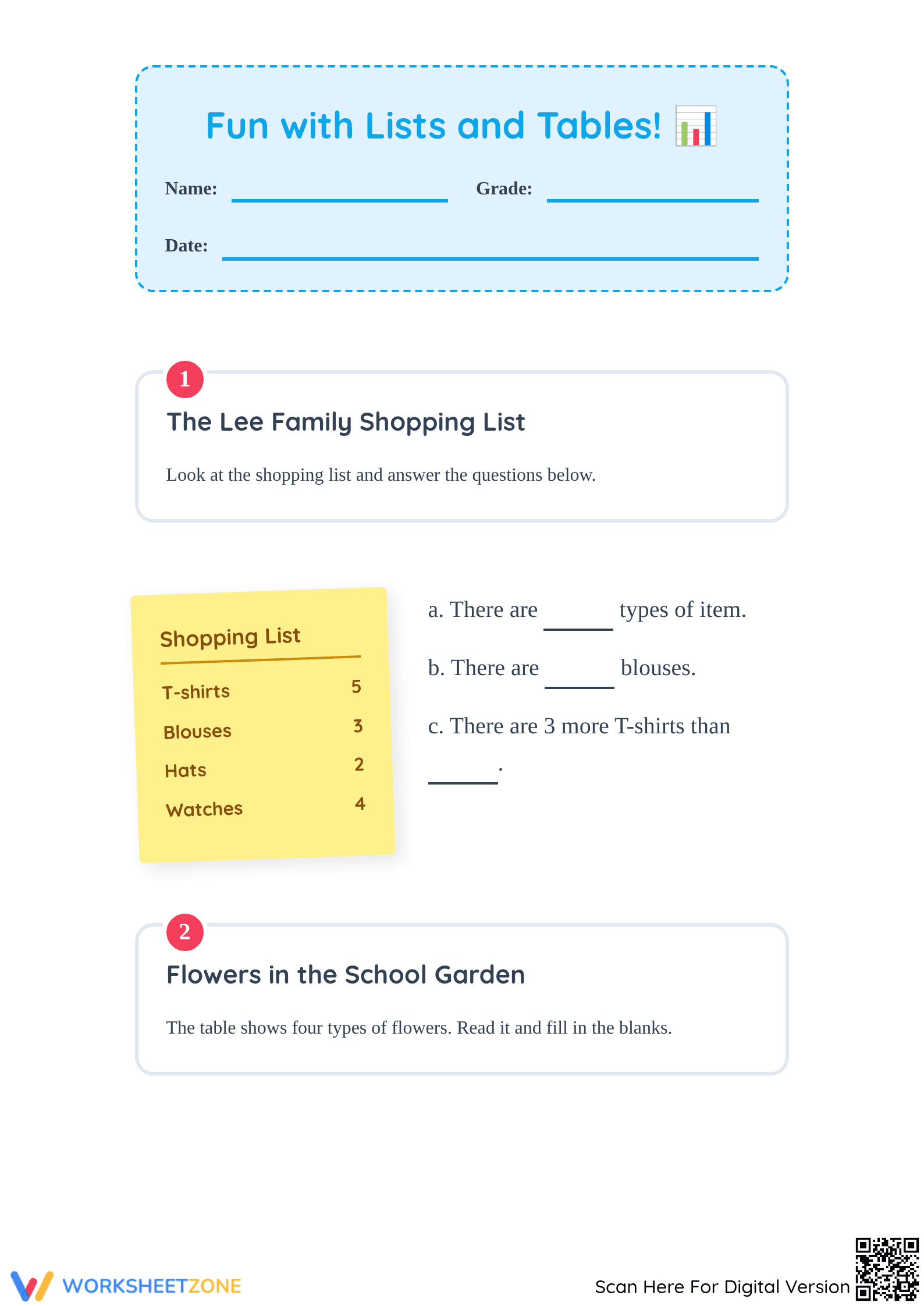
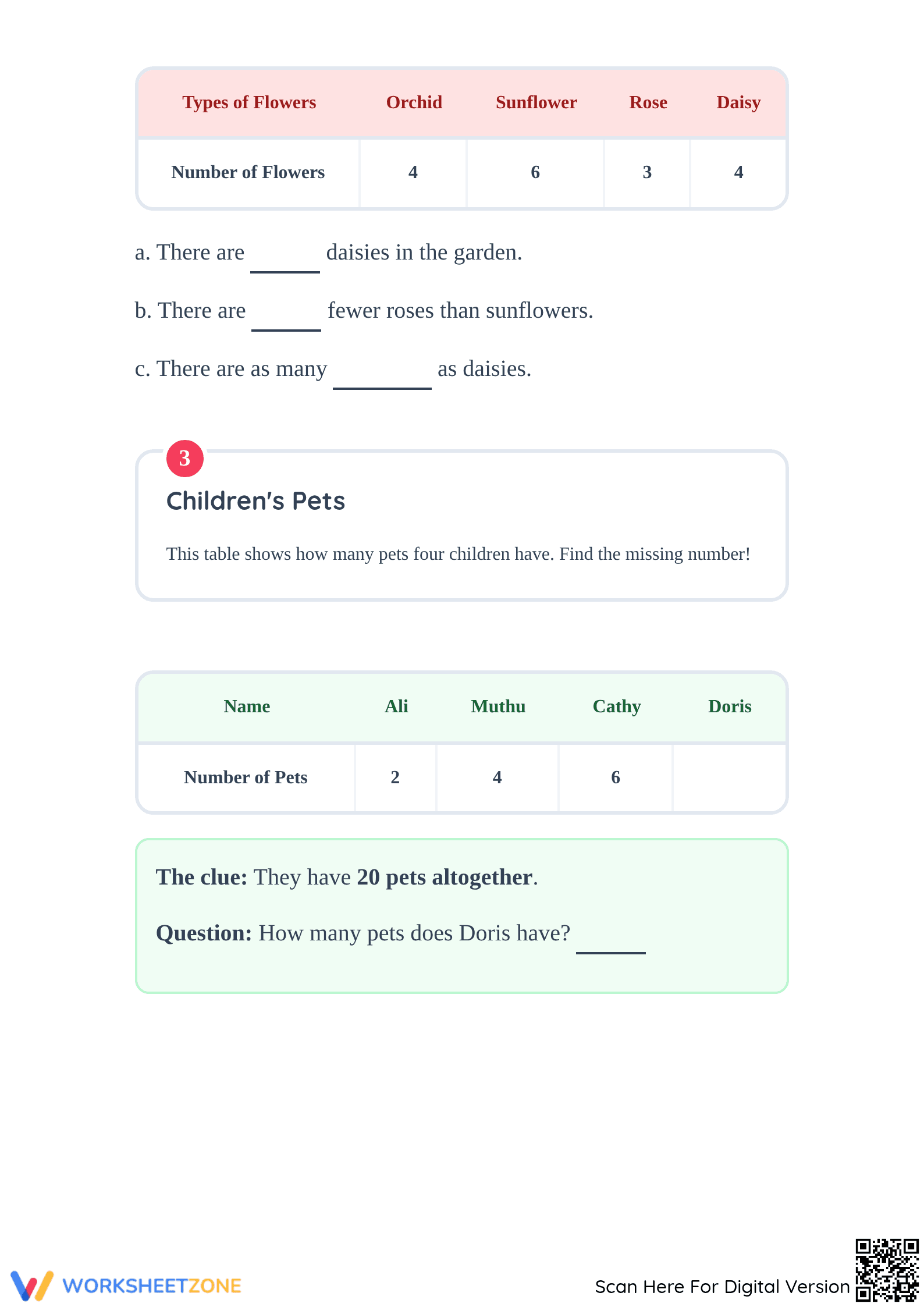
This Grade 1 Math worksheet empowers students to interpret real-world data through organized shopping lists and data tables. By analyzing quantities of items, flowers, and pets, learners develop essential comparison skills and logical reasoning. Students will confidently answer questions about totals, "more than" relationships, and missing values across four engaging, structured sections.
At a Glance
- Grade: Grade 1 · Subject: Math
- Standard:
CCSS.MATH.CONTENT.1.MD.C.4— Organize and interpret data with multiple categories to answer quantity questions- Skill Focus: Interpreting tables and lists
- Format: 3 pages · 10 problems · Answer key included · PDF
- Best For: Independent practice or formative assessment
- Time: 15–20 minutes
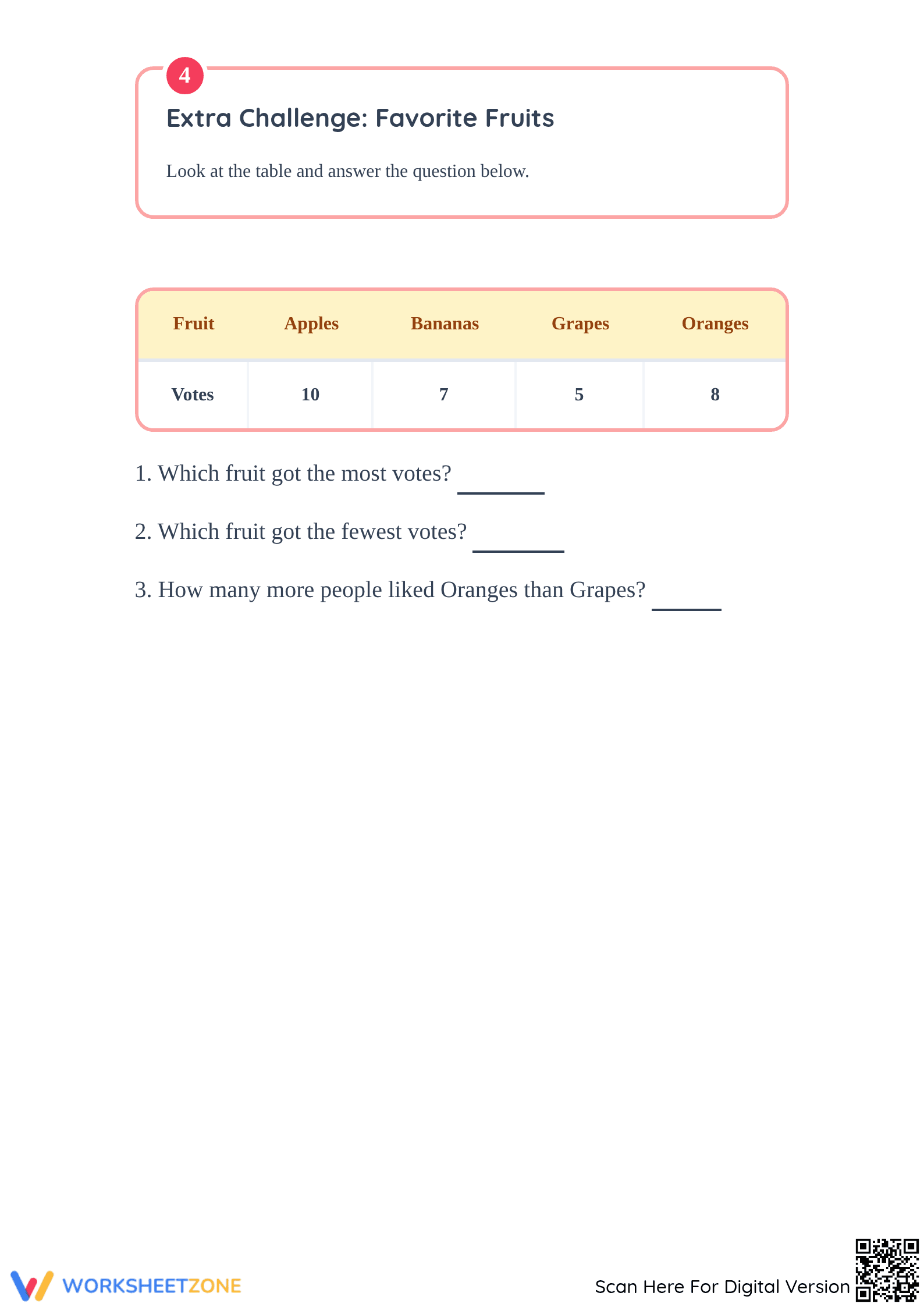
This comprehensive 3-page packet contains four distinct scenarios: a family shopping list, a school garden flower count, a pet ownership table with a missing value challenge, and a "Favorite Fruits" extra challenge. It includes multiple-choice style blanks, comparison tasks, and a logical word problem. A full answer key is provided for immediate feedback and grading.
Zero-Prep Workflow
- Print: Print the three-page PDF and distribute it to students in under 30 seconds.
- Distribute: Students spend 15 minutes working independently through the four data sets.
- Review: Review the missing value challenge in the third section as a whole-class check in 2 minutes.
This resource is perfect for substitute plans or morning work due to its self-explanatory layout and clear instructional cues.
Standards Alignment
Aligned to CCSS.MATH.CONTENT.1.MD.C.4, this resource requires students to "organize, represent, and interpret data with up to three categories" (expanded here to four) and answer questions about total data points and comparative values. Both standard codes can be copied directly into lesson plans, IEP goals, or district curriculum mapping tools.
How to Use It
Assign this worksheet during the "You Do" phase of a data unit to verify students can transfer table-reading skills to novel contexts. Observe students as they tackle Section 3; those who struggle with the "20 pets altogether" clue may need additional support with part-part-whole relationships. It also works as a quick homework assignment to reinforce data literacy.
Who It's For
Designed for first-grade students, this worksheet is also suitable for Kindergarten extension or Grade 2 review. The simple language supports English Language Learners, while the "Extra Challenge" fruit table provides necessary extension for early finishers. It pairs naturally with a hands-on classroom poll or a tally mark lesson to bridge concrete and abstract representations.
According to the RAND AIRS (2024) report on elementary numeracy, the ability to transition from concrete objects to abstract data representations like tables is a critical predictor of later success in algebraic thinking. This worksheet directly supports this developmental bridge by providing structured practice in interpreting data within categories, a skill identified by EdReports (2024) as a foundational pillar of the Grade 1 Measurement and Data strand. By requiring students to calculate "how many more" and find missing values within a set total, the tasks align with research-based strategies for developing operational fluency through contextualized problem-solving. Educators can utilize these formatted tables to provide the high-dosage, targeted practice recommended by ScienceDirect TpT Analysis for closing achievement gaps in early mathematical literacy. The explicit alignment with CCSS.MATH.CONTENT.1.MD.C.4 ensures that instructional time is focused on the high-leverage standards necessary for achieving year-end mastery in data interpretation.


