


























Views
Downloads
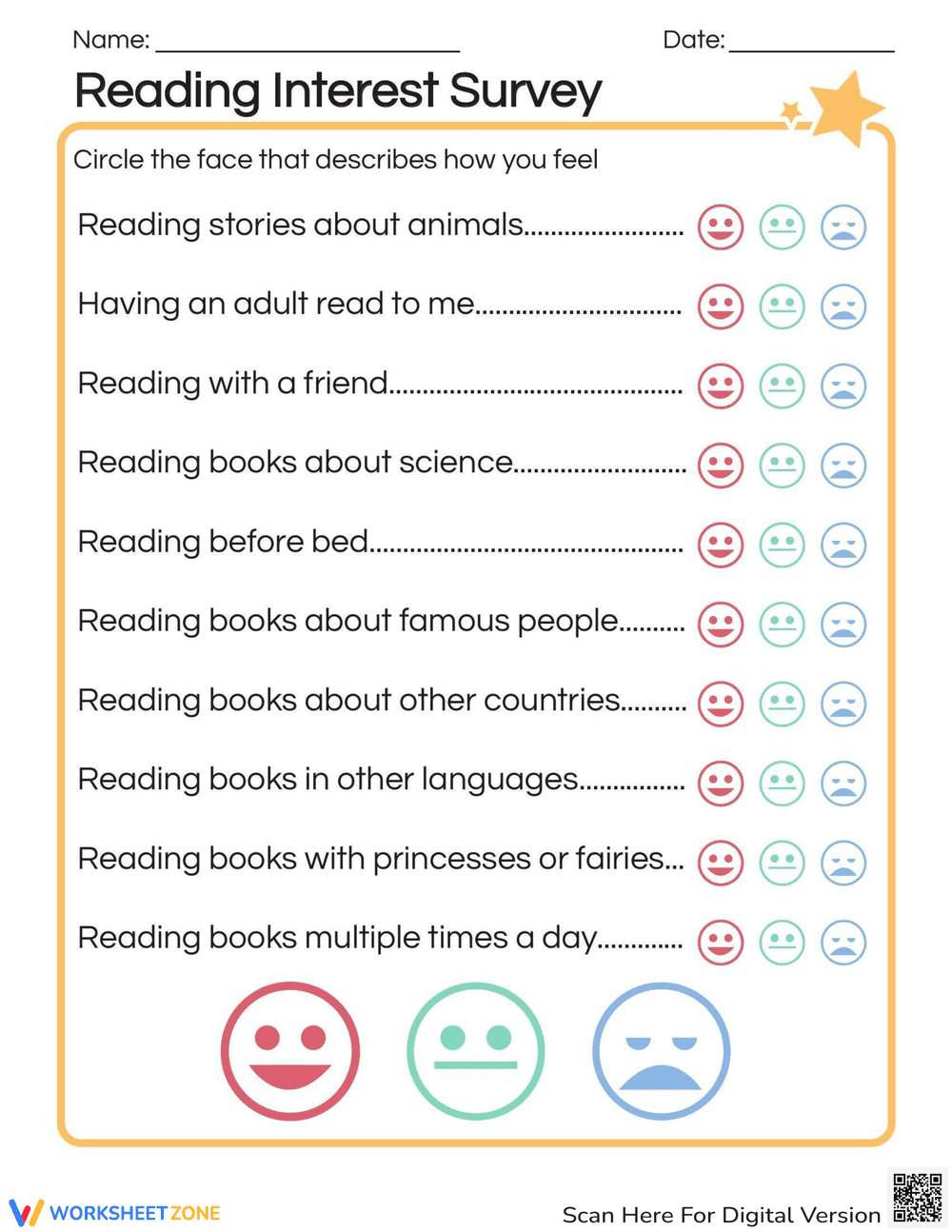

Grade K Reading Interest Survey — Printable Worksheet
Paste this activity's link or code into your existing LMS (Google Classroom, Canvas, Teams, Schoology, Moodle, etc.).
Students can open and work on the activity right away, with no student login required.
You'll still be able to track student progress and results from your teacher account.
This early literacy reading interest survey captures student reading preferences to help educators select engaging texts. Young learners evaluate ten reading topics and environments, connecting visual emoji symbols to their feelings. This foundational activity builds self-awareness and promotes active engagement in classroom reading routines.
At a Glance
- Grade: Kindergarten · Subject: ELA
- Standard:
CCSS.ELA-LITERACY.RL.K.10— Actively engage in group reading activities with purpose and understanding- Skill Focus: Reading Interest Identification
- Format: 1 page · 10 problems · Student survey format · PDF
- Best For: Beginning of year literacy planning
- Time: 10–15 minutes
What's Inside
This single-page survey features ten prompts covering various reading genres and social settings, such as reading with friends or exploring science books. Each prompt pairs with a visual three-face rating scale (happy, neutral, sad). Because this tool measures individual preferences, it operates as an open-ended inventory where no answer key is required.
Zero-Prep Workflow
Designed for immediate implementation, this worksheet requires under two minutes of total teacher preparation time, making it ideal for substitute teacher plans.
- Print (1 minute): Download the ready-to-use PDF and print class sets directly without complex assembly.
- Distribute (30 seconds): Hand out the single-page survey during morning work transitions.
- Review (30 seconds): Read prompts aloud while students circle corresponding feeling faces.
Standards Alignment
This resource aligns directly with primary standard CCSS.ELA-LITERACY.RL.K.10, requiring students to actively engage in group reading activities with purpose and understanding. Additionally, it supports CCSS.ELA-LITERACY.RI.K.10 by assessing interest in informational texts like science books. Both standard codes can be copied directly into lesson plans, IEP goals, or district curriculum mapping tools.
How to Use It
Teachers can deploy this survey before direct instruction at the start of a reading unit to determine which book baskets generate high engagement. Second, utilize it during independent reading conferences to help students select library books matching their interests. As a formative-assessment observation tip, watch how quickly students select feeling faces; hesitation may indicate unfamiliarity with a genre. Expected completion time ranges from 10 to 15 minutes.
Who It's For
This survey is tailored for preschool and kindergarten students beginning their literacy journey. For differentiation, teachers can project the worksheet to model circling faces for English language learners. This resource pairs naturally with a direct instruction lesson on classroom library organization, helping young learners connect survey preferences to specific book bins.
Effective early literacy instruction relies heavily on understanding student motivation and reading preferences. By utilizing this structured survey aligned with CCSS.ELA-LITERACY.RL.K.10, educators can systematically identify student reading interests and actively engage young learners in group reading activities with purpose and understanding. According to research from Fisher & Frey (2014), establishing clear purpose and leveraging student interest during foundational literacy instruction significantly increases academic engagement and reading comprehension outcomes. When teachers align classroom libraries and read-aloud selections with documented student preferences, young learners develop stronger intrinsic motivation to read. This zero-prep assessment tool provides the essential baseline data required to curate high-interest reading materials, support individualized reading conferences, and establish a positive classroom reading culture from the very beginning of the academic year.


