


























Views
Downloads

Printable Corona Virus Reading Worksheet | Grade 6-10 ELA
Paste this activity's link or code into your existing LMS (Google Classroom, Canvas, Teams, Schoology, Moodle, etc.).
Students can open and work on the activity right away, with no student login required.
You'll still be able to track student progress and results from your teacher account.
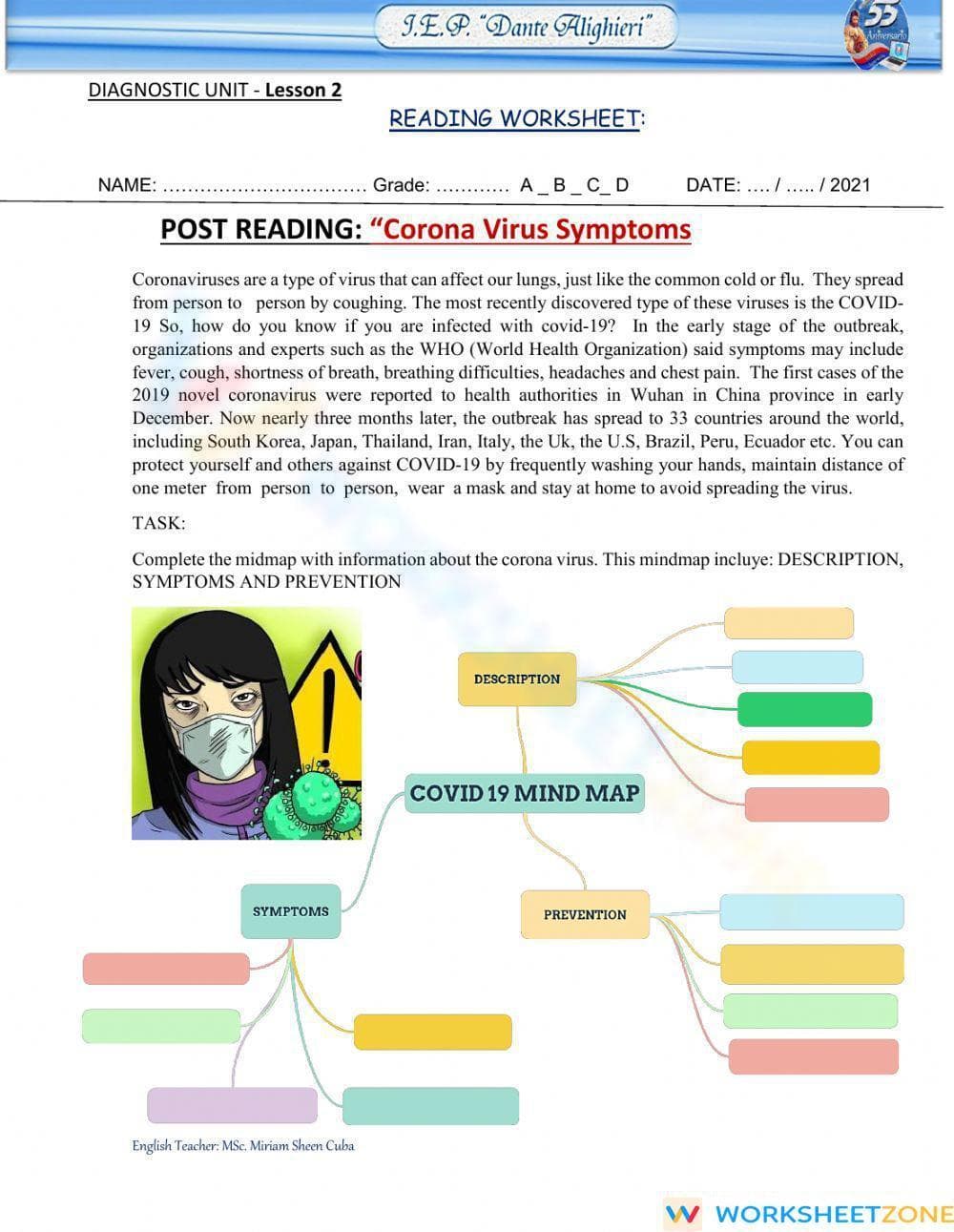
This worksheet helps secondary students synthesize health information by analyzing a text on Corona Virus symptoms and prevention. By completing a structured mind map, learners practice identifying key details and organizing informational text, ensuring they grasp essential protocols while strengthening reading comprehension. It serves as an effective post-reading assessment for any diagnostic unit.
At a Glance
- Grade: 6–10 · Subject: ELA Reading
- Standard:
CCSS.ELA-LITERACY.RI.6.2— Determine central ideas and provide a summary of informational text- Skill Focus: Information Synthesis & Mind Mapping
- Format: 1 page · 12 tasks · No-prep PDF format
- Best For: Secondary health literacy and reading assessment
- Time: 15–20 minutes
This single-page PDF includes a concise informational passage detailing COVID-19 origins, symptoms, and prevention. Below the text, a vibrant mind map provides 12 specific data points for students to populate across three categories: Description, Symptoms, and Prevention. The visual layout uses color-coded boxes to help students categorize information effectively, making it a highly accessible tool for all secondary learners.
Zero-Prep Workflow
This resource follows a streamlined three-step workflow. First, print the single-page document (30 seconds). Second, distribute it to students as a post-reading activity or diagnostic check (30 seconds). Third, review the mind maps collectively to reinforce health literacy and comprehension (1 minute). Total teacher preparation time is under two minutes, making it an ideal choice for emergency sub plans or quick lesson transitions.
Standards Alignment
The primary alignment is CCSS.ELA-LITERACY.RI.6.2, which requires students to determine central ideas of a text and provide an objective summary. This mind map serves as a graphic summary, requiring students to extract pertinent facts from the provided passage. This standard code can be copied directly into lesson plans, IEP goals, or district curriculum mapping tools.
How to Use It
Use this worksheet as a formative assessment immediately following a class reading of the text. For a collaborative twist, have students work in pairs to cross-reference their mind maps, ensuring all 12 boxes are filled with accurate details from the text. This allows teachers to observe how effectively students can filter through a paragraph to find specific evidence-based answers. Expected completion time is 15 to 20 minutes.
Who It's For
This resource is designed for students in Grades 6 through 10, particularly in ELA or Health Science courses. It is especially effective for learners who benefit from visual organizers and scaffolded summary tasks. It pairs naturally with a broader unit on modern health challenges or as a standalone lesson on how to read and interpret informational brochures and health advisories.
Standard CCSS.ELA-LITERACY.RI.6.2 focuses on the student's ability to synthesize informational text into a coherent summary, a skill that Fisher & Frey (2014) identify as fundamental to academic literacy across all content areas. Research in the ScienceDirect TpT Analysis indicates that graphic organizers like mind maps significantly improve retention of complex informational details by reducing cognitive load during the extraction process. By organizing "Corona Virus" data into discrete categories of description, symptoms, and prevention, students transition from passive reading to active information management. This diagnostic tool provides immediate feedback on a student's capacity to identify essential information within a technical passage. The 12-task structure ensures that secondary students are challenged to find multiple pieces of evidence, moving beyond surface-level understanding toward a comprehensive mastery of the text's central themes and supporting health details.


