


























Views
Downloads


Essential Reading and Writing Decimals Worksheet | Grade 5
Paste this activity's link or code into your existing LMS (Google Classroom, Canvas, Teams, Schoology, Moodle, etc.).
Students can open and work on the activity right away, with no student login required.
You'll still be able to track student progress and results from your teacher account.
Master decimal notation with this comprehensive 5-page practice set for Grade 5 students. This resource bridges the gap between numbers and language by requiring students to convert decimals between standard, word, and expanded forms. By engaging with 50 problems, learners solidify their understanding of place value through thousandths, ensuring accuracy in mathematical communication.
At a Glance
- Grade: 5 · Subject: Math
- Standard:
CCSS.MATH.CONTENT.5.NBT.A.3.a— Read and write decimals to thousandths using numerals, names, and expanded form- Skill Focus: Decimal notation conversion
- Format: 5 pages · 50 problems · Answer key included · PDF
- Best For: Independent practice and place value reinforcement
- Time: 30–45 minutes
What's Inside
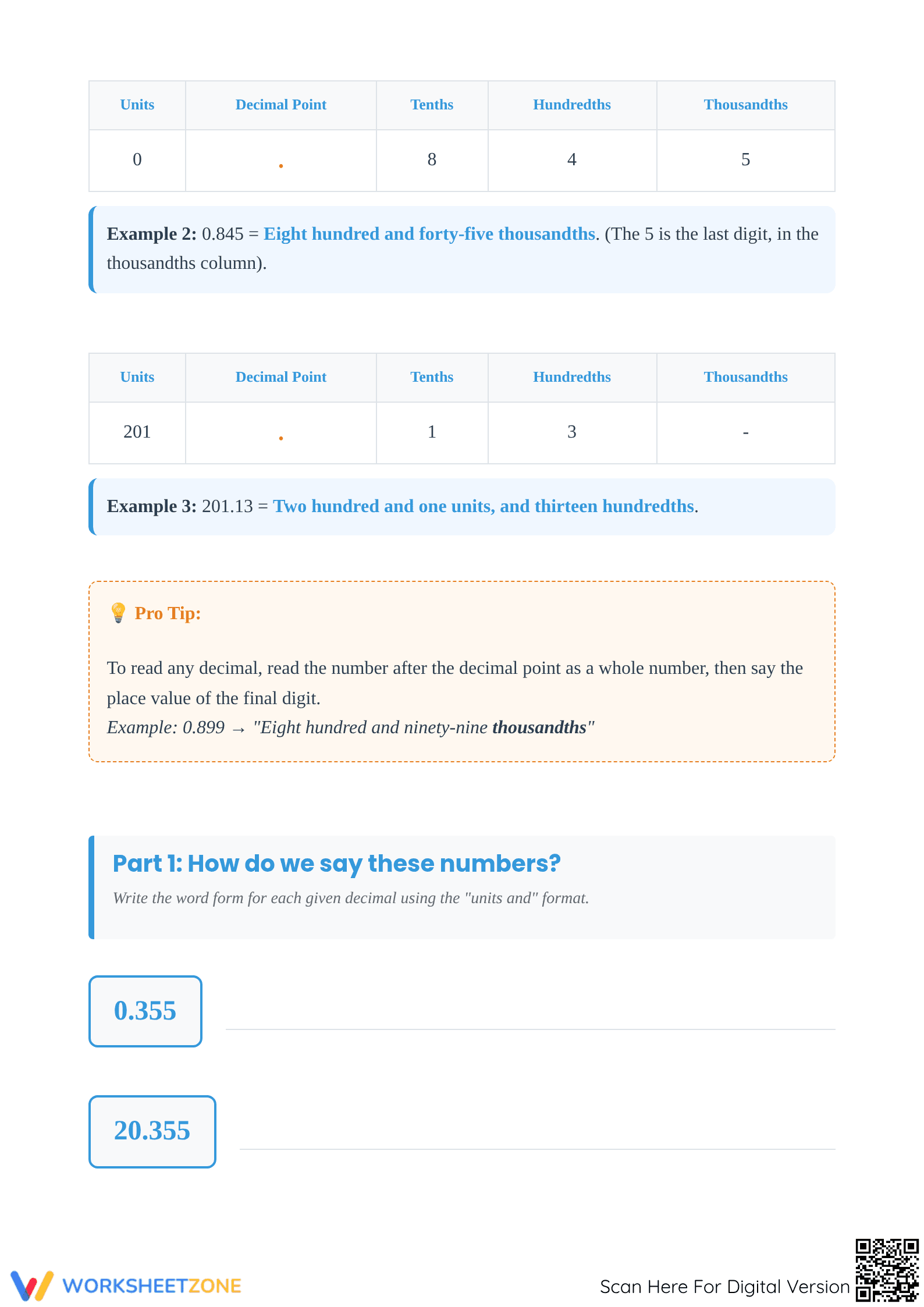
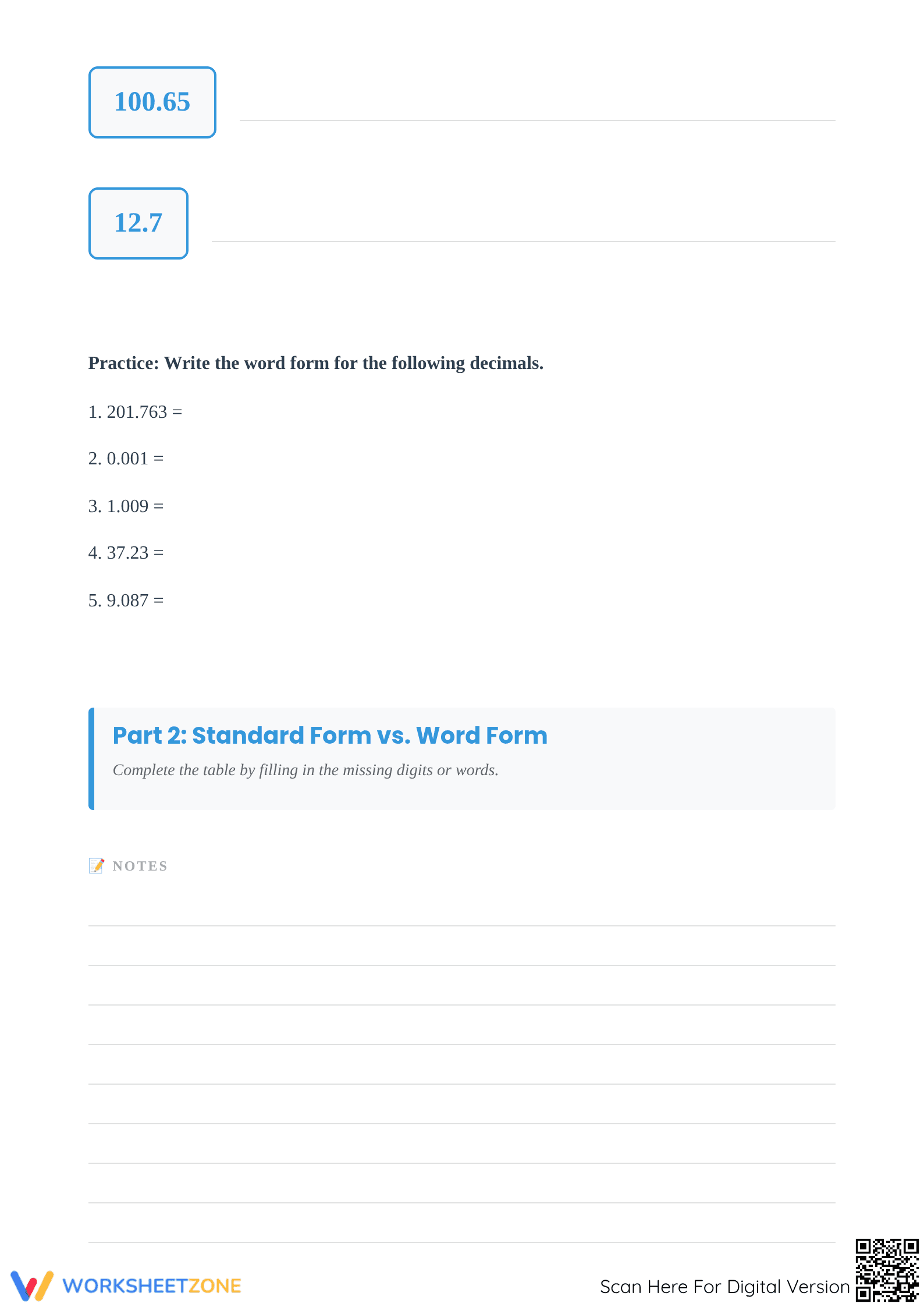
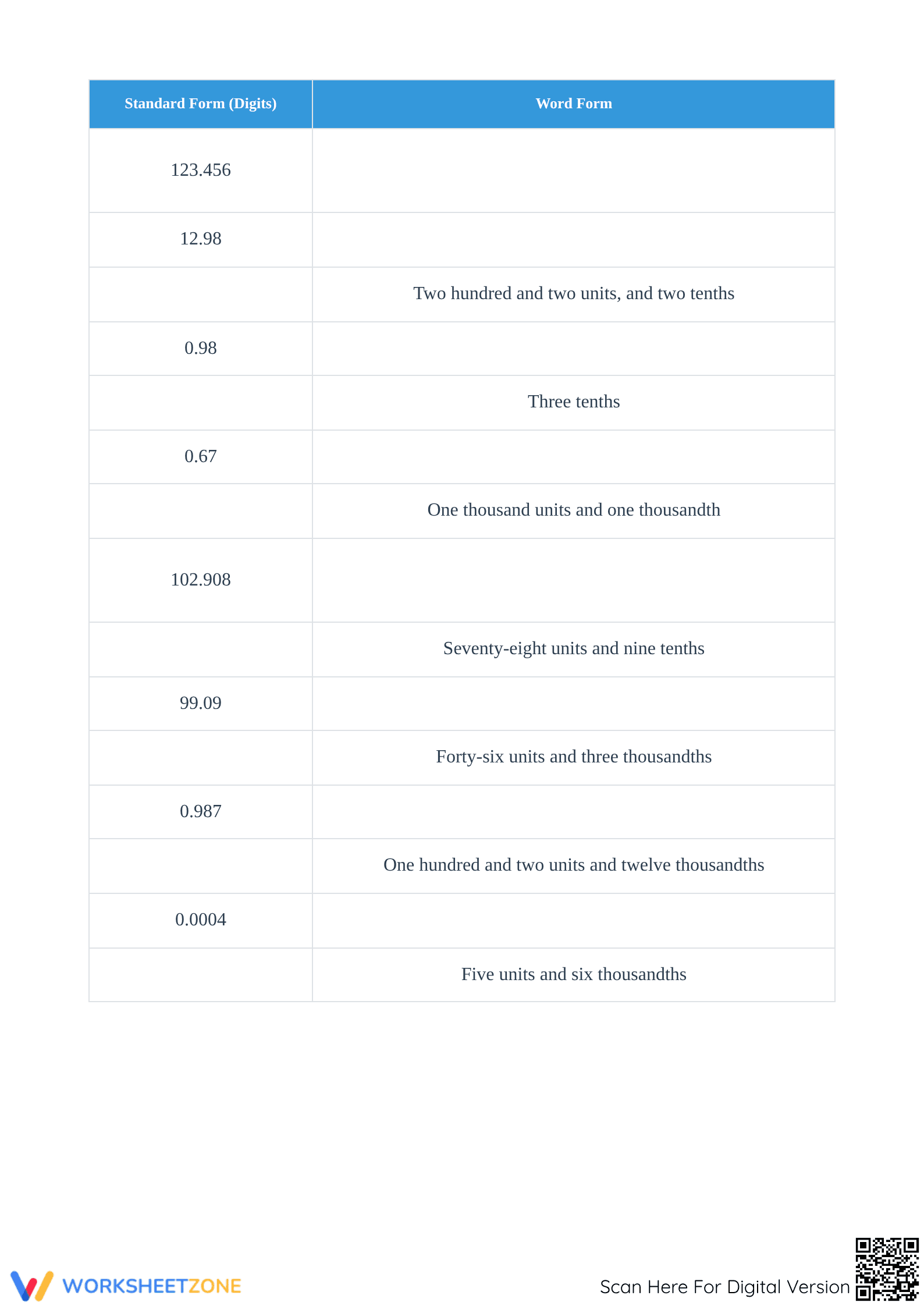
This printable packet contains five pages of structured exercises. The first two pages focus on translating between standard form and word form. The subsequent pages challenge students to decompose decimals into expanded form and back again. The layout is clean, featuring 10 problems per page. A complete five-page answer key is provided for immediate feedback.
Skill Progression
- Guided Practice (20 problems): Converting decimals to word and standard form with clear prompts to reinforce place value names.
- Supported Practice (20 problems): Transitioning to expanded notation to identify specific digit values through hundredths and thousandths.
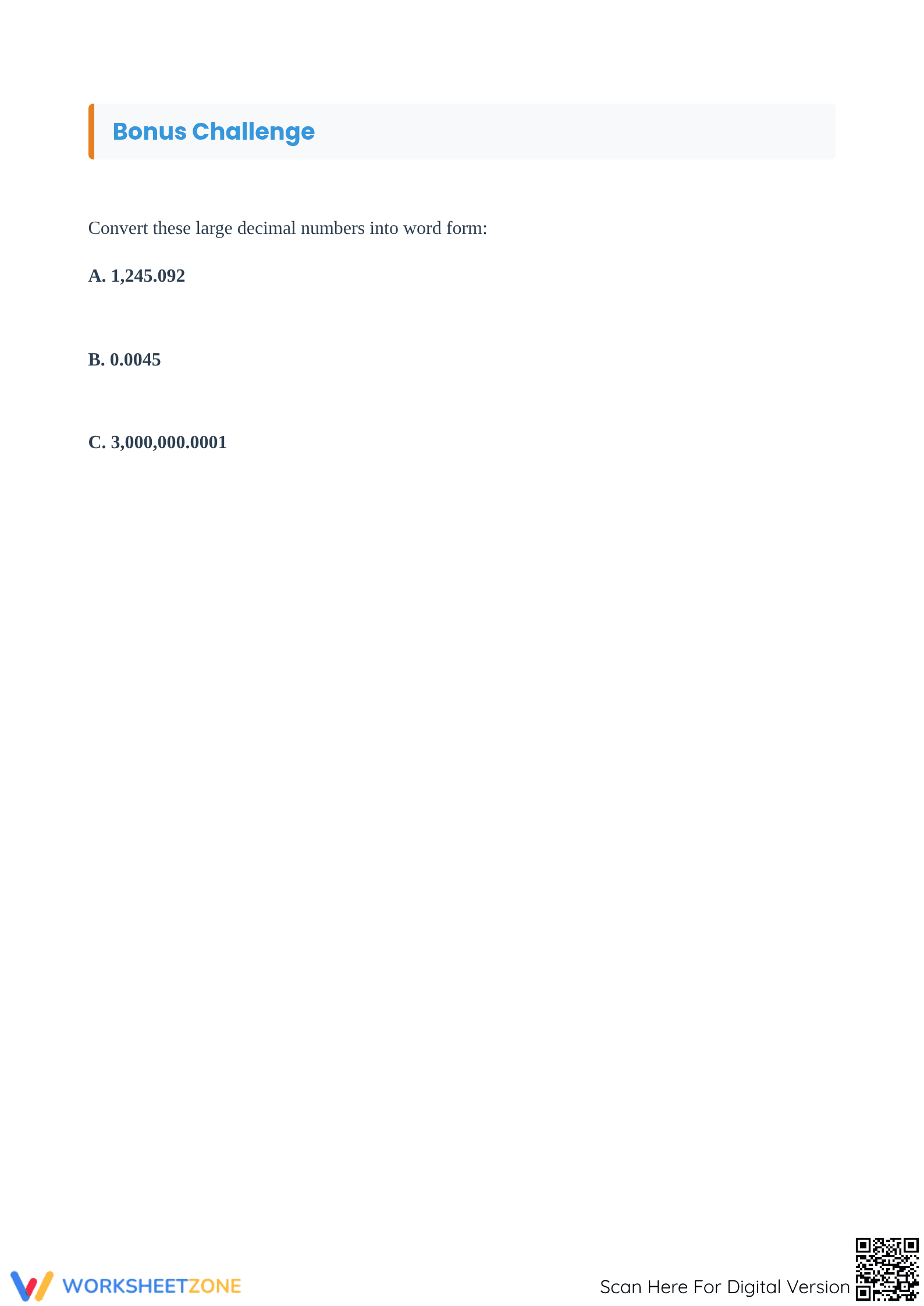
- Independent Practice (10 problems): Mixed-skill review focusing on multi-digit thousandths to ensure fluency in all notation formats.
This structured approach follows the gradual-release model of I Do, We Do, You Do to ensure full student mastery.
Standards Alignment
The primary focus is `CCSS.MATH.CONTENT.5.NBT.A.3.a`, which mandates that students read and write decimals to thousandths using base-ten numerals, number names, and expanded form. This resource directly targets each component of the standard across its five distinct pages. Both standard codes can be copied directly into lesson plans, IEP goals, or district curriculum mapping tools.
How to Use It
Use this resource as summative practice after instruction on place value. It is effective for small-group rotations where teachers can observe students' ability to correctly spell number names. Teachers should monitor for errors with "zero" place-holders in standard form. Expected completion time is approximately 40 minutes for the entire 50-problem set.
Who It's For
This resource is tailored for fifth-grade students beginning their decimal units and sixth-grade students requiring remedial place value support. It serves as an excellent pairing with a base-ten block demonstration or a decimal place value anchor chart. The clear structure makes it suitable for English Language Learners who need practice with specific mathematical vocabulary.
According to the NAEP (2024) mathematics framework, a deep conceptual understanding of place value in decimals is the strongest predictor of success in middle-school algebraic operations. This worksheet leverages the research-backed "Concrete-Representational-Abstract" sequence by asking students to translate between linguistic (word form) and symbolic (standard form) representations. Fisher & Frey (2014) emphasize that repeated, structured practice in number notation is essential for reducing cognitive load when students later encounter multi-step operations like decimal multiplication or division. By isolating the conversion skill across 50 targeted problems, this resource provides the necessary density of practice required for long-term retention. This printable PDF ensures that students meet the CCSS.MATH.CONTENT.5.NBT.A.3.a criteria with precision. The inclusion of expanded form specifically targets the ability to decompose numbers, a critical skill highlighted in recent ScienceDirect TpT Analysis as a hallmark of high-quality, classroom-ready materials.


