


























Views
Downloads
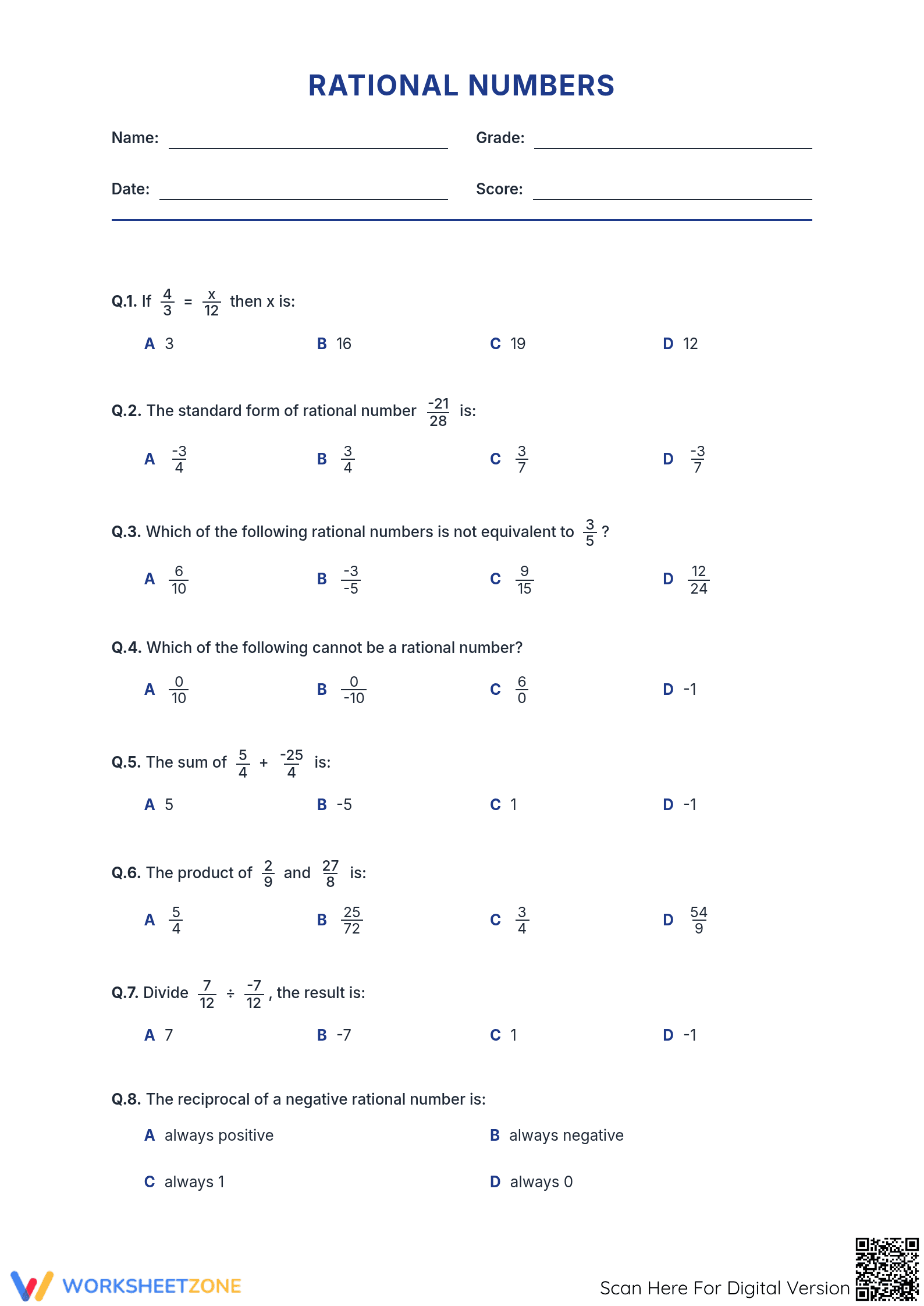


Rational Numbers Worksheet | Grade 7 Math Printable
Paste this activity's link or code into your existing LMS (Google Classroom, Canvas, Teams, Schoology, Moodle, etc.).
Students can open and work on the activity right away, with no student login required.
You'll still be able to track student progress and results from your teacher account.
This comprehensive Grade 7 math worksheet provides targeted practice with rational numbers, helping students master essential operations, standard form, and equivalence. By working through these carefully sequenced problems, students will build the fluency needed to confidently add, subtract, multiply, divide, and compare positive and negative fractions.
At a Glance
- Grade: 7 · Subject: Math
- Standard:
CCSS.MATH.CONTENT.7.NS.A.3— Solve mathematical problems involving operations with rational numbers- Skill Focus: Rational Number Operations
- Format: 3 pages · 30 problems · Answer key included · PDF
- Best For: Independent practice and review
- Time: 25–35 minutes
What's Inside
This three-page resource features a variety of question formats to thoroughly assess student understanding. It includes 15 multiple-choice questions covering standard form, equivalence, and basic operations, followed by five fill-in-the-blank conceptual questions. Additionally, students will complete a five-part matching activity and a five-part comparison section using inequality symbols. A complete, three-page answer key is provided for quick and accurate grading.
Skill Progression
- Guided practice: The initial multiple-choice section serves as a warm-up, allowing students to identify standard forms and equivalent fractions with the support of provided options (15 problems).
- Supported practice: The fill-in-the-blank and matching sections require students to recall properties of rational numbers and apply operational rules to connect expressions with their correct simplified values (10 problems).
- Independent practice: The final comparison section challenges students to independently evaluate and compare rational numbers without multiple-choice scaffolding (5 problems).
This structured progression follows a gradual-release model, ensuring students build confidence before tackling more complex evaluations.
Standards Alignment
Aligned to primary standard CCSS.MATH.CONTENT.7.NS.A.3: Solve real-world and mathematical problems involving the four operations with rational numbers. It also supports foundational skills in understanding the number system and fraction equivalence. Both standard codes can be copied directly into lesson plans, IEP goals, or district curriculum mapping tools.
How to Use It
This worksheet is highly versatile and can be deployed during the independent practice phase of a lesson on rational numbers. It also serves as an excellent end-of-unit review or homework assignment. As a formative assessment tip, monitor how students approach the matching section; errors here often reveal misconceptions about negative signs or reciprocal values that can be addressed immediately. Expected completion time is 25 to 35 minutes.
Who It's For
Designed primarily for 7th-grade math students, this resource is also valuable for 8th graders needing a refresher on fraction operations before starting algebraic equations. For students requiring differentiation, teachers might assign only the multiple-choice and matching sections to reduce the cognitive load. It pairs perfectly with interactive anchor charts detailing integer and fraction rules.
Mastering rational numbers is a critical stepping stone for middle school mathematics and future algebraic success. Aligned with CCSS.MATH.CONTENT.7.NS.A.3, this resource helps students solve mathematical problems involving operations with rational numbers. According to EdReports 2024, instructional materials that provide focused, varied practice on rational number operations significantly improve students' procedural fluency and conceptual understanding. When learners engage with multiple question formats—ranging from multiple-choice to direct comparisons and matching—they solidify their grasp of positive and negative fractions. This targeted repetition reduces cognitive load during more complex problem-solving tasks, ensuring learners build a robust mathematical foundation. Furthermore, consistent exposure to standard form and equivalence builds the automaticity required for higher-level algebra and geometry courses. By integrating these foundational skills into daily practice, educators can effectively close learning gaps and promote long-term retention of essential number system concepts.


