


























Views
Downloads

Printable Rainbow Unicorn Coloring Grid | Grade 5 Math
Paste this activity's link or code into your existing LMS (Google Classroom, Canvas, Teams, Schoology, Moodle, etc.).
Students can open and work on the activity right away, with no student login required.
You'll still be able to track student progress and results from your teacher account.
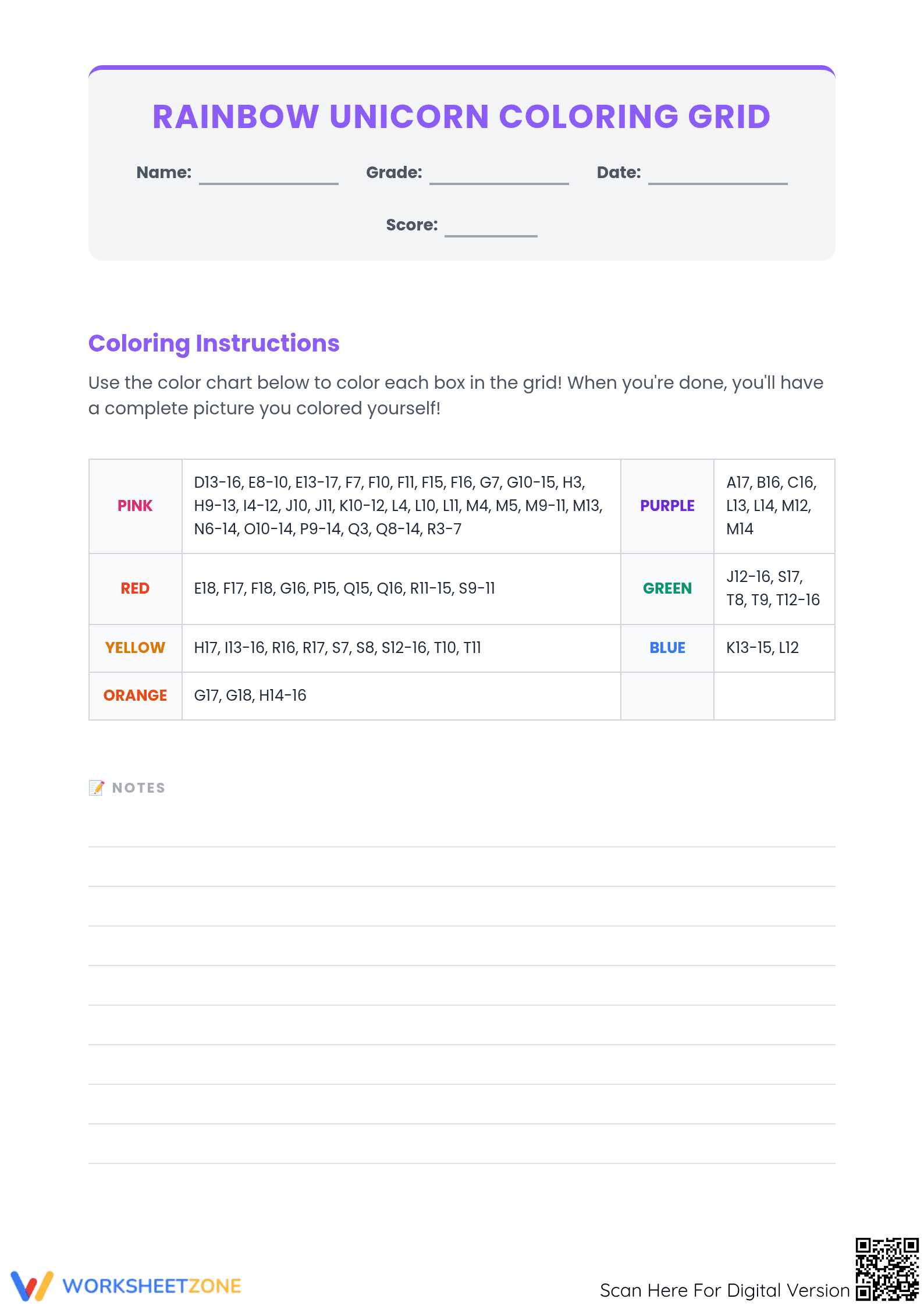
Engage students with this Rainbow Unicorn Coloring Grid, a printable activity designed to reinforce coordinate graphing and following precise directions. Students use a color-coded chart to identify specific grid intersections, resulting in a vibrant unicorn image. This worksheet provides a creative way to build spatial awareness and attention to detail in a classroom or home setting.
At a Glance
- Grade: 5 · Subject: Math
- Standard:
CCSS.MATH.CONTENT.5.G.A.1— Graph points on the coordinate plane to solve real-world and mathematical problems- Skill Focus: Coordinate Graphing and Spatial Recognition
- Format: 2 pages · 400 boxes · Answer key included · PDF
- Best For: Independent math practice or creative cool-down
- Time: 20–30 minutes
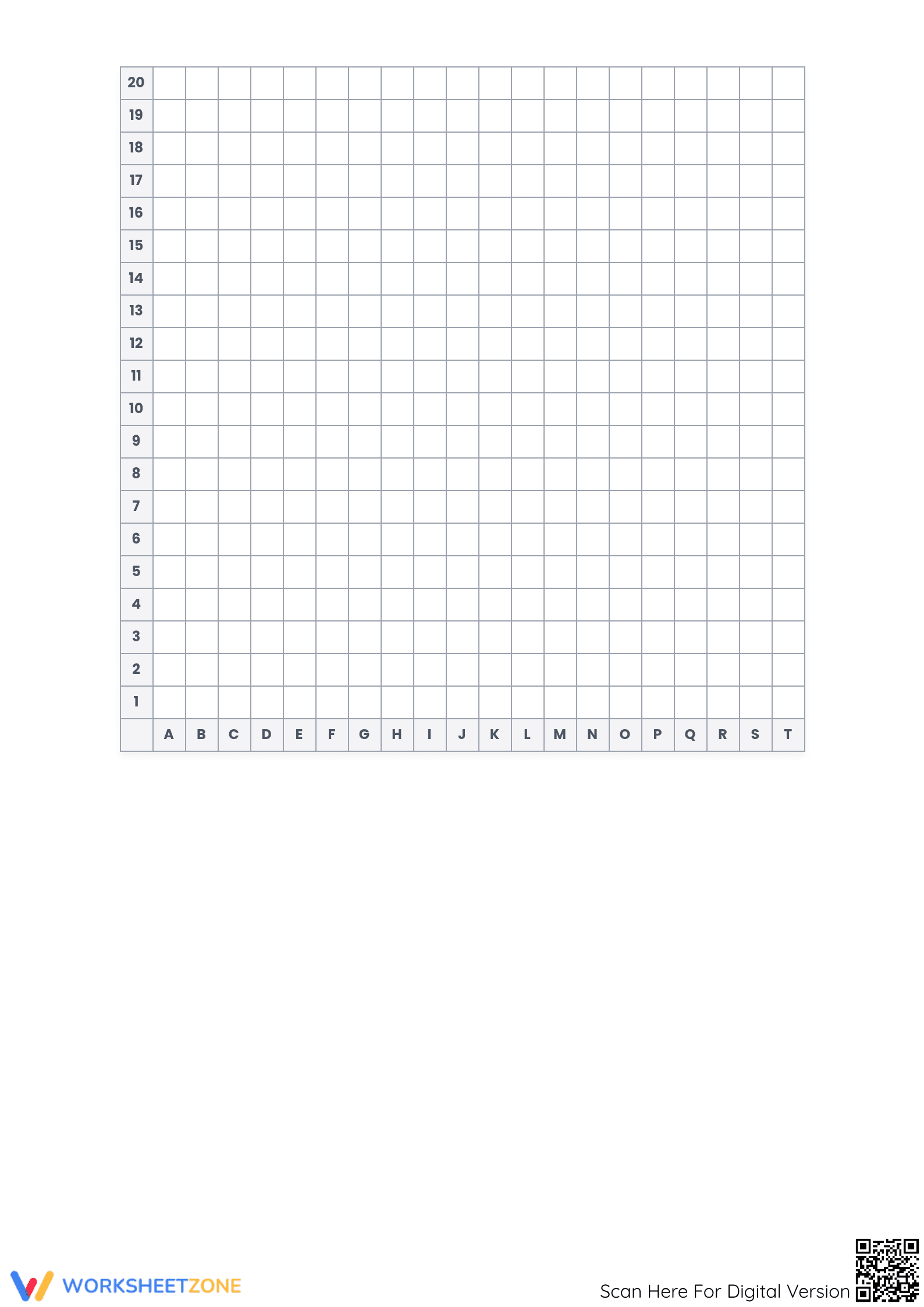
Inside this resource, you will find a two-page PDF consisting of a detailed coloring instruction sheet and a corresponding 20x20 letter-number grid. The first page provides color-coded coordinates for pink, red, yellow, orange, purple, green, and blue, while the second page offers a clean workspace for student completion. A full-color answer key is provided for immediate visual verification.
Guided to Independent Workflow
- Guided practice: Teachers can demonstrate the first five coordinates (e.g., A17, B16) to ensure students understand the letter-number intersection logic.
- Supported practice: Students work in pairs to cross-reference the color chart with the grid, checking their neighbor's progress every few minutes.
- Independent practice: Students complete the remaining 350+ grid cells individually to reveal the hidden unicorn picture, demonstrating mastery of grid navigation.
This gradual release of responsibility ensures that students gain confidence in their spatial reasoning skills before completing the complex visual task independently.
Standards Alignment
This activity aligns with CCSS.MATH.CONTENT.5.G.A.1, which requires students to use a pair of perpendicular number lines, called axes, to define a coordinate system. While this uses a letter-number grid typical of early geometry, it builds the foundational logic needed for Cartesian coordinates. This standard code can be copied directly into lesson plans, IEP goals, or district curriculum mapping tools.
How to Use It
Use this worksheet as a formative assessment after introducing the concept of grids and coordinates. It serves as an excellent "early finisher" activity or a calming task during transition periods. To use it as a formative tool, observe if students are consistently confusing the horizontal (letter) and vertical (number) axes during the first ten minutes of work.
Who It's For
This resource is ideal for Grade 5 and 6 students who need a high-engagement way to practice grid navigation. It is particularly effective for visual learners and can be paired with an anchor chart demonstrating "over then up" coordinate logic for additional scaffolding.
According to NAEP research, integrating artistic tasks with mathematical concepts like coordinate systems significantly increases student engagement and long-term retention of spatial logic. The CCSS.MATH.CONTENT.5.G.A.1 standard is a critical milestone in elementary geometry, serving as the gateway to algebraic graphing and data visualization. By utilizing a 20x20 grid, this worksheet provides over 400 points of interaction, ensuring students develop the stamina and precision required for higher-level math. Research from ScienceDirect TpT Analysis suggests that "mystery picture" formats provide immediate self-correction feedback, as students can visually detect errors in their graphing when the expected pattern is disrupted. This specific activity focuses on the intersection of letter-based horizontal axes and numerical vertical axes, a common bridge used by educators to transition students into pure numerical Cartesian planes.


