


























Views
Downloads

Essential Romeo and Juliet Vocab Worksheet
Paste this activity's link or code into your existing LMS (Google Classroom, Canvas, Teams, Schoology, Moodle, etc.).
Students can open and work on the activity right away, with no student login required.
You'll still be able to track student progress and results from your teacher account.
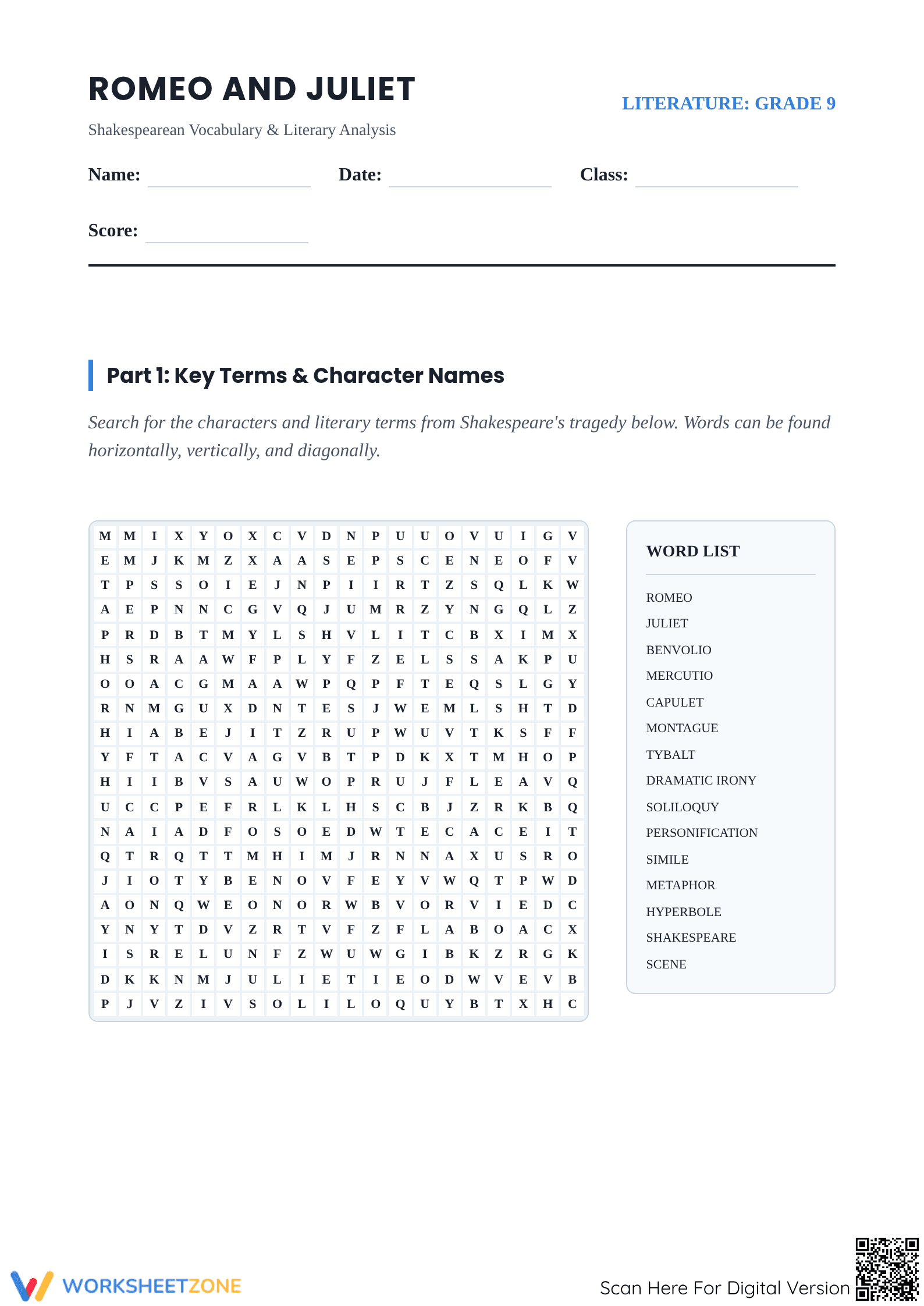
This Grade 9 Romeo and Juliet worksheet provides students with 24 interactive tasks to reinforce Shakespearean vocabulary and literary device identification. By engaging with key character names and dramatic terms, learners build the foundational knowledge required for deep textual analysis of the tragedy. State the skill and the student outcome clearly before explaining the mechanics.
At a Glance
- Grade: 9 · Subject: ELA
- Standard:
CCSS.ELA-LITERACY.RL.9-10.4— Determine the meaning of words and phrases as they are used in a text- Skill Focus: Shakespearean Vocabulary & Literary Devices
- Format: 2 pages · 24 problems · Answer key included · PDF
- Best For: Introductory unit review or sub plans
- Time: 25–35 minutes
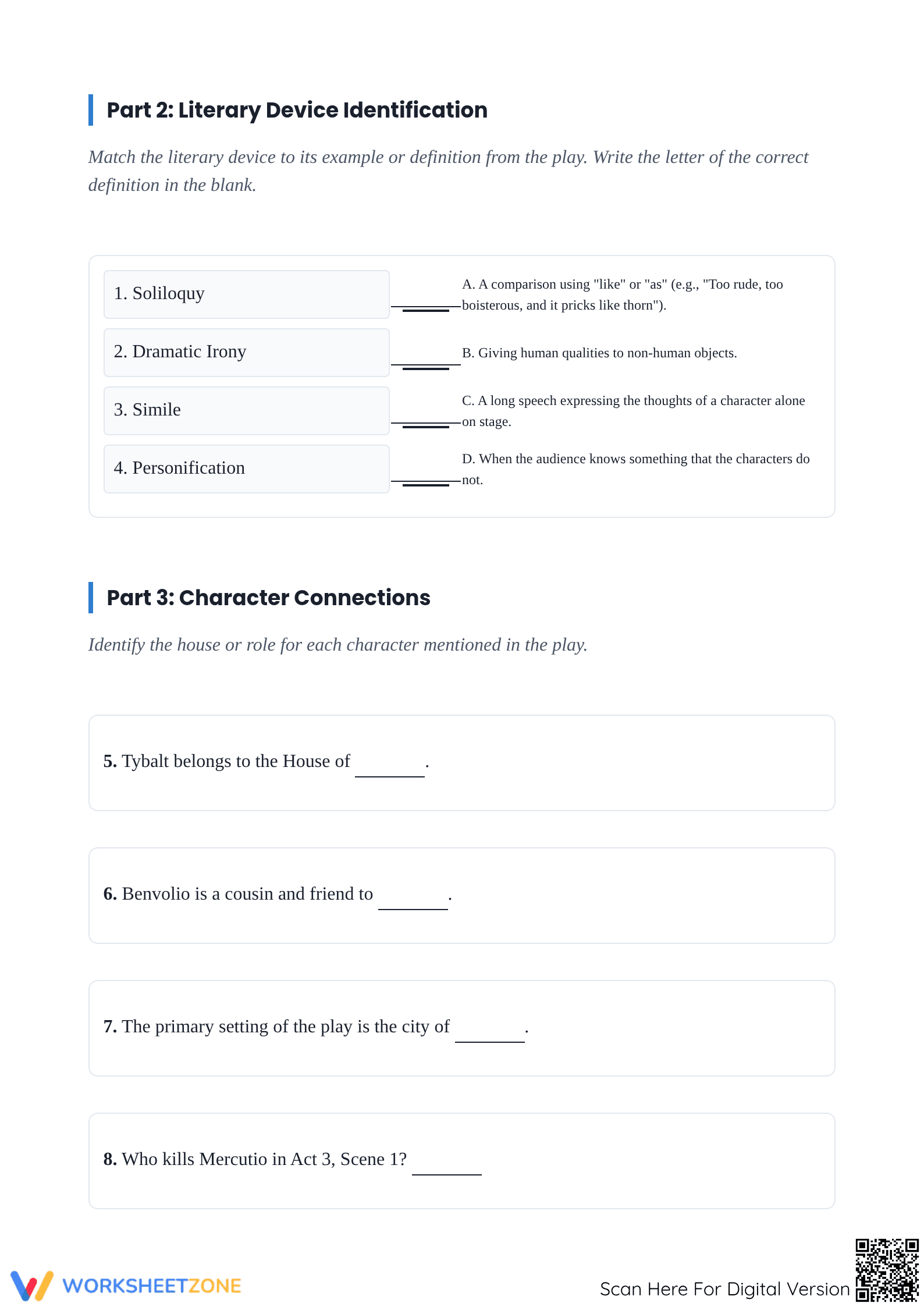
This comprehensive 2-page PDF features three distinct sections designed for maximum engagement. Part 1 is a 16-word search containing character names and literary terms like soliloquy and dramatic irony. Part 2 offers 4 matching tasks for literary device definitions, while Part 3 includes 4 fill-in-the-blank questions regarding character houses and plot settings. A full answer key is provided for rapid grading and immediate student feedback.
Zero-Prep Workflow
- Print: Generate double-sided copies of the 2-page PDF in under 1 minute.
- Distribute: Hand out the self-explanatory sheets; no complex verbal instructions are required.
- Review: Use the included answer key to grade all 24 tasks in less than 5 minutes.
This streamlined process makes the worksheet an ideal solution for unexpected sub days or transition periods between reading acts.
Standards Alignment
The primary focus is `CCSS.ELA-LITERACY.RL.9-10.4`, which requires students to determine the meaning of words and phrases, including figurative and connotative meanings. It also supports `CCSS.ELA-LITERACY.RL.9-10.3` by asking students to identify character roles and relationships within the play's structure. Both standard codes can be copied directly into lesson plans, IEP goals, or district curriculum mapping tools.
How to Use It
Assign this worksheet during the first week of a Romeo and Juliet unit to familiarize students with the complex terminology they will encounter. It also serves as an effective formative assessment after reading Act 1. Observe how quickly students can match definitions to terms like "personification" to gauge their readiness for more complex analysis. Completion typically takes 30 minutes in a standard classroom setting.
Who It's For
This resource is tailored for Grade 9 ELA students, including English Language Learners who benefit from the visual reinforcement of the word search. It pairs naturally with a character anchor chart or a direct instruction lesson on Shakespearean drama. The structured format provides necessary scaffolding for students who struggle with abstract literary concepts or archaic language.
This Grade 9 ELA resource aligns with CCSS.ELA-LITERACY.RL.9-10.4, focusing on the mastery of Shakespearean vocabulary and literary devices such as soliloquy and dramatic irony. Research from Fisher & Frey (2014) emphasizes that front-loading academic vocabulary and providing multiple exposures to domain-specific terms are critical for comprehension of complex classical texts. By combining a low-stakes word search with high-stakes matching and identification tasks, the worksheet facilitates the retrieval practice necessary for long-term retention. The inclusion of 24 specific tasks ensures that students engage with both the "who" and the "how" of the play, bridging the gap between basic recall and analytical application. This dual-page approach supports the gradual release of responsibility, moving from recognition to application. Educators can reliably use this tool to document student progress toward standards-based mastery in secondary literature units.


