


























Views
Downloads

Grade 4 Homophones — Printable No-Prep Worksheet
Paste this activity's link or code into your existing LMS (Google Classroom, Canvas, Teams, Schoology, Moodle, etc.).
Students can open and work on the activity right away, with no student login required.
You'll still be able to track student progress and results from your teacher account.
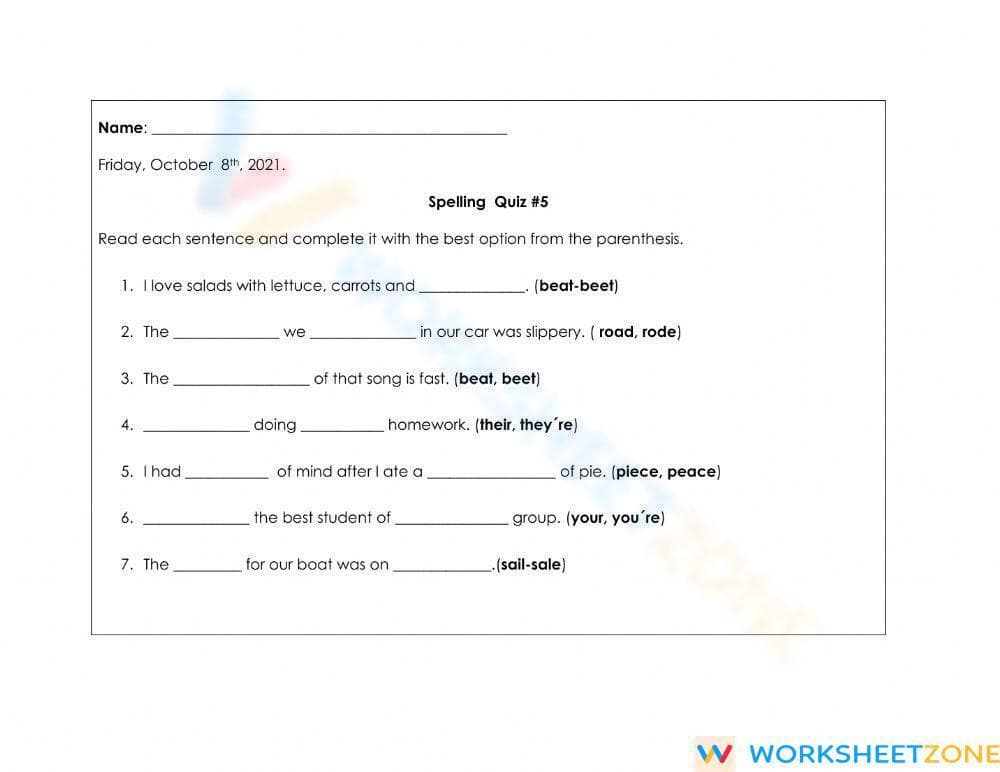
This Grade 4 and 5 spelling quiz focuses on mastering homophones through context-based sentence completion. Students practice distinguishing between frequently confused words like "their/they're" and "your/you're" to improve written clarity. This printable resource ensures learners can identify the correct lexical choice based on sentence meaning for enhanced grammatical accuracy.
At a Glance
- Grade: 4-5 · Subject: English Language Arts
- Standard:
CCSS.ELA-LITERACY.L.4.1.G— Use frequently confused words like their/they're and your/you're correctly in writing- Skill Focus: Homophone Identification and Spelling
- Format: 1 page · 7 problems · Answer key included · PDF
- Best For: Quick formative assessment or spelling quiz
- Time: 10–15 minutes
What's Inside
This focused one-page worksheet contains seven sentence-completion tasks designed to test lexical accuracy. Each item presents a pair of homophones, requiring students to select the correct spelling for one or two blanks per sentence. The document features a clean layout with a clear header for student names and an organized structure that facilitates easy grading. An answer key is included for rapid verification.
Zero-Prep Workflow
The zero-prep design allows teachers to implement this assessment in under two minutes of total preparation time.
- Print (1 minute): Download and print copies for the class or small groups.
- Distribute (30 seconds): Hand out the sheets as a bell-ringer, warm-up, or quick quiz.
- Review (30 seconds): Use the included answer key for immediate feedback or peer grading sessions.
This efficient workflow makes the quiz an ideal resource for substitute folders or for filling unexpected gaps in the instructional block, ensuring that learning time is always productive.
Standards Alignment
This resource is directly aligned with CCSS.ELA-LITERACY.L.4.1.G, which requires students to correctly use frequently confused words (e.g., to, too, two; there, their) in their writing. By focusing on common homophone pairs like "piece/peace" and "sail/sale," it builds the linguistic precision essential for upper elementary literacy. This standard code can be copied directly into lesson plans, IEP goals, or district curriculum mapping tools to document targeted practice.
How to Use It
Use this quiz as a "ticket-out-the-door" formative assessment after a lesson on confusing word pairs to gauge understanding. Alternatively, assign it as a morning work activity to keep spelling skills sharp and reinforce prior learning. For a quick assessment tip, observe if students read sentences aloud, as this often helps them identify the correct homophone through auditory context. Completion typically takes around 10 to 15 minutes.
Who It's For
This resource is tailored for Grade 4 and Grade 5 students working to refine their spelling and vocabulary skills. It is especially effective for English Language Learners (ELLs) who may struggle with phonological similarities between words. For additional support, the worksheet can be paired with a classroom homophone anchor chart to provide visual scaffolds during independent work. It serves as a versatile tool for general education, special education, and intervention settings.
Research from Fisher & Frey (2014) emphasizes explicit instruction and structured practice as critical for mastering standard English conventions. This worksheet targets CCSS.ELA-LITERACY.L.4.1.G by providing a focused opportunity to apply homophone knowledge—words that sound alike but have different meanings and spellings. Requiring students to use sentence context to distinguish between pairs like "their/they're" and "your/you're," reinforces the connection between word meaning and orthography. Regular use of such exercises supports precise written communication and reduces common grammatical errors, consistent with EdReports 2024 analyses on high-quality instructional materials.


