


























Views
Downloads

Printable CCSS.1.G.A.1: 3D Shapes — Grade 1
Paste this activity's link or code into your existing LMS (Google Classroom, Canvas, Teams, Schoology, Moodle, etc.).
Students can open and work on the activity right away, with no student login required.
You'll still be able to track student progress and results from your teacher account.
Mastering 3D Shapes in Grade 1
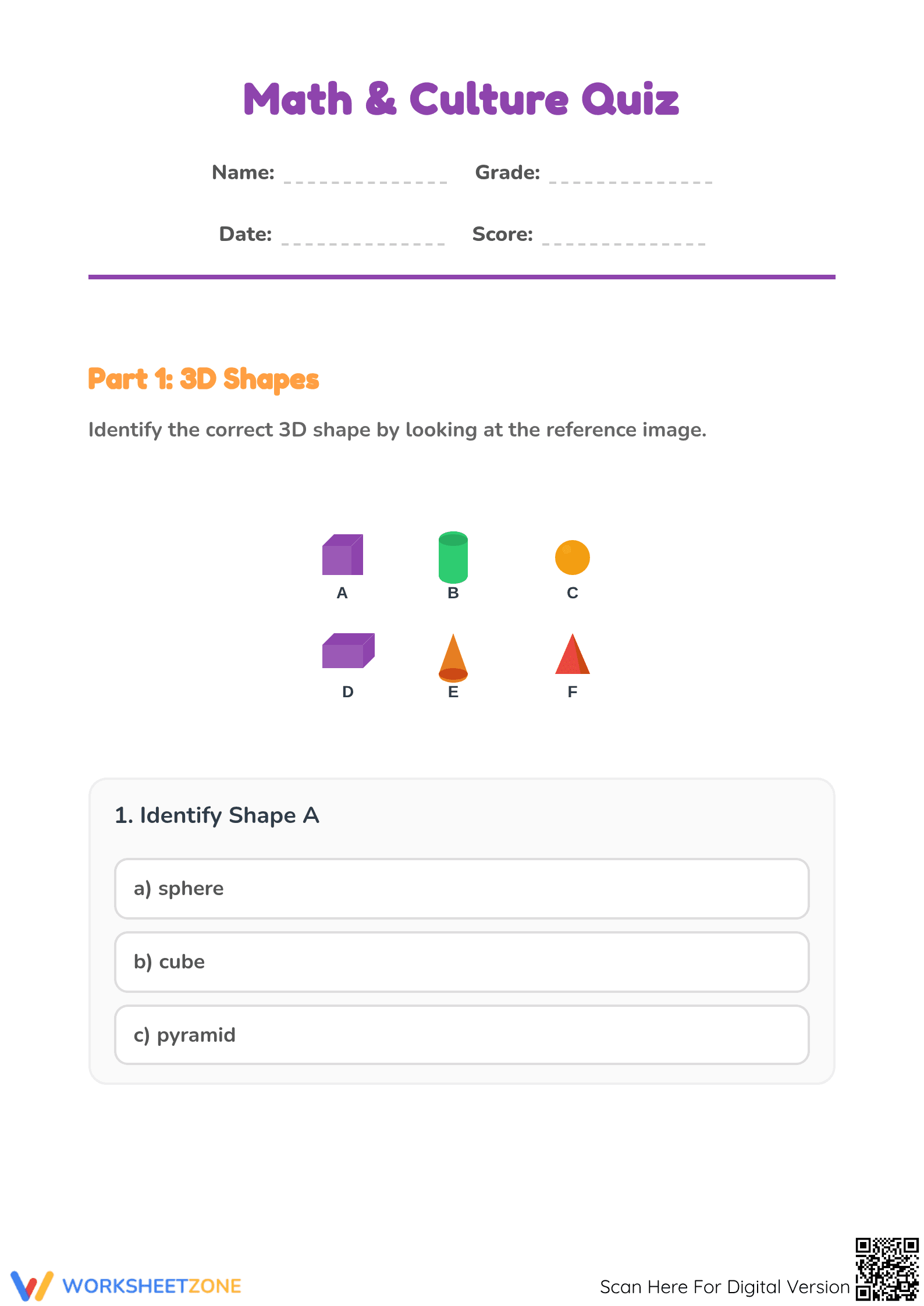
This Grade 1 math worksheet offers a comprehensive review of identifying three-dimensional shapes. Through 16 structured problems across five pages, students will practice recognizing cubes, cones, spheres, and cylinders in both abstract and real-world contexts. It is designed to build foundational geometry skills aligned with common core standards, ensuring students develop a robust understanding for future success.
At a Glance
- Grade: 1 · Subject: Math
- Standard:
CCSS.MATH.CONTENT.1.G.A.1— Distinguish defining attributes of 3D shapes- Skill Focus: 3D Shapes Identification
- Format: 5 pages · 16 problems · Answer key included · PDF
- Best For: Geometry review, formative assessment, homework
- Time: 15–20 minutes
What's Inside This Geometry Worksheet
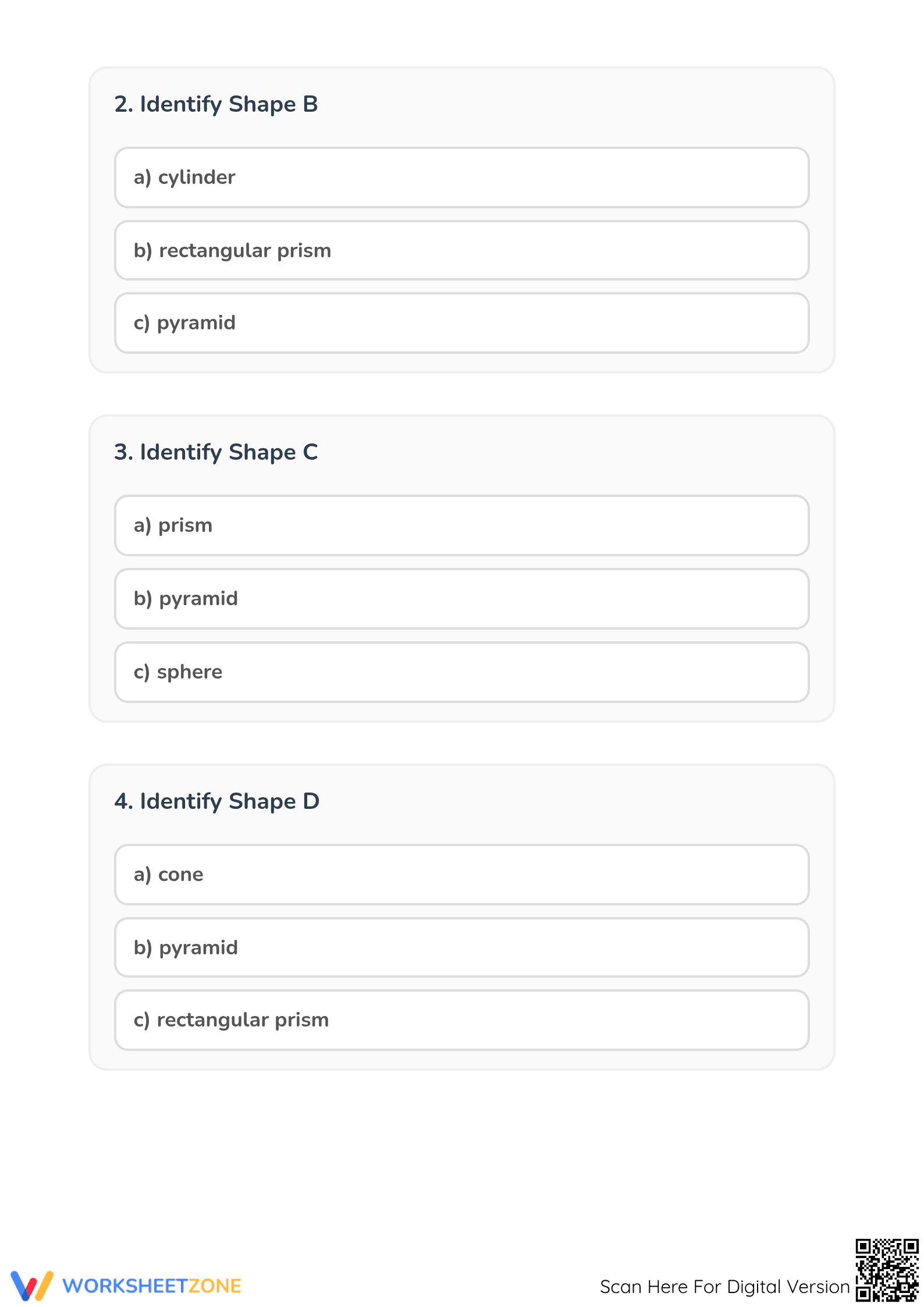
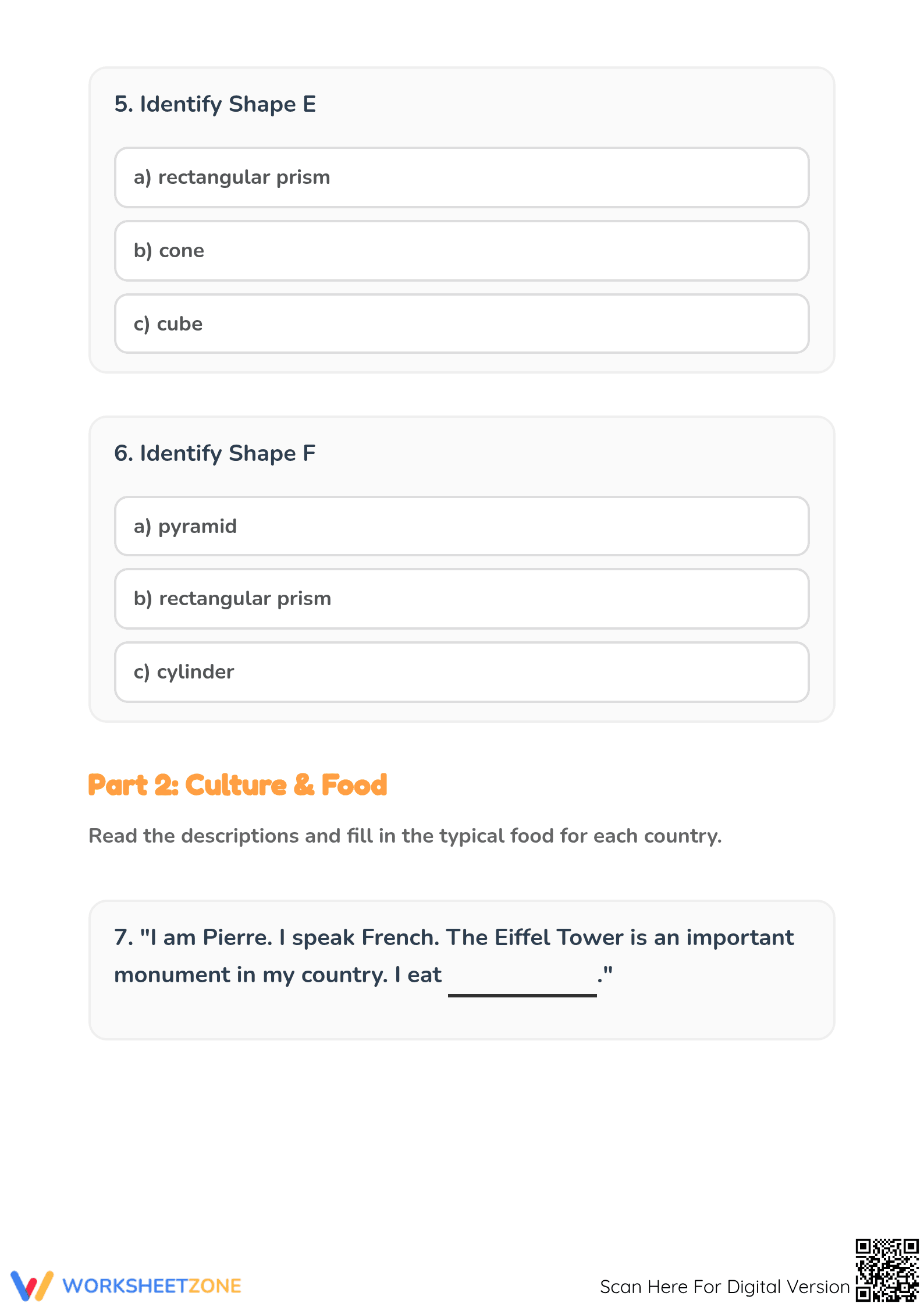
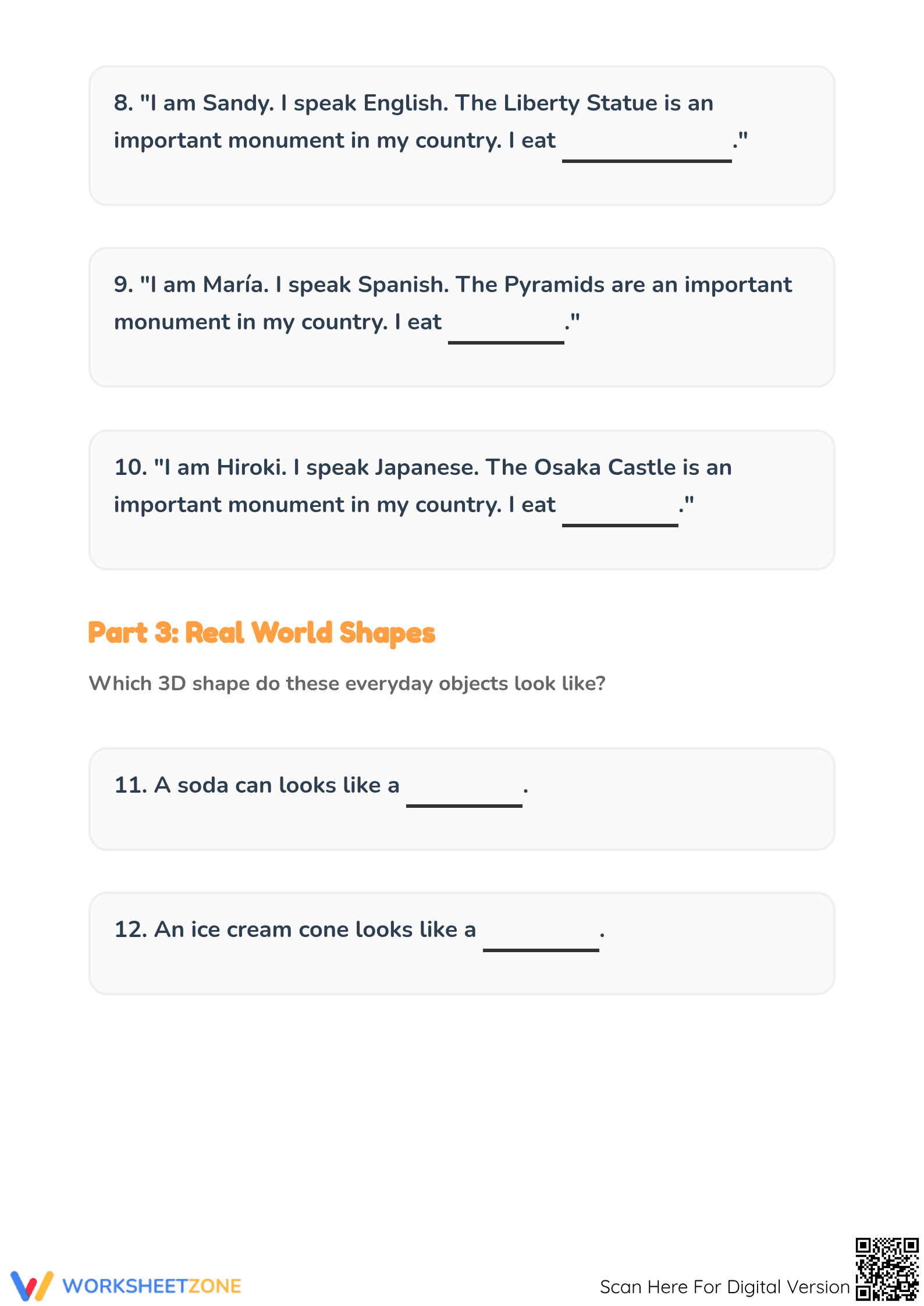
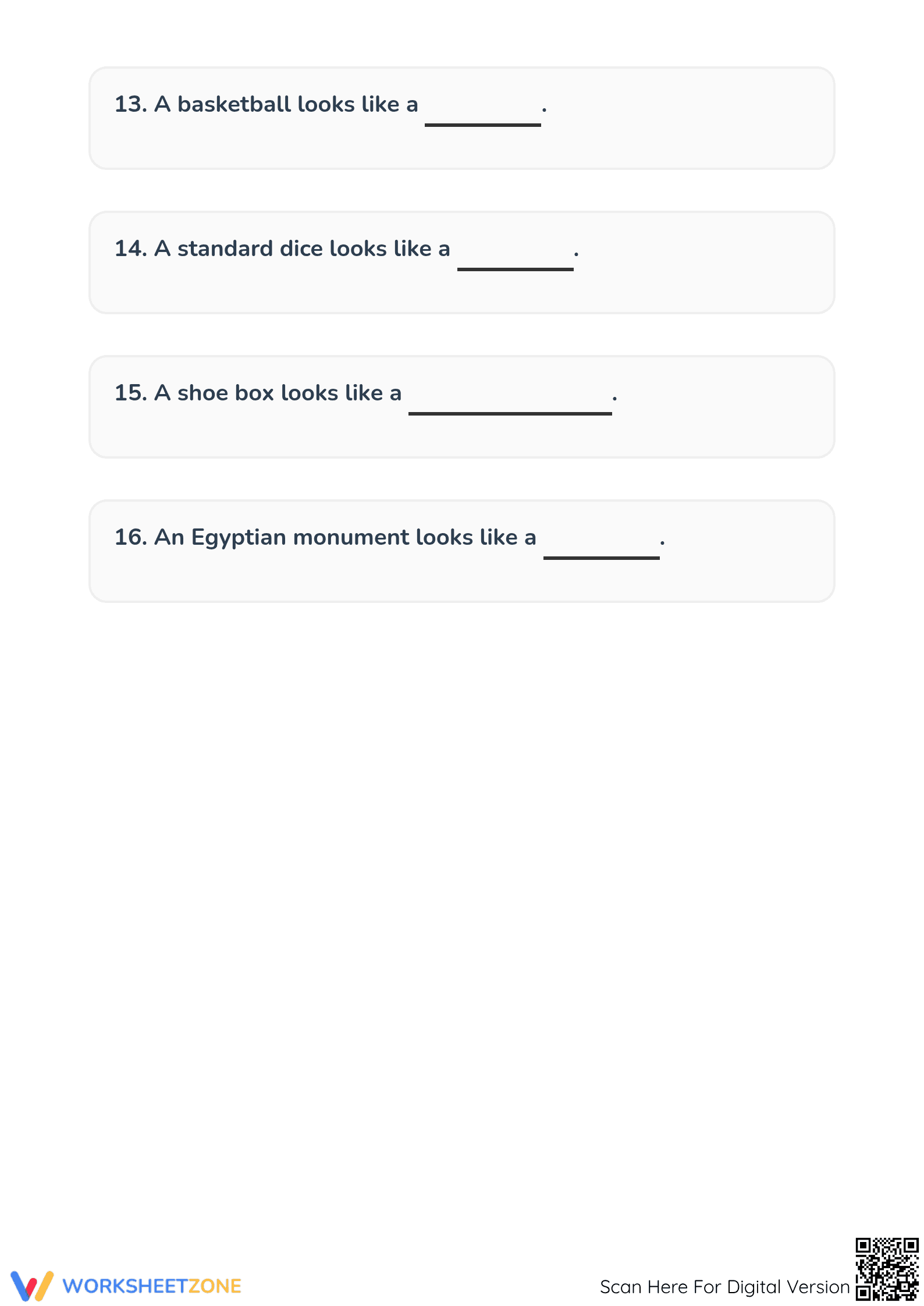
This five-page resource contains three distinct parts that increase in complexity. Part 1 features six multiple-choice questions for identifying basic 3D shapes from a visual bank. Part 2 is a short, four-question matching activity, adding a cross-curricular element. Part 3 concludes with six fill-in-the-blank questions where students identify the 3D shapes of common real-world objects. A complete five-page answer key is provided for easy grading and student self-checking.
Evidence of Mastery and Data-Driven Instruction
This standards-aligned resource provides clear evidence of student mastery for identifying 3D shapes. Each task maps to a sub-skill of CCSS.MATH.CONTENT.1.G.A.1, moving from basic recognition to applying knowledge to real-world objects, which enables precise progress tracking. Although no formal rubric is included, the clear progression of tasks allows teachers to pinpoint where a student may be struggling. Scores can be integrated directly into gradebooks or IEP progress notes, supporting data-driven instruction and targeted interventions in early mathematics.
Standards Alignment for Lesson Planning
This worksheet directly aligns with CCSS.MATH.CONTENT.1.G.A.1, which requires students to "distinguish between defining attributes (e.g., triangles are closed and three-sided) versus non-defining attributes (e.g., color, orientation, overall size); build and draw shapes to possess defining attributes." While this resource focuses primarily on identification, it builds the necessary visual foundation for meeting the full standard. The standard code can be copied directly into lesson plans, curriculum maps, or school-wide data systems.
How to Use It in the Classroom
Use this worksheet as a pre-assessment before a geometry unit, or as a summative quiz after instruction on 3D shapes. For formative assessment, observe which "real world shapes" in Part 3 give students the most trouble, indicating a need for more hands-on examples. The activity can function as independent practice in a math center, a whole-class review, or a homework assignment. Expect students to take approximately 15-20 minutes to complete all 16 problems.
Who It's For
This resource is designed for first-grade students learning to identify and name common 3D shapes. The clear instructions and visual aids make it accessible for diverse learners, including English language learners. It can also serve as an effective review for second-grade students at the beginning of a geometry unit. For a more tactile learning experience, pair this worksheet with a set of physical 3D shape manipulatives that students can touch and examine.
Foundational geometry skills, such as identifying 3D shapes, are critical for developing spatial reasoning in early elementary students. This worksheet supports CCSS.MATH.CONTENT.1.G.A.1 by providing focused practice on distinguishing the attributes of common three-dimensional figures. According to research from the RAND AIRS (2024), early and consistent exposure to geometric concepts is a key predictor of future success in mathematics. This resource reinforces visual discrimination and vocabulary for robust geometric understanding, aligning with best practices for building long-term mathematical proficiency and STEM readiness.


