




























Views
Downloads
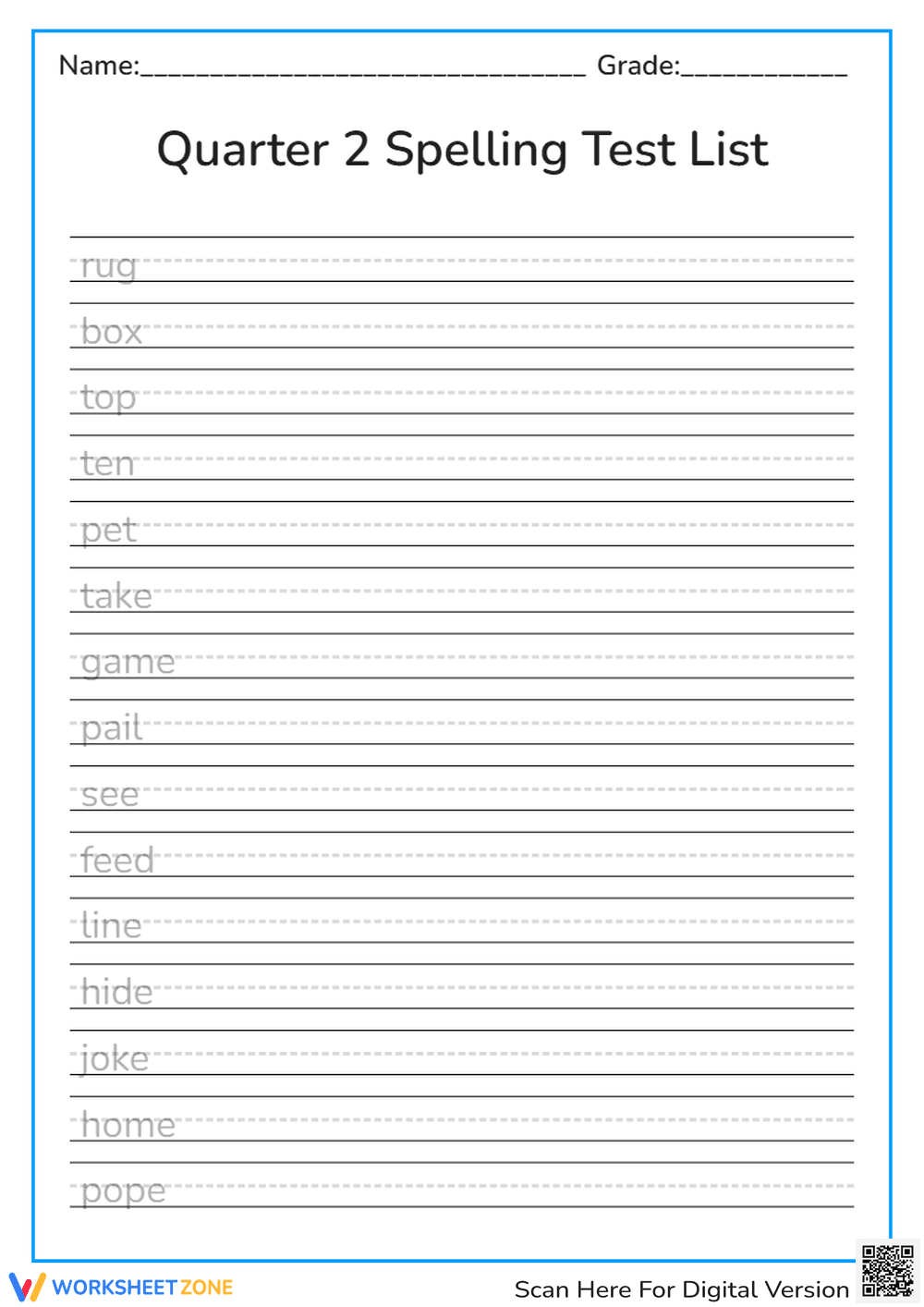

Grade 1 Spelling Test List — Essential Handwriting Guide

Paste this activity's link or code into your existing LMS (Google Classroom, Canvas, Teams, Schoology, Moodle, etc.).
Students can open and work on the activity right away, with no student login required.
You'll still be able to track student progress and results from your teacher account.
This Grade 1 spelling test list provides a structured format for students to practice handwriting and reinforce phonics patterns, including CVC words and long vowel silent-e structures. By using this printable, educators can help students master spelling conventions through tracing and repetitive writing during the second quarter of the academic year.
At a Glance
- Grade: 1 · Subject: Handwriting
- Standard:
CCSS.ELA-LITERACY.L.1.2.D— Spell untaught words phonetically using phonemic awareness and spelling conventions- Skill Focus: Spelling CVC and CVCe patterns
- Format: 1 page · 16 problems · Answer key included · PDF
- Best For: Weekly spelling assessments or phonics practice
- Time: 10–15 minutes
What's Inside
This 1-page PDF features 16 high-frequency spelling words printed in a legible, traceable font. Each word is placed on primary handwriting lines with a dotted midline to guide proper letter formation. The layout includes a header for student identification and a clean, professional border suitable for classroom use and easy filing.
Zero-Prep Workflow
- Print: Select the PDF and print enough copies for your entire literacy block or spelling center (30 seconds).
- Distribute: Provide the sheets as a morning warm-up or independent practice activity during rotations (1 minute).
- Review: Check for letter formation accuracy and spelling recall during small group instruction or individual conferences (5 minutes).
This resource is designed for immediate implementation, requiring less than two minutes of total teacher preparation time.
Standards Alignment
This worksheet aligns with `CCSS.ELA-LITERACY.L.1.2.D`: "Spell untaught words phonetically, drawing on phonemic awareness and spelling conventions." It also supports foundational writing skills by emphasizing correct letter placement on primary lines. Both standard codes can be copied directly into lesson plans, IEP goals, or district curriculum mapping tools.
How to Use It
Use this worksheet during the independent practice phase of your phonics lesson to reinforce the week's spelling list. It serves as an excellent formative assessment tool; observe students as they trace to identify those struggling with fine motor control or specific vowel patterns. Expected completion time ranges from 10 to 15 minutes depending on student proficiency.
Who It's For
This resource is ideal for first-grade students, English Language Learners (ELL), and students receiving Tier 2 intervention for spelling. It pairs naturally with a weekly spelling passage or an anchor chart displaying CVCe "silent e" rules to provide a comprehensive literacy experience for early writers.
The CCSS.ELA-LITERACY.L.1.2.D standard requires first-grade students to spell untaught words phonetically by drawing on phonemic awareness and spelling conventions. This worksheet facilitates that specific student action by providing a clear, distraction-free environment for phonetic transcription and handwriting practice. Research by Fisher & Frey (2014) emphasizes that regular, low-stakes assessments of spelling patterns are vital for developing orthographic mapping skills in early readers. By focusing on 16 specific word targets, this resource allows teachers to identify gaps in vowel team recognition or consonant blending. The inclusion of primary handwriting lines ensures that students maintain proper letter size and spacing while focusing on the cognitive load of spelling. This dual-purpose approach supports both fine motor development and linguistic mastery. Using such structured tools helps bridge the gap between isolated phonics instruction and applied writing fluency, providing a reliable data point for quarterly progress monitoring and instructional goals.


