


























Views
Plays
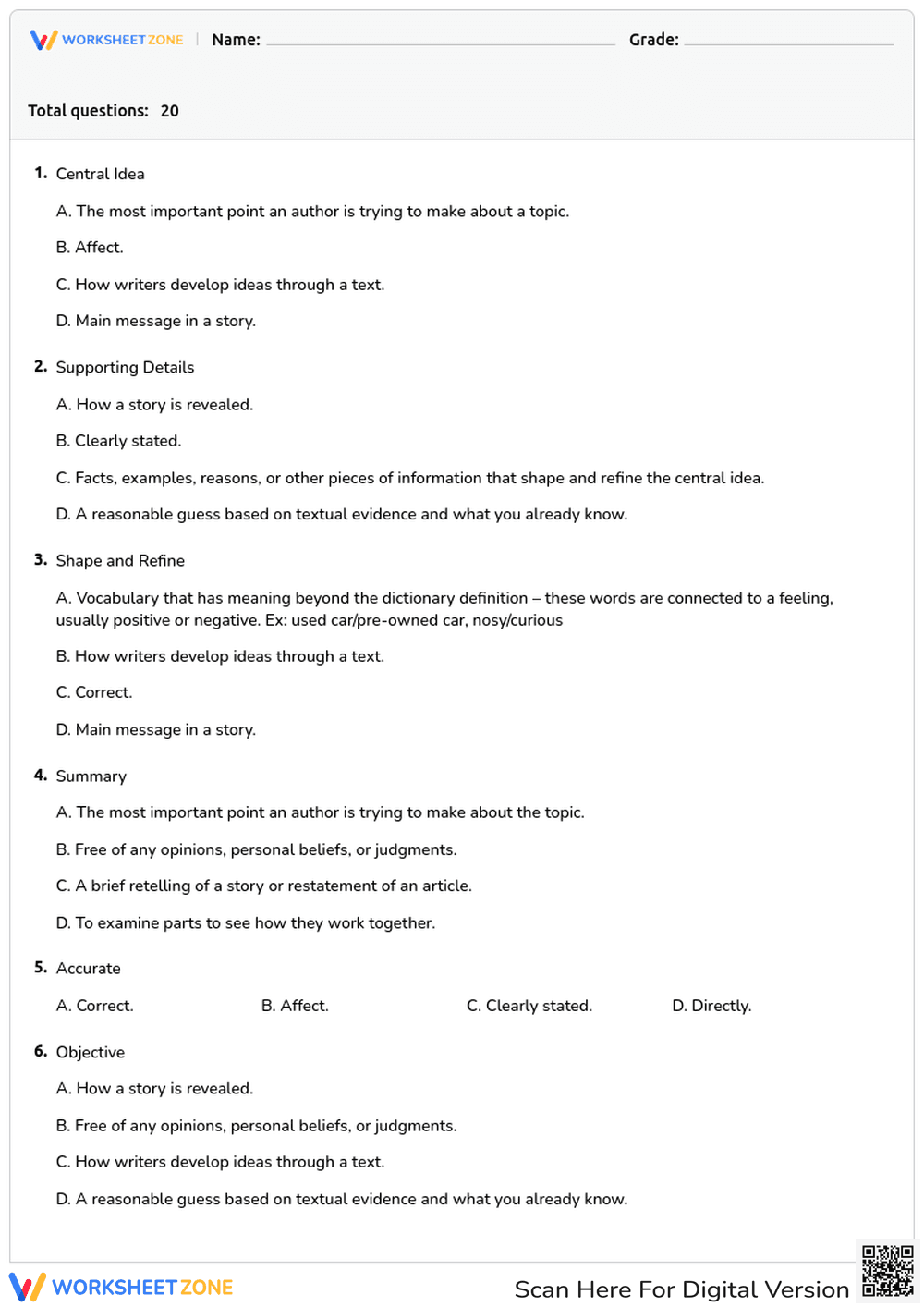


Grade 6 Academic Vocabulary Quiz | Essential ELA Worksheet
Paste this activity's link or code into your existing LMS (Google Classroom, Canvas, Teams, Schoology, Moodle, etc.).
Students can open and work on the activity right away, with no student login required.
You'll still be able to track student progress and results from your teacher account.
This Grade 6 academic vocabulary worksheet provides 20 multiple-choice questions to master essential ELA terminology. By defining concepts like central idea and inference, students build the foundation for complex text analysis. This resource ensures learners accurately identify domain-specific language across various literary genres and informational texts.
At a Glance
- Grade: 6 · Subject: ELA
- Standard:
CCSS.ELA-LITERACY.L.6.6— Acquire and use grade-appropriate general academic and domain-specific words and phrases- Skill Focus: Academic Vocabulary Mastery
- Format: 4 pages · 20 problems · Answer key included · PDF
- Best For: Formative assessment or sub plans
- Time: 20–30 minutes
What's Inside: This comprehensive 4-page PDF contains 20 multiple-choice questions designed to test student recognition of academic terms. Each question presents a key term—such as "Objective," "Connotative Meaning," or "Resolution"—and asks students to select the correct definition from four options. The layout is clean and distraction-free, featuring a clear header for student names and grades. A full answer key is provided to facilitate rapid grading or student self-correction.
Zero-Prep Workflow
- Print: Generate the 4-page document in seconds for your entire class.
- Distribute: Hand out the worksheets as a "bell-ringer" or quiet assessment with no teacher setup required.
- Review: Use the included answer key to review definitions as a whole class or collect for a quick formative grade.
Total teacher prep time is under 2 minutes, making this an ideal candidate for emergency sub plans or last-minute review sessions.
Standards Alignment
The primary focus is `CCSS.ELA-LITERACY.L.6.6`, which requires students to acquire and use accurately grade-appropriate general academic and domain-specific words and phrases. Additionally, it supports `CCSS.ELA-LITERACY.RI.6.4` by reinforcing the technical meanings of words used in informational texts. Both standard codes can be copied directly into lesson plans, IEP goals, or district curriculum mapping tools.
How to Use It
Use this worksheet as a pre-assessment before a unit on literary analysis to gauge baseline vocabulary knowledge. During the instructional period, it serves as an excellent formative check after teaching story elements or text structures. Teachers should observe which terms (e.g., "Inference" vs. "Explicit") cause the most confusion to guide future mini-lessons. Expect students to complete the 20 questions within a 20 to 30-minute window.
Who It's For
This resource is ideal for general education students in grades 4 through 6, as well as English Language Learners (ELLs) who require explicit vocabulary instruction. It pairs naturally with a literary terms anchor chart or a direct instruction lesson on citing text evidence.
According to Fisher & Frey (2014), the intentional teaching of academic vocabulary is a cornerstone of adolescent literacy, as it bridges the gap between basic communication and complex academic discourse. This worksheet targets CCSS.ELA-LITERACY.L.6.6 by isolating 20 high-frequency terms that appear across standardized testing and middle-school curricula. Research indicates that students who master domain-specific language, such as "analyze," "evidence," and "theme," demonstrate significantly higher comprehension scores on the NAEP and state-level assessments. By providing structured multiple-choice practice, this resource allows for the repeated exposure necessary for lexical acquisition. The inclusion of terms like "objective" and "connotative" aligns with the shift toward evidence-based writing and critical media literacy. This assessment tool provides a reliable data point for educators to track vocabulary growth and identify specific gaps in student understanding before moving to higher-order synthesis tasks.


