


























Views
Plays
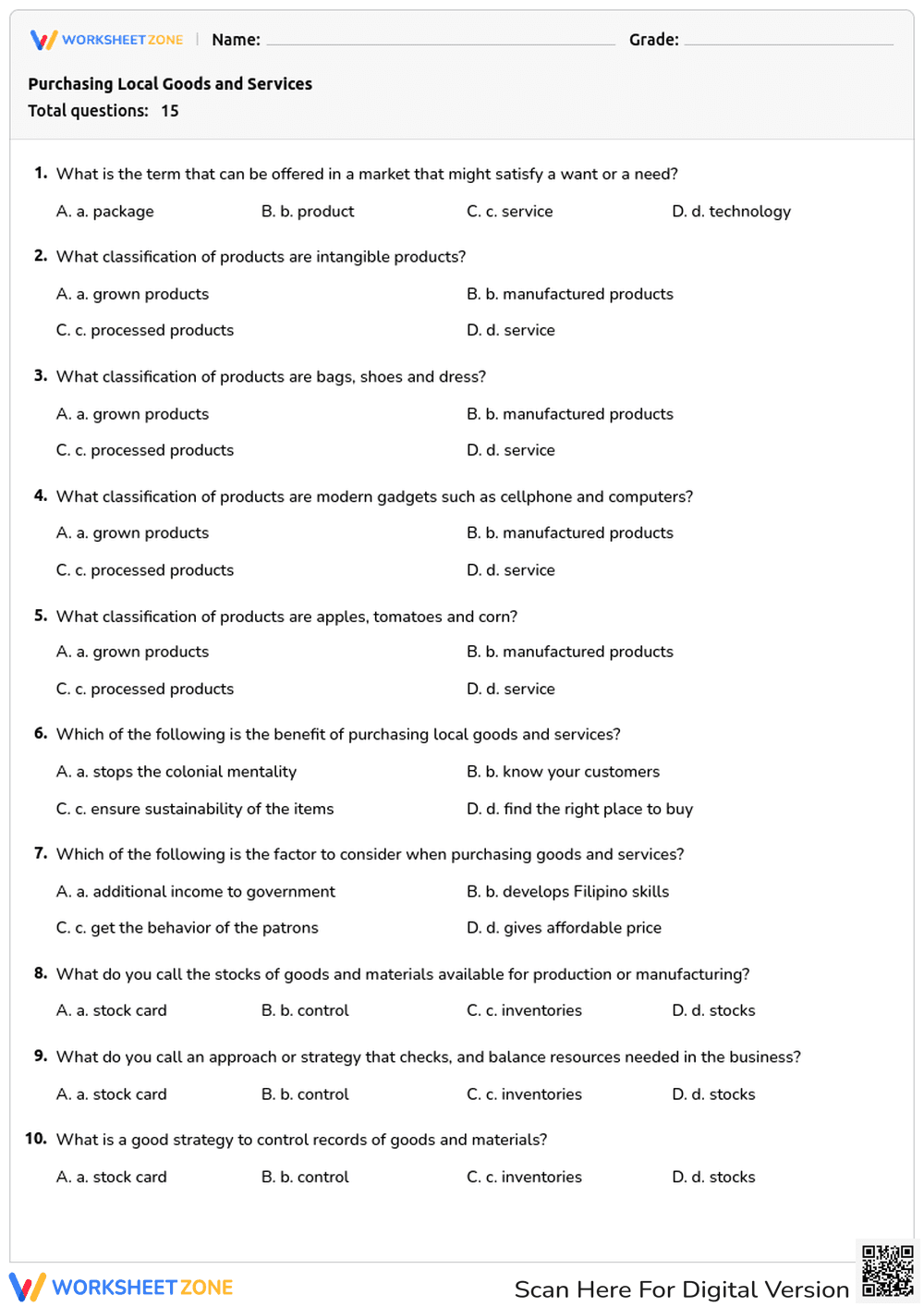


Business Vocabulary & Inventory | Grade 11-12 Printable Quiz
Paste this activity's link or code into your existing LMS (Google Classroom, Canvas, Teams, Schoology, Moodle, etc.).
Students can open and work on the activity right away, with no student login required.
You'll still be able to track student progress and results from your teacher account.
This Grade 11 and 12 business and economics worksheet gives students targeted practice with essential industry terminology. By evaluating classifications of products, services, and inventory management strategies, high school learners will solidify their understanding of foundational business concepts and supply chain vocabulary.
At a Glance
- Grade: 11-12 · Subject: Business & Economics
- Standard:
CCSS.ELA-LITERACY.RH.11-12.4— Determine the meaning of economic vocabulary- Skill Focus: Business vocabulary and inventory management
- Format: 2 pages · 15 problems · Answer key included · PDF
- Best For: Formative assessment and review
- Time: 15–20 minutes
This comprehensive assessment features 15 multiple-choice questions spanning two pages. Students will encounter a variety of terminology-based tasks, identifying the differences between grown, manufactured, and processed products, as well as defining key inventory control terms like raw materials, work-in-process, and finished goods. A complete answer key is provided to ensure accurate grading and immediate feedback.
Designed for maximum efficiency, this resource requires virtually zero teacher preparation:
- Print (1 minute): Simply download the PDF and print a class set. The clean, straightforward layout is easy to read and saves ink.
- Distribute (1 minute): Hand out the two-page quiz at the beginning of class as a bell-ringer or at the end of a unit as a summative check.
- Review (5 minutes): Use the included answer key to quickly grade submissions or facilitate a peer-review session where students discuss their rationale for each answer.
With a total prep time of under two minutes, this worksheet is an excellent addition to any emergency sub plan folder for high school business or CTE courses.
Aligned to CCSS.ELA-LITERACY.RH.11-12.4, this resource requires students to determine the meaning of words and phrases as they are used in a text, including vocabulary describing political, social, or economic aspects of history and social science. It also supports general Career and Technical Education (CTE) objectives for entrepreneurship and business management. Both standard codes can be copied directly into lesson plans, IEP goals, or district curriculum mapping tools.
This versatile worksheet functions perfectly as a mid-unit formative assessment. Assign it after direct instruction on product classification and inventory control to gauge class comprehension. Alternatively, use it as an independent study guide before a major unit exam. While students work, teachers can circulate and observe which specific vocabulary terms are causing confusion, allowing for targeted reteaching. Expect students to complete the 15 questions in 15 to 20 minutes.
This resource is designed for high school juniors and seniors enrolled in business, economics, or entrepreneurship electives. The straightforward multiple-choice format provides built-in scaffolding for English Language Learners and students needing accommodations, as they can rely on recognition rather than recall. It pairs excellently with introductory lectures on supply chain management or local economic impact studies.
Integrating domain-specific vocabulary practice into high school technical subjects is critical for long-term academic and professional success. Aligned with CCSS.ELA-LITERACY.RH.11-12.4, this resource helps students determine the meaning of economic vocabulary in context. According to Fisher & Frey (2014), explicit vocabulary instruction in disciplinary literacy significantly improves reading comprehension and content retention, particularly in specialized fields like business and economics. By repeatedly exposing students to terms like "work-in-process" and "manufactured products" through structured multiple-choice tasks, educators can build the foundational knowledge required for advanced entrepreneurial coursework and real-world financial literacy.


