


























Views
Downloads
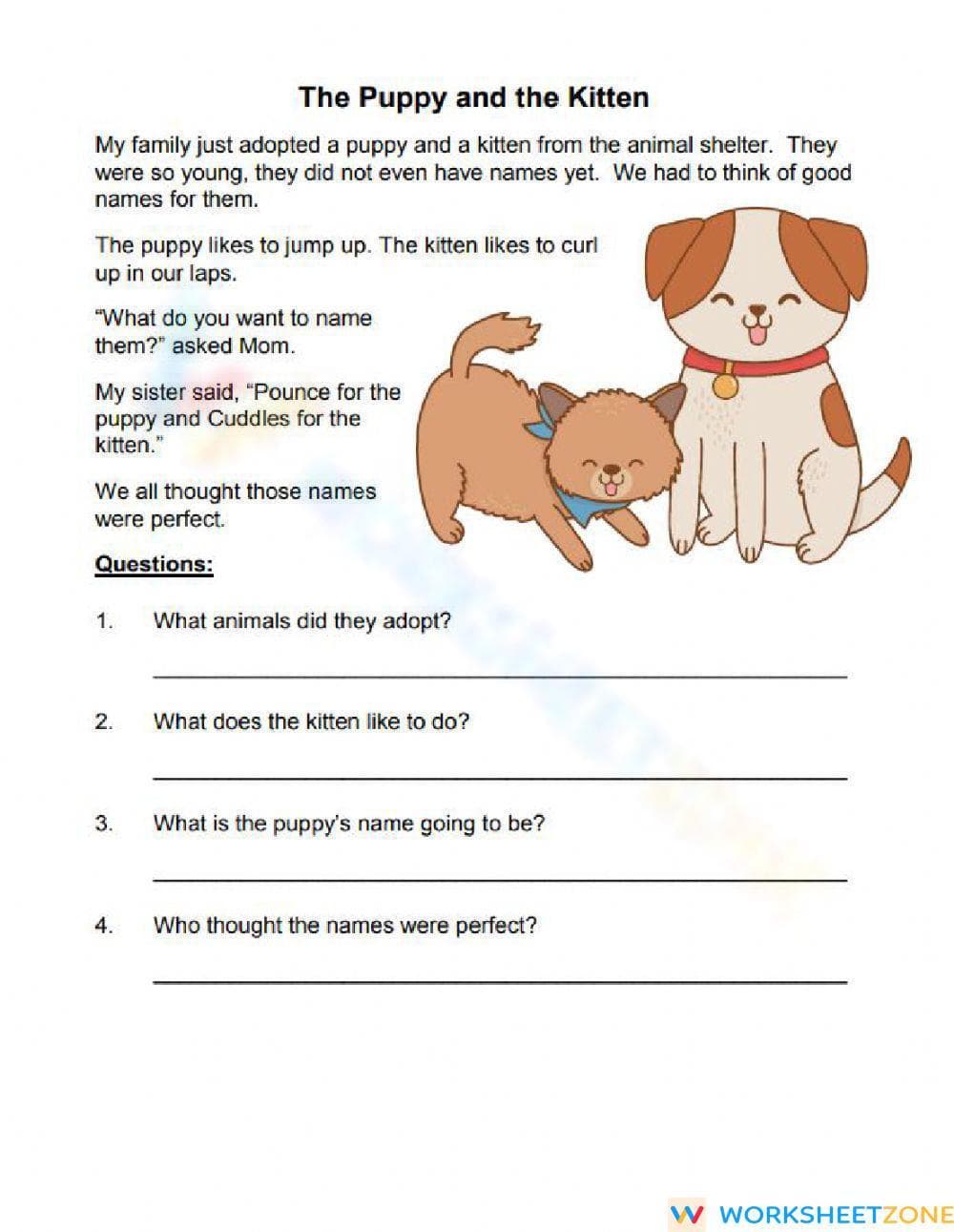

Grade 3-4 Puppy and Kitten — Printable No-Prep Worksheet
Paste this activity's link or code into your existing LMS (Google Classroom, Canvas, Teams, Schoology, Moodle, etc.).
Students can open and work on the activity right away, with no student login required.
You'll still be able to track student progress and results from your teacher account.
This puppy and kitten reading comprehension worksheet helps Grade 3-4 students build literacy skills by identifying key details in narrative text. By answering text-dependent questions about an adoption story, learners demonstrate their ability to refer explicitly to the passage as the basis for their answers.
At a Glance
- Grade: 3-4 · Subject: English Language Arts
- Standard:
CCSS.ELA-LITERACY.RL.3.1— Ask and answer questions to demonstrate understanding by referring explicitly to the text- Skill Focus: Literal Reading Comprehension
- Format: 1 page · 4 problems · Answer key included · PDF
- Best For: Independent practice or quick formative assessment
- Time: 10–15 minutes
What's Inside
This single-page PDF features an engaging short story titled "The Puppy and the Kitten," accompanied by charming illustrations of the animals. The worksheet includes four structured comprehension questions that require students to retrieve specific information from the text, such as animal names and character actions. A complete answer key is provided for rapid grading and student self-correction.
Zero-Prep Workflow
Teachers can integrate this resource with minimal effort. First, print the single-page document (30 seconds). Second, distribute the copies for independent work or as a warm-up (1 minute). Third, review the answers using the provided key for immediate feedback (5 minutes). This streamlined process requires under two minutes of preparation, making it ideal for emergency sub plans or busy mornings.
Standards Alignment
This resource is directly aligned with CCSS.ELA-LITERACY.RL.3.1: "Ask and answer questions to demonstrate understanding of a text, referring explicitly to the text as the basis for the answers." It also supports Grade 4 standards by encouraging students to draw inferences based on text evidence. Both standard codes can be copied directly into lesson plans, IEP goals, or district curriculum mapping tools.
How to Use It
Use this worksheet as a "cool-down" activity after a lesson on finding text evidence. Alternatively, assign it as morning work to gauge reading accuracy. During the activity, observe if students look back at the text; this provides a formative tip for identifying those needing scaffolding with scanning techniques. Completion typically takes 10 to 15 minutes.
Who It's For
This activity is designed for Grade 3 and Grade 4 students, including those in ESL or special education programs who benefit from clear, concise narratives. It pairs naturally with a short passage about pets or an anchor chart detailing "How to Find Answers in a Story." Differentiation is easily achieved by providing sentence frames for the written responses.
Reading comprehension serves as the bedrock for academic success. According to the RAND AIRS 2024 analysis, providing students with short, high-interest texts focusing on literal comprehension tasks improves their ability to process narratives. This worksheet targets CCSS.ELA-LITERACY.RL.3.1 by requiring students to extract specific details about character behavior. By engaging with 4 targeted questions, learners practice the essential plain-English skill of finding evidence within a text to support their claims. This method of structured practice aligns with evidence-based instruction, ensuring students develop the scanning and retrieval skills necessary for standardized testing. The combination of narrative text and direct questioning makes this resource an effective tool for classroom-ready instruction and formative data collection.


