




























Views
Downloads

Proven State Names Word Search | Grades 6–7 Social Studies

Paste this activity's link or code into your existing LMS (Google Classroom, Canvas, Teams, Schoology, Moodle, etc.).
Students can open and work on the activity right away, with no student login required.
You'll still be able to track student progress and results from your teacher account.
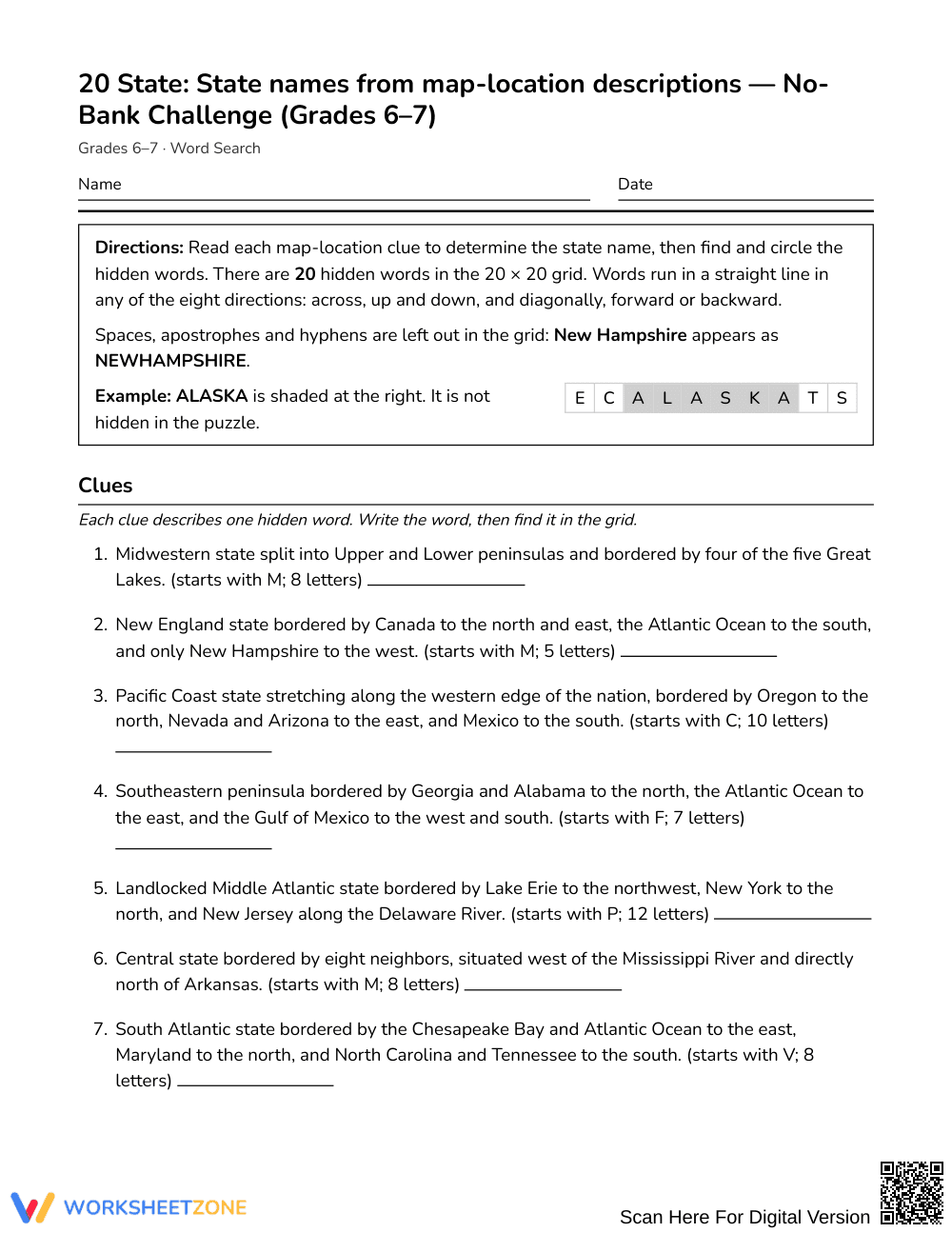
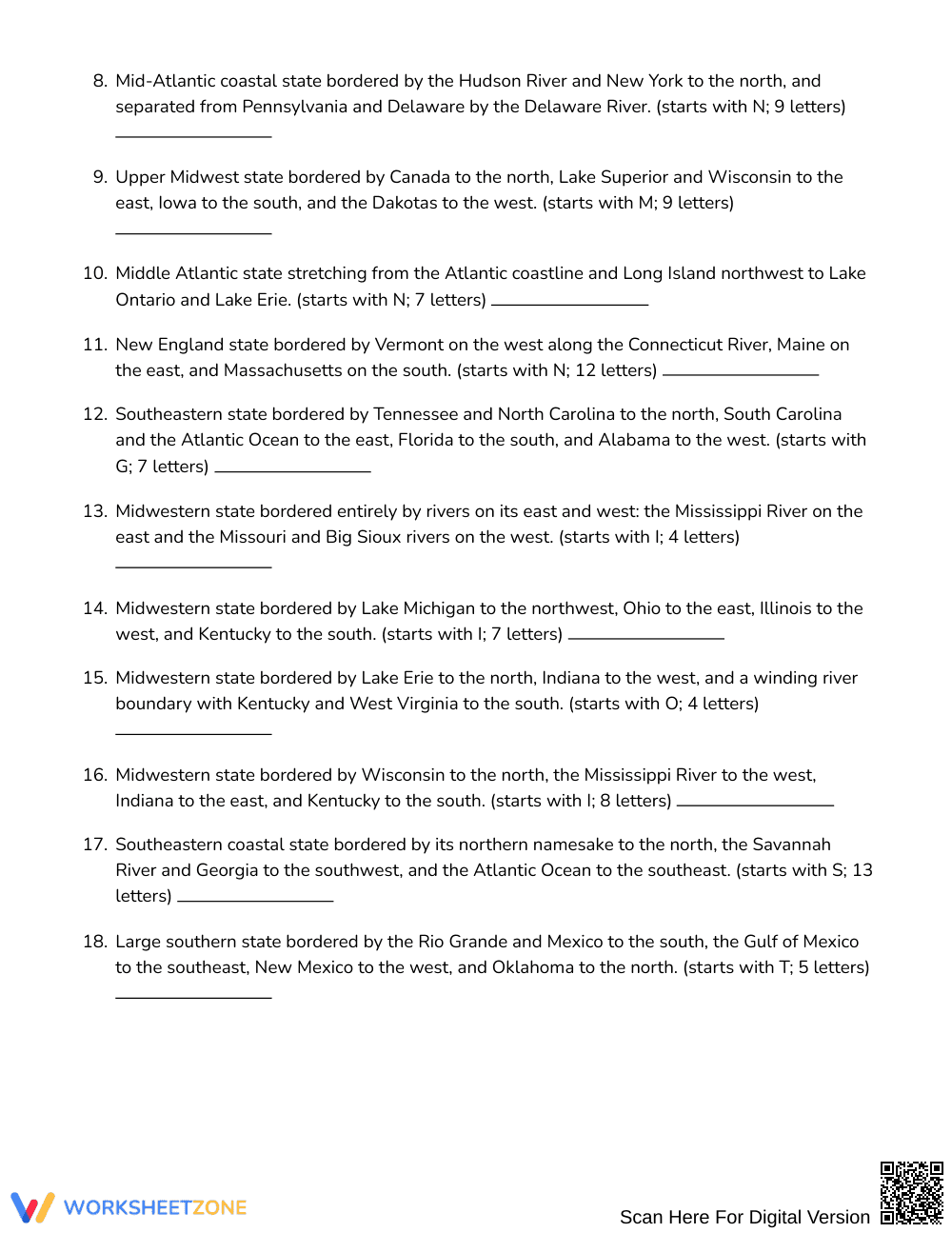
This Grades 6–7 social studies word search reinforces United States geography by challenging students to identify 20 states using map-location clues. Learners analyze regional boundaries, bordering water bodies, and neighboring states to determine each hidden state name, boosting geographic literacy and critical deduction skills through an engaging, no-bank puzzle format.
At a Glance
- Grade: Grades 6–7 · Subject: Social Studies
- Standard: Not standards-assessed — vocabulary enrichment
- Skill Focus: State names from map-location descriptions
- Format: 3 printable student pages · 20 words · Full answer key included · PDF
- Best For: Geography unit review and independent early finisher enrichment
- Time: 25–35 minutes of focused learning
What's Inside
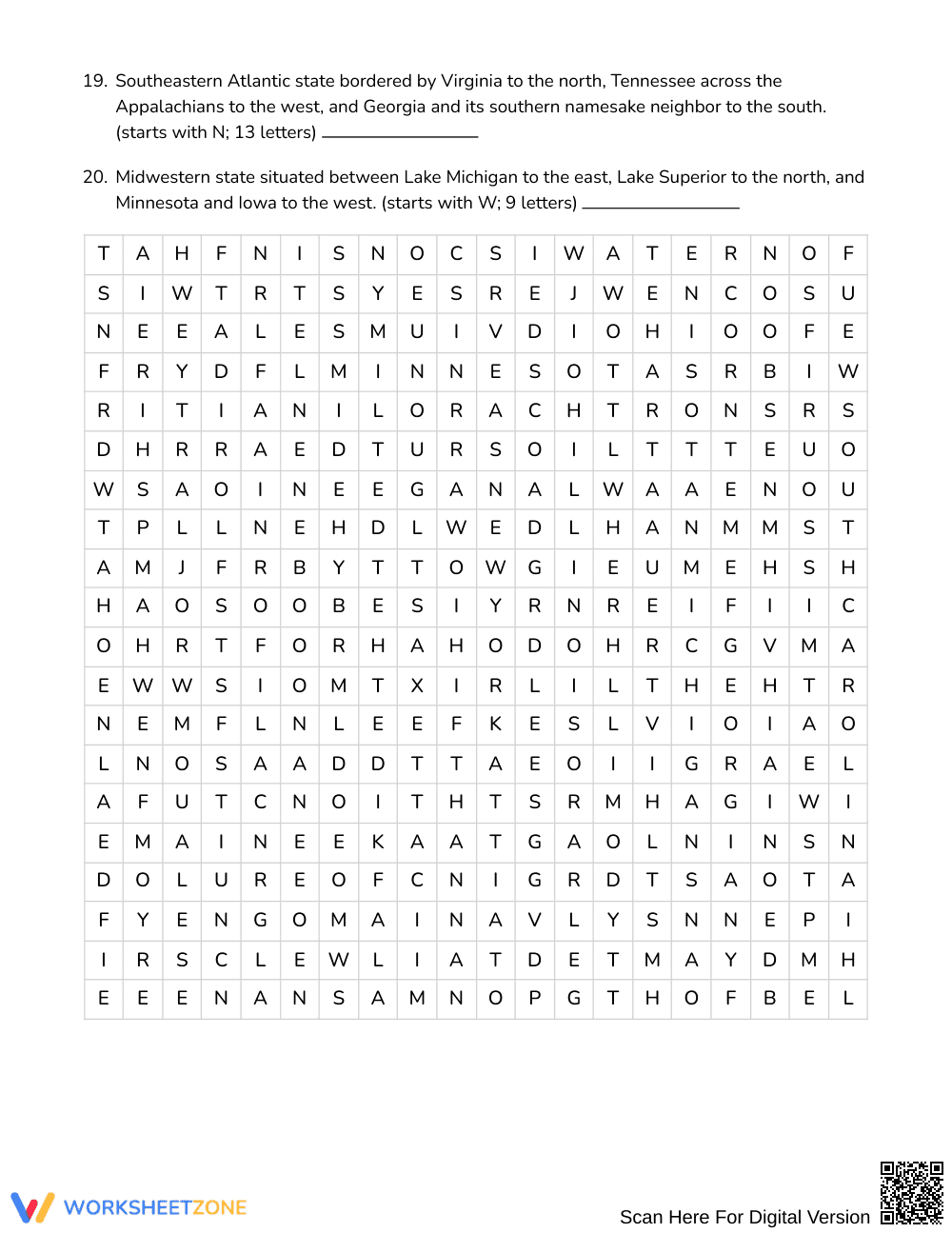
This resource features a 3-page printable activity containing 20 clue-based tasks and an accompanying 4-page answer key. Instead of a standard word list, students receive 20 detailed geographic descriptions highlighting cardinal borders, river systems, and coastlines. Learners must solve each clue to identify the correct state before locating the term within the letter grid.
How the Puzzle Works
The puzzle is built on a 20 by 20 letter grid designed to test both deductive reasoning and visual scanning. Target words run in all 8 compass directions: north, northeast, east, southeast, south, southwest, west, and northwest, including forward and backward orientations. Because no word bank is provided, students cannot rely on passive word matching; they must derive each target state directly from its geographic clue.
Standards Alignment
This activity provides targeted vocabulary enrichment and spatial reasoning practice rather than aligning to a specific formal state standard. It supports core middle school social studies competencies by prompting students to connect spatial terminology, border analysis, and physical features to the political map of the United States.
How to Use It
Deploy this activity after direct instruction on United States regions to consolidate boundary knowledge, or use it as an independent station during social studies rotations. For formative assessment, observe whether students identify states immediately from river and border clues or require an atlas. Most students will complete the reading and puzzle search within 25 to 35 minutes.
Who It's For
This puzzle is designed for Grades 6–7 social studies students developing mental map recall. For students needing support, pair the activity with a blank United States physical reference map. For an extension, challenge advanced students to identify capital cities for each discovered state without consulting outside resources.
Geography vocabulary enrichment in middle grades builds essential spatial reasoning and domain-specific background knowledge. According to Fisher & Frey (2014), intentional word-learning tasks that require retrieval practice and contextual deduction solidify conceptual retention far more effectively than passive memorization. By deducing state names from geographic boundary descriptions—such as bordering waterways, cardinal neighbors, and landforms—before locating them within a complex grid, middle school students actively rehearse mental maps. This dual-demand activity strengthens orthographic processing alongside spatial literacy, encouraging learners to synthesize physical geography markers with state identification. Because the activity functions without an explicit word bank, it activates deep retrieval pathways and reinforces geographical terminology across diverse regional contexts. Such structured retrieval exercises provide educators with meaningful qualitative insights into student mastery of United States geography, fostering independent problem-solving skills and long-term disciplinary literacy across secondary social studies classrooms.


