


























Views
Downloads





Proven Source Integration Worksheet | Grade 11 English III
Paste this activity's link or code into your existing LMS (Google Classroom, Canvas, Teams, Schoology, Moodle, etc.).
Students can open and work on the activity right away, with no student login required.
You'll still be able to track student progress and results from your teacher account.
This research writing worksheet equips Grade 11 English III students to eliminate dropped quotations and patchwriting through deliberate source synthesis. Learners analyze an unrevised student draft, rebuild flawed sentences using an oral history dossier, and justify rhetorical decisions to achieve authentic, postsecondary-ready scholarly writing.
At a Glance
- Grade: 11 · Subject: English III
- Standard:
W.11-12.8— Integrate research smoothly, cite sources using MLA format, and prevent plagiarism- Skill Focus: Source-Integration Check
- Format: 6 pages · 12 problems · Answer key included · PDF
- Best For: Research essay revision and citation practice
- Time: 45–60 minutes
What's Inside
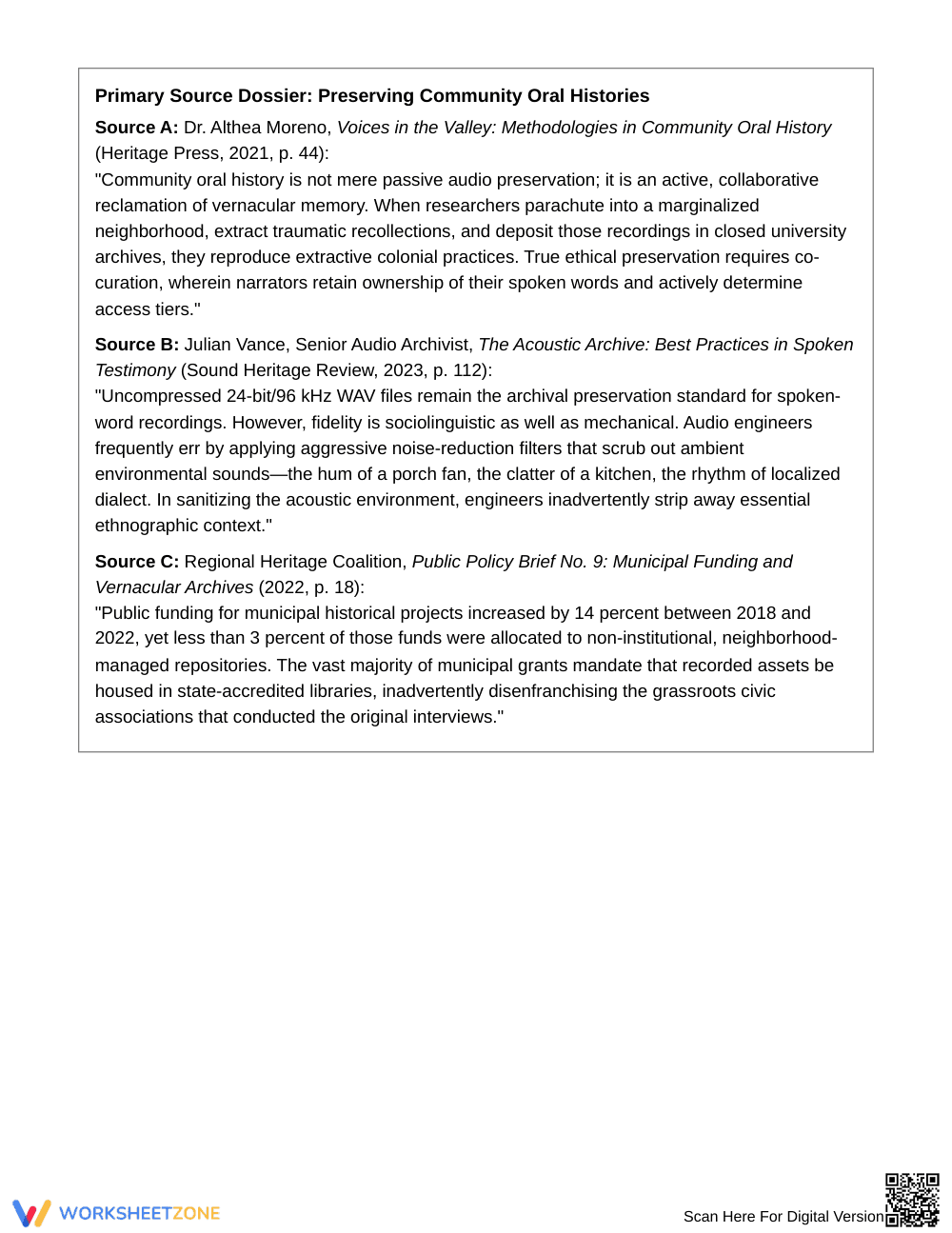
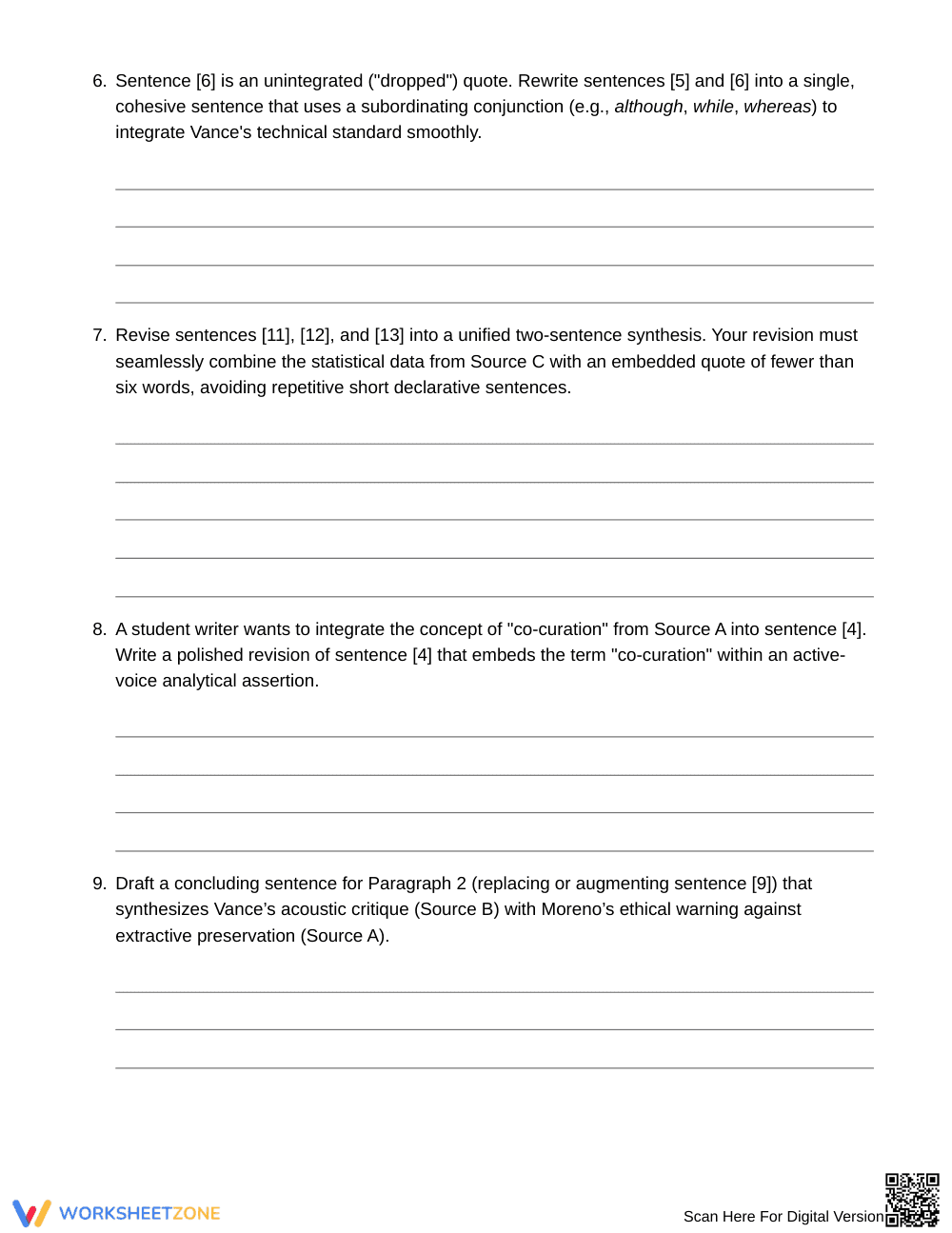
Across six structured pages, students examine an Academic Integration Framework, a three-source community history dossier, and a 14-sentence flawed student draft. The resource provides 12 rigorous tasks across diagnostic, revision, and analytical sections, supported by a 3-page answer key detailing model revisions and syntactic criteria.
Skill Progression
The activity moves through three distinct cognitive phases:
- Guided practice (Tasks 1–3): Students diagnose dropped quotations and patchwriting within the draft using the reference dossier.
- Supported practice (Tasks 4–9): Writers rewrite six flawed sentences by embedding short quotes and constructing original paraphrases.
- Independent practice (Tasks 10–12): Students evaluate competing revisions and defend citation necessity against common-knowledge claims.
This sequence follows the gradual-release model to ensure mastery before students write major term papers.
Standards Alignment
This worksheet aligns directly with W.11-12.8: Gather relevant information from authoritative sources, integrating material selectively to maintain flow while avoiding plagiarism and adhering to standard citation formats. Additionally, the revision analysis supports RI.11-12.1 through evidence-based textual evaluations. Both standard codes can be copied directly into lesson plans, IEP goals, or district curriculum mapping tools.
How to Use It
Assign this packet during the revision stage of an argumentative research unit following direct instruction on signal phrases. Alternatively, use it as a paired peer-review workshop. While circulating, verify whether students completely restructure sentence syntax rather than simply swapping synonyms. Expected completion time is 45 to 60 minutes.
Who It's For
Designed for Grade 11 English III and AP Language students writing evidence-based essays. Teachers can provide signal phrase frames for emerging writers or require active voice revisions for advanced learners. Pair this worksheet with an argumentative research rubric or an MLA style guide.
Mastering academic research writing requires explicit instruction in synthesizing external evidence, a core demand of standard W.11-12.8. Rather than treating citation solely as a mechanical exercise in bibliography formatting, secondary students must learn quotation integration, syntactic blending, and authentic paraphrasing to preserve their authorial voice. According to Fisher & Frey (2014), gradual release frameworks that guide students from diagnostic text analysis to independent sentence generation yield substantial gains in informational writing proficiency and disciplinary literacy. By diagnosing dropped quotations and patchwriting within a realistic student draft, 11th-grade learners confront common stylistic missteps in a low-stakes context. The scaffolded 12-task progression guides pupils to blend statistical evidence smoothly, embed concise quoted phrases, and defend their rhetorical justifications. This deliberate approach transforms quotation integration from passive compliance into an active, analytical habit that supports postsecondary writing readiness across academic domains.


