




























Views
Downloads



Proven Register & Distance Worksheet | Grade 10 English II

Paste this activity's link or code into your existing LMS (Google Classroom, Canvas, Teams, Schoology, Moodle, etc.).
Students can open and work on the activity right away, with no student login required.
You'll still be able to track student progress and results from your teacher account.
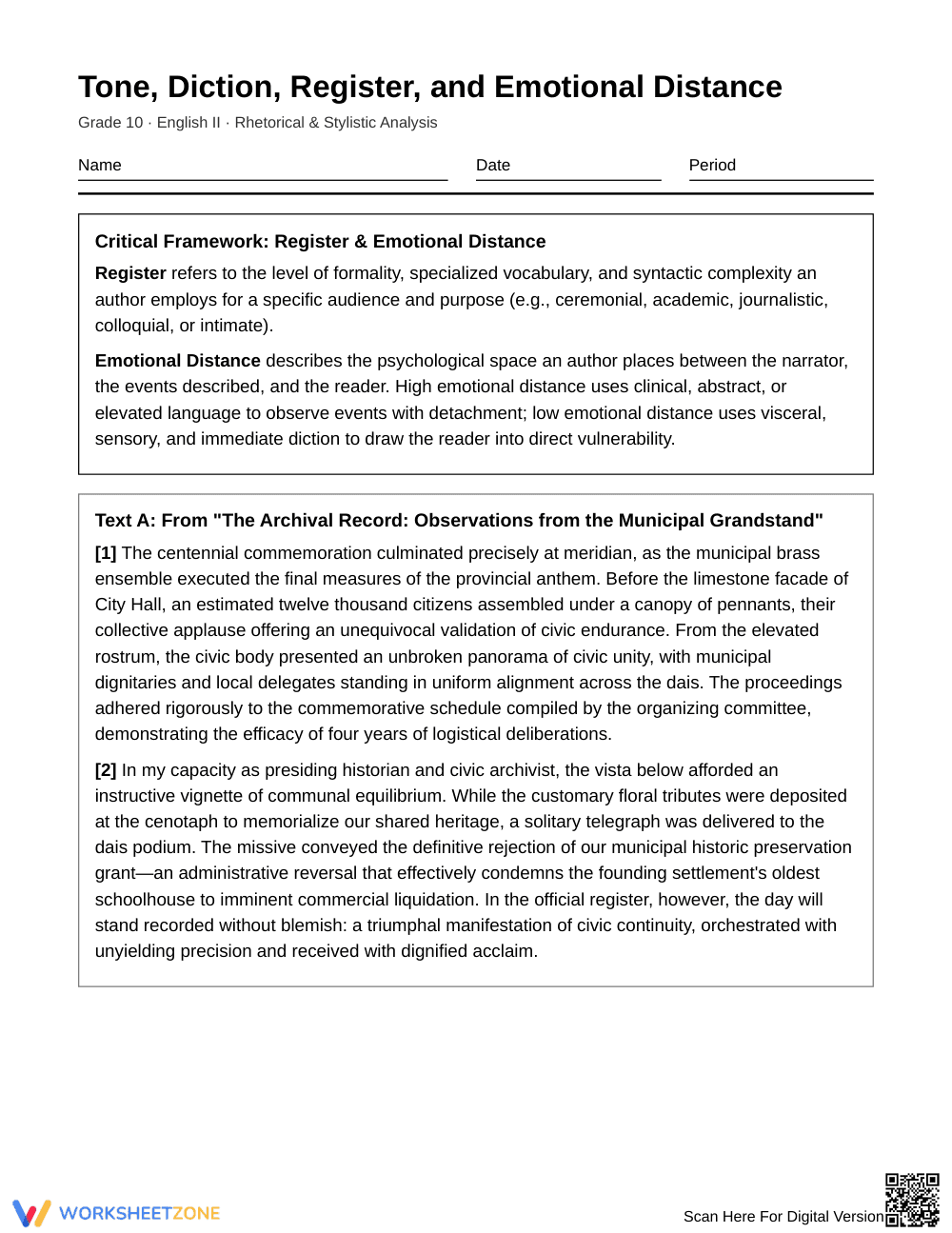
This Grade 10 rhetorical analysis worksheet equips students to compare register and emotional distance across contrasting non-fiction texts. Learners examine how formal language creates psychological detachment while concrete diction generates vulnerability. Through rigorous text-dependent questions, students evaluate how deliberate word choice and syntactic structures govern authorial perspective during a shared historical event.
At a Glance
- Grade: 10 · Subject: English II
- Standard:
RI.9-10.4— Analyze the impact of specific word choices on text tone- Skill Focus: Compare Register and Emotional Distance
- Format: 6 pages · 10 problems · Answer key included · PDF
- Best For: Paired-text rhetorical analysis practice
- Time: 45–60 minutes
What's Inside
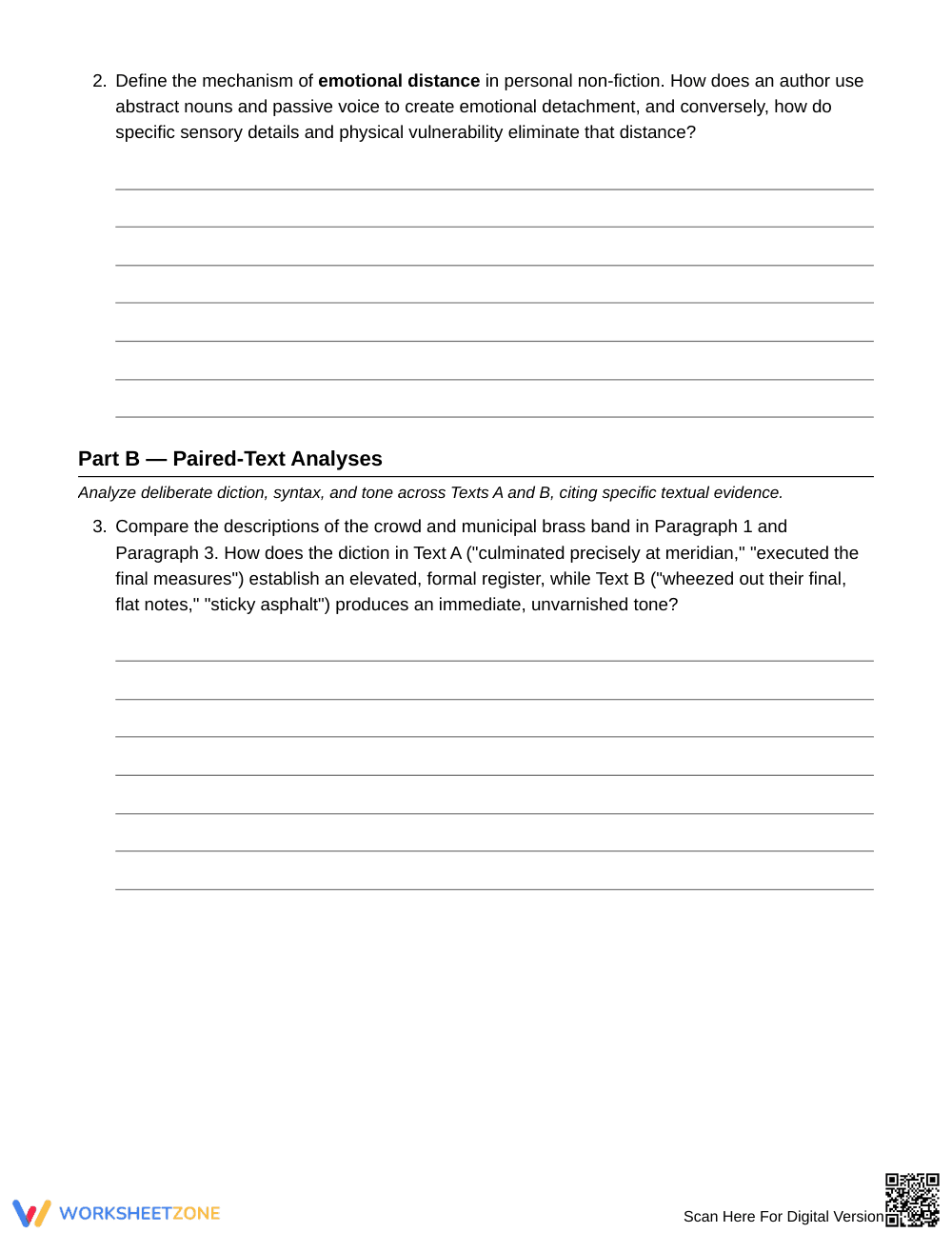
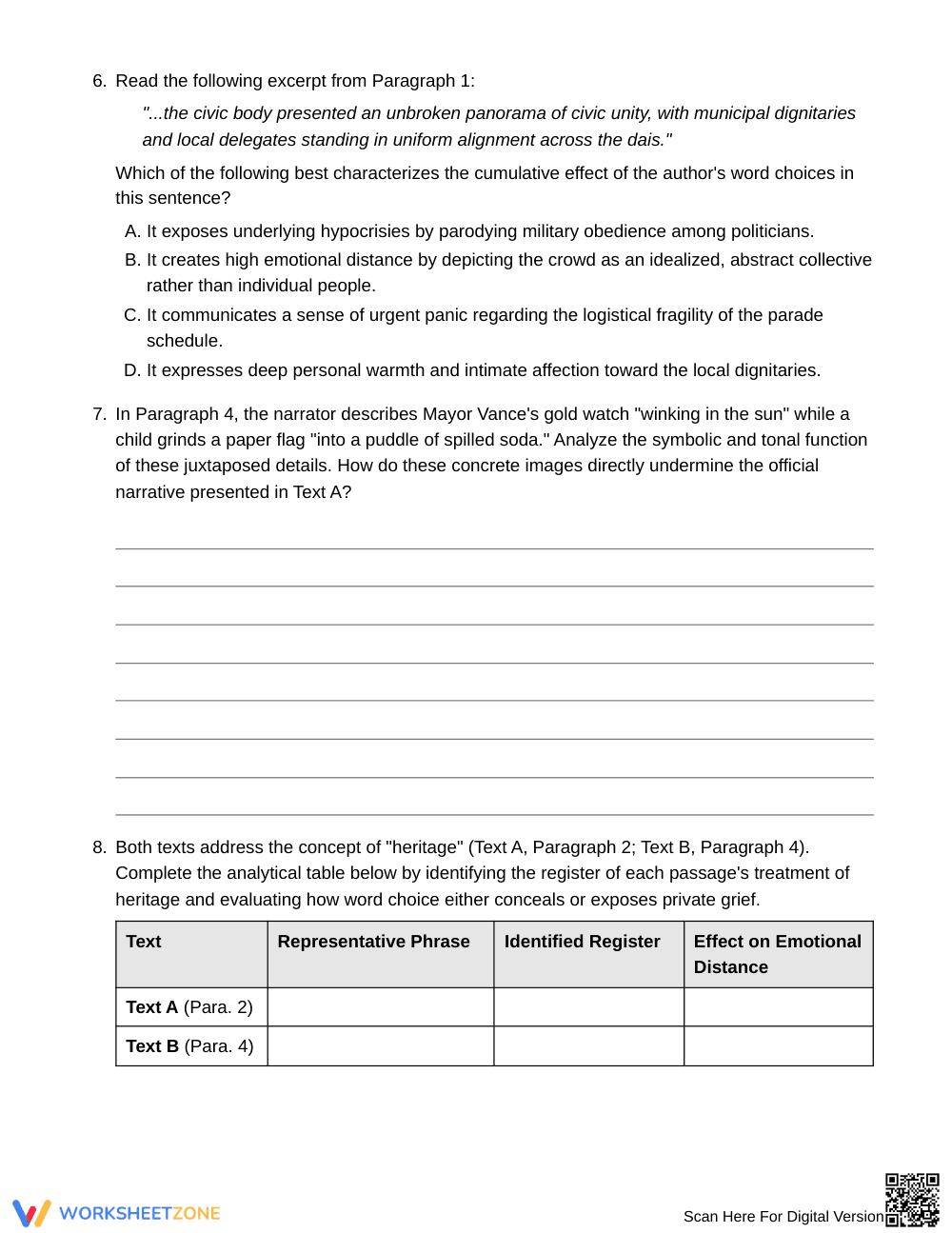
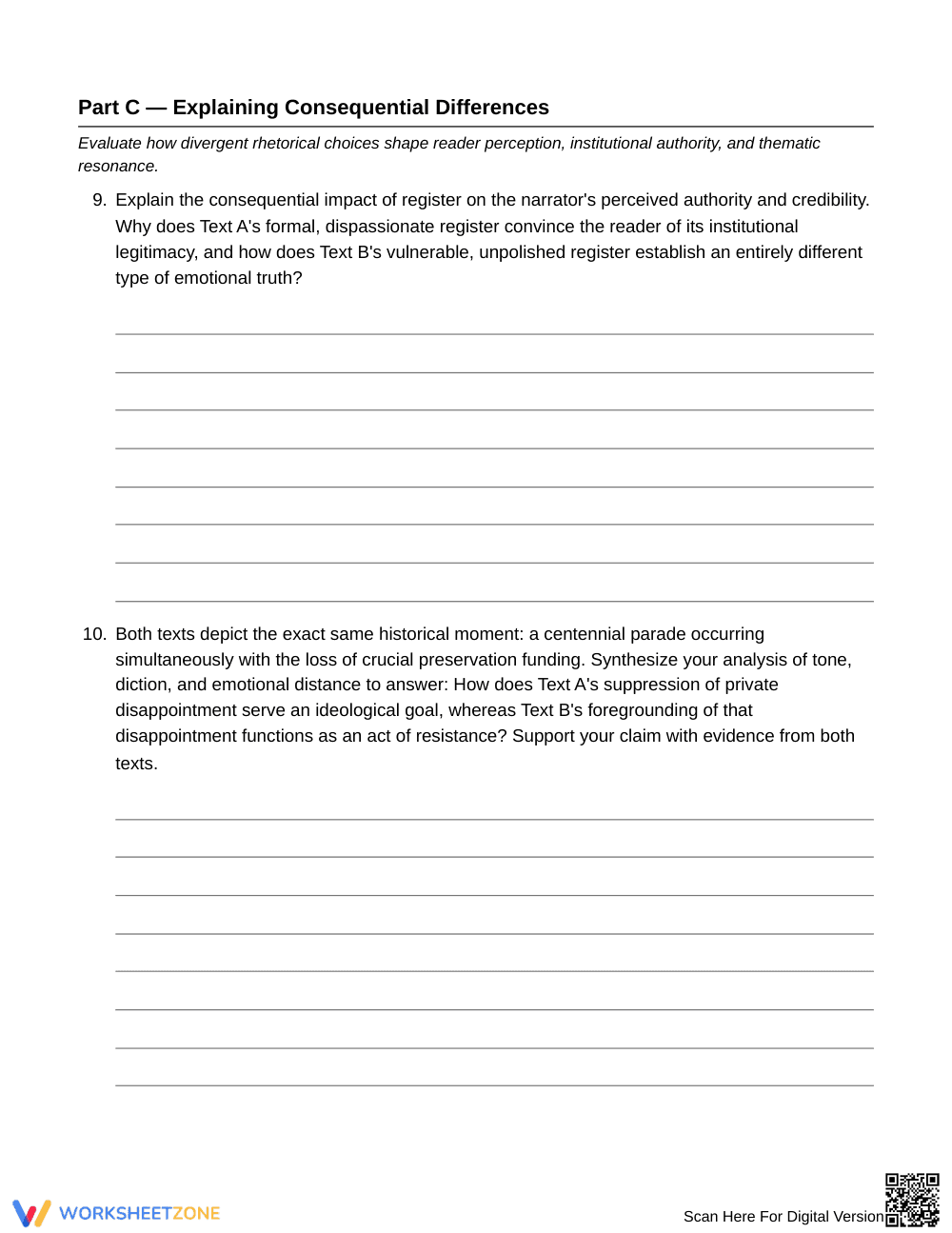
The 6-page printable resource pairs two contrasting non-fiction accounts of the same municipal centennial commemoration with 10 structured analytical items. Students begin by defining foundational rhetorical metrics before tackling short-answer queries, an evidence-based multiple-choice question, and a comparative alignment table. The document concludes with high-level evaluative prompts alongside a comprehensive 4-page annotated answer key containing exemplar student responses.
Skill Progression
- Guided practice (Tasks 1–2): Conceptual prompts establish explicit metrics for syntax, abstract diction, and emotional detachment before students analyze passages.
- Supported practice (Tasks 3–8): Six text-dependent items guide students through close-reading comparisons, spatial perspective analyses, tone identification, and an evidence table.
- Independent practice (Tasks 9–10): Two synthesis prompts challenge students to evaluate ideological motives, institutional legitimacy, and rhetorical resistance.
This gradual-release structure moves learners smoothly from conceptual grounding to scaffolded text dissection and independent rhetorical evaluation.
Standards Alignment
This resource aligns directly to `RI.9-10.4`: Determine the meaning of words and phrases as they are used in a text, including figurative, connotative, and technical meanings; analyze the cumulative impact of specific word choices on meaning and tone. It also reinforces `W.9-10.9` by requiring textual evidence to support analytical claims. Both standard codes can be copied directly into lesson plans, IEP goals, or district curriculum mapping tools.
How to Use It
Deploy this worksheet after direct instruction on authorial tone and register. In a collaborative analysis lesson, have student pairs complete Part B to trace narrator perspective before writing individual Part C responses. For formative assessment, review the comparative table in Task 8 to verify whether learners can distinguish institutional distance from personal vulnerability. Typical completion requires 45 to 60 minutes.
Who It's For
This worksheet serves Grade 10 English II students preparing for state standardized assessments and Advanced Placement English Language coursework. Scaffolds such as explicit conceptual frameworks assist developing readers, while complex parallel texts stretch advanced analytical thinkers. Pair this activity directly with an anchor chart detailing high, neutral, and low rhetorical registers.
According to Fisher & Frey (2014), scaffolded close reading of paired complex texts substantially increases secondary students' capacity to detect authorial stance and evaluate tone. This Grade 10 English II worksheet addresses standard RI.9-10.4 by requiring learners to compare register and emotional distance across two non-fiction perspectives detailing a single historical episode. By contrasting institutional detachment with immediate personal testimony, students systematically analyze how lexical precision and sentence architecture shape meaning. The resource moves from foundational definition through targeted text-dependent questions to extended synthesis, supporting rigorous mastery of rhetorical diction. Complete with a 4-page exemplar response key and 10 focused analytical tasks across 6 pages, this instructional document offers high school educators an authentic tool for teaching how subtle stylistic variations establish authority, subvert official narratives, and manipulate reader intimacy during non-fiction textual analysis.


