


























Views
Downloads



Proven Quote Integration Worksheet | Grade 11 English III
Paste this activity's link or code into your existing LMS (Google Classroom, Canvas, Teams, Schoology, Moodle, etc.).
Students can open and work on the activity right away, with no student login required.
You'll still be able to track student progress and results from your teacher account.
This quotation integration and paraphrasing worksheet trains Grade 11 English III students to identify and repair patchwriting, dropped quotations, and semantic distortions. Working with authentic oral history excerpts, learners evaluate flawed peer edits and craft academically rigorous sentences that preserve source fidelity and follow MLA style conventions.
At a Glance
- Grade: 11 · Subject: English III
- Standard: Strengthen writing by revising syntax, editing mechanics, and integrating textual evidence accurately
- Skill Focus: Repair Dropped Quotations and Patchwriting
- Format: 6 pages · 10 problems · Answer key included · PDF download
- Best For: Research essay revision and evidence integration practice
- Time: 45–60 minutes
What's Inside
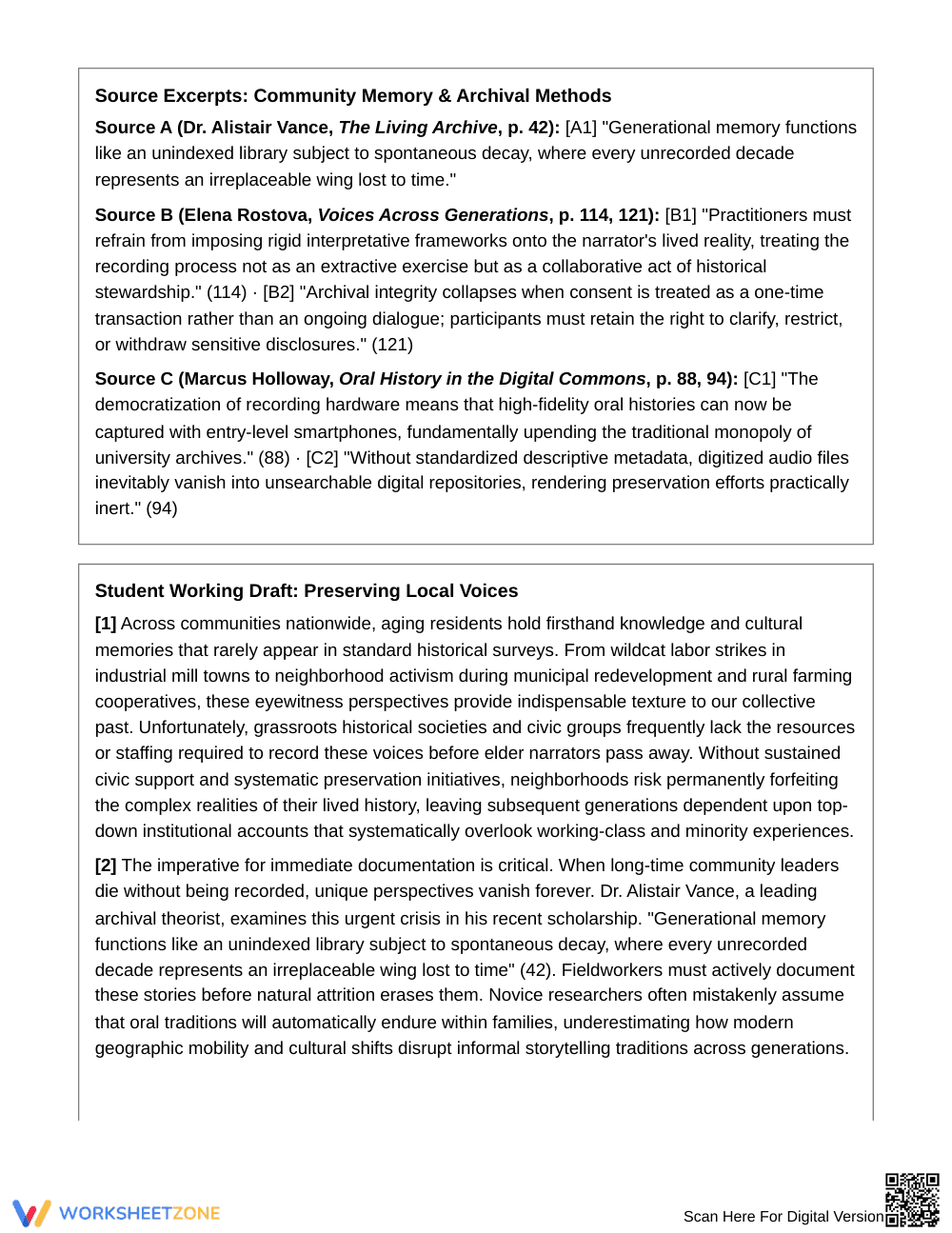
This 6-page resource includes a reference table defining core mechanics, three source excerpts on oral history preservation, and a realistic draft. Across 10 tasks, students analyze 5 flawed peer edits and rewrite each into an academically polished sentence. A 3-page answer key provides error explanations and model revisions.
Skill Progression
- Guided practice (Problems 1–3): Students consult the Core Integration Rules to diagnose patchwriting, dropped quotes, and distortions in peer drafts.
- Supported practice (Problems 4–5): Learners analyze syntactic inversion and uncredited borrowing, identifying subtle context mismatches between sources and revisions.
- Independent practice (Problems 6–10): Students synthesize diagnostic insights by drafting authentic paraphrases, framed quotes, and partial embeds in MLA format.
This structure uses gradual release to move learners from error detection to autonomous academic writing.
Standards Alignment
This worksheet aligns with high school writing standards requiring students to develop and strengthen writing by revising, editing, and integrating evidence while avoiding plagiarism. Both standard codes can be copied directly into lesson plans, IEP goals, or district curriculum mapping tools.
How to Use It
Deploy this activity during the revision phase of a research paper unit after direct instruction on signal phrases. In class, check Part A to ensure students distinguish synonym swapping from structural paraphrasing. Alternatively, assign Part B for peer revision pairs. Completion time is 45 to 60 minutes.
Who It's For
Designed for Grade 11 English III and AP Language students preparing for college research writing, this worksheet supports writers struggling with dropped quotes. Pair it with an anchor chart on MLA signal verbs or a lesson on syntactic blending.
Teaching high school writers to repair dropped quotations and eliminate patchwriting addresses a critical gap between basic source location and sophisticated academic synthesis. As documented by Fisher & Frey (2014), explicit instruction in syntactic modeling and guided error analysis enables secondary students to transition successfully from clumsy mechanical insertion to authentic, voice-preserving source integration. When learners evaluate peer-level drafting errors—such as uncredited borrowing, dropped quotes, and semantic distortion—they build metacognitive awareness of authorial voice and academic integrity. This 10-task worksheet reinforces rigorous evidence integration by combining explicit diagnostic analysis with targeted sentence-level rewriting. Grounded in research-backed gradual release principles, the resource supports eleventh-grade students in mastering MLA signal phrasing, original syntactic framing, and precise contextual fidelity, ensuring that evidence functions smoothly within scholarly arguments rather than interrupting prose flow or misrepresenting original research findings.


