




























Views
Downloads




Proven Plate Boundary Defense Worksheet | Grade 8 Science

Paste this activity's link or code into your existing LMS (Google Classroom, Canvas, Teams, Schoology, Moodle, etc.).
Students can open and work on the activity right away, with no student login required.
You'll still be able to track student progress and results from your teacher account.
This Grade 8 science worksheet equips students to evaluate synthetic geophysical data and defend tectonic boundary classifications through evidence-based reasoning. Learners analyze crustal density, topography, earthquake focal depths, and volcanic patterns to distinguish oceanic-continental subduction zones from continental collision belts while refuting alternative geological claims.
At a Glance
- Grade: 8 · Subject: Science
- Standard: Plate Tectonics — Analyze geological survey data to defend convergent boundary classifications
- Skill Focus: Defend a Boundary Classification
- Format: 5 pages · 8 problems · Answer key included · PDF
- Best For: Data-driven convergent boundary assessment
- Time: 45–60 minutes
What's Inside
This 5-page printable resource includes a synthetic dataset comparing two convergence zones across six geological parameters, followed by 8 targeted analysis prompts. Students reference crustal density benchmarks and cross-sectional data before tackling classification tasks and refutations. A comprehensive 3-page answer key provides complete mechanistic explanations for every prompt.
Skill Progression
- Guided practice (Part A, 2 tasks): Students isolate diagnostic survey observations from the comparative dataset, identifying specific topographic and volcanic indicators that distinguish subduction zones from collision margins under structured prompt framing.
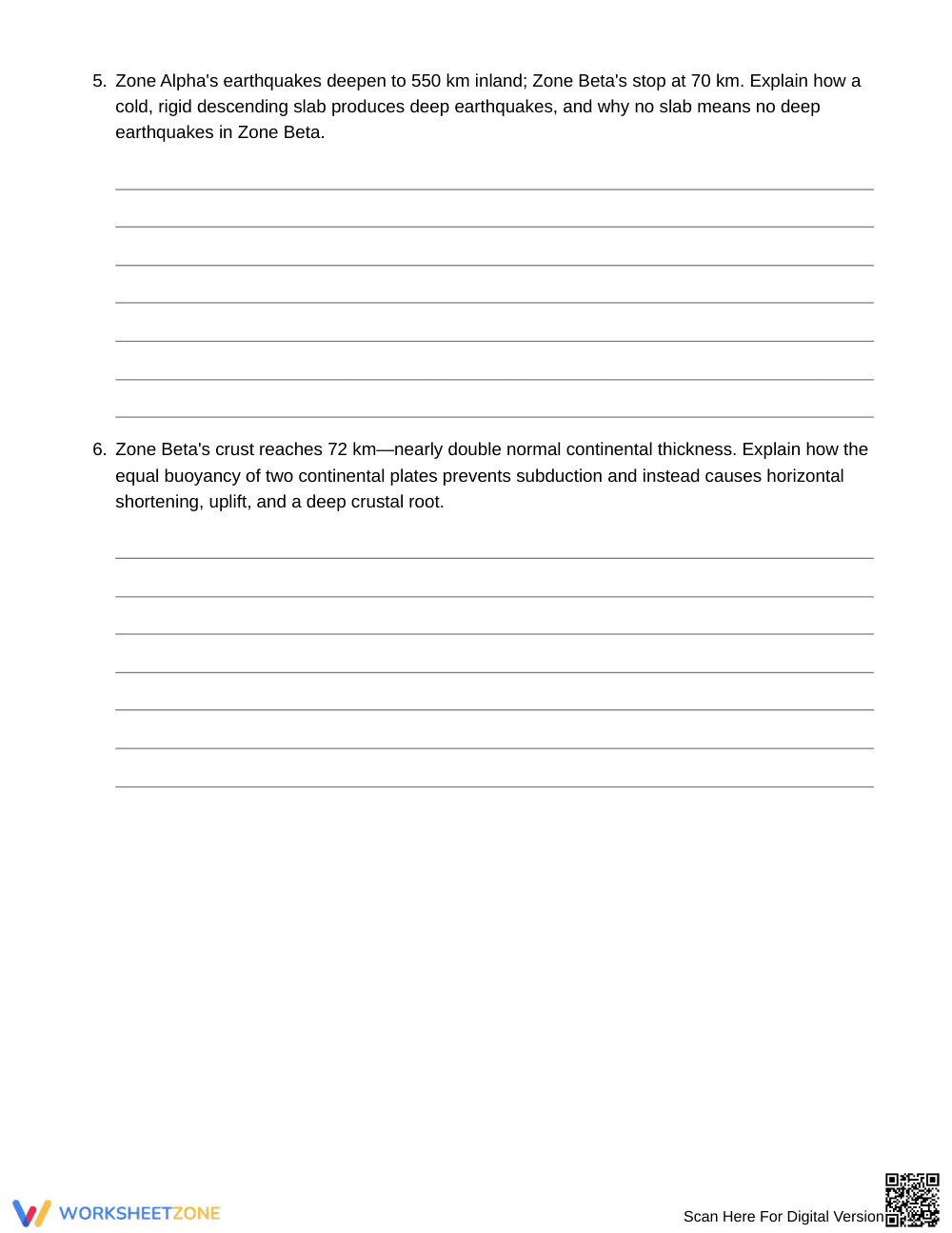
- Supported practice (Part B, 4 tasks): Learners link observable data to underlying physical mechanisms, connecting density differentials, slab-delivered water, and Benioff-zone seismicity to trench formation and partial melting.
- Independent practice (Part C, 2 tasks): Students independently refute competing tectonic claims by evaluating anomalous hypotheses against multi-variable empirical evidence.
This sequence follows the gradual-release framework, moving learners from guided data extraction to rigorous independent scientific argumentation.
Standards Alignment
This resource supports middle school Earth and space science standards addressing plate tectonics and large-scale system interactions. Students construct scientific explanations based on empirical evidence for how geoscience processes change Earth's surface at convergent margins. Both standard codes can be copied directly into lesson plans, IEP goals, or district curriculum mapping tools.
How to Use It
Implement this worksheet after direct instruction on convergent boundary dynamics, plate density, and subduction mechanics. For formative assessment, circulate during Part B to check whether students identify water-flux melting rather than frictional heating as the driver of subduction volcanism. The complete 8-task sequence requires 45 to 60 minutes of focused class time or paired scientific discourse.
Who It's For
This activity is designed for Grade 8 Earth science classes, introductory high school geology units, and students developing scientific argumentation skills. Sentence starters and reference density principles support emerging bilingual learners, while the competing claims in Part C challenge advanced thinkers. Pair this activity with an interactive plate tectonics simulation or seismic mapping cross-section.
Middle school science curricula frequently present plate tectonics as static vocabulary memorization rather than empirical model evaluation. This worksheet centers on the critical cognitive skill of defending a boundary classification by coordinating multiple lines of geological evidence. Students examine synthetic datasets featuring crustal thickness, earthquake depth profiles, and volcanic chemistry to justify tectonic models and dismantle flawed counterarguments. According to Fisher & Frey (2014), structured scaffolds that transition from evidence identification to mechanistic reasoning dramatically strengthen disciplinary literacy and student-led scientific discourse. By requiring students to articulate why dense oceanic lithosphere sinks while buoyant continental crust thickens into mountain roots, this resource embeds conceptual rigor into routine Earth science practice. The accompanying 3-page explanatory answer key clarifies common misconceptions regarding transform faults and volcanic arc elevations, providing educators with concrete diagnostic benchmarks for evaluating student explanations and claim refutations.


