


























Views
Downloads


Proven Permeability Evidence Worksheet | Grade 10 Biology
Paste this activity's link or code into your existing LMS (Google Classroom, Canvas, Teams, Schoology, Moodle, etc.).
Students can open and work on the activity right away, with no student login required.
You'll still be able to track student progress and results from your teacher account.
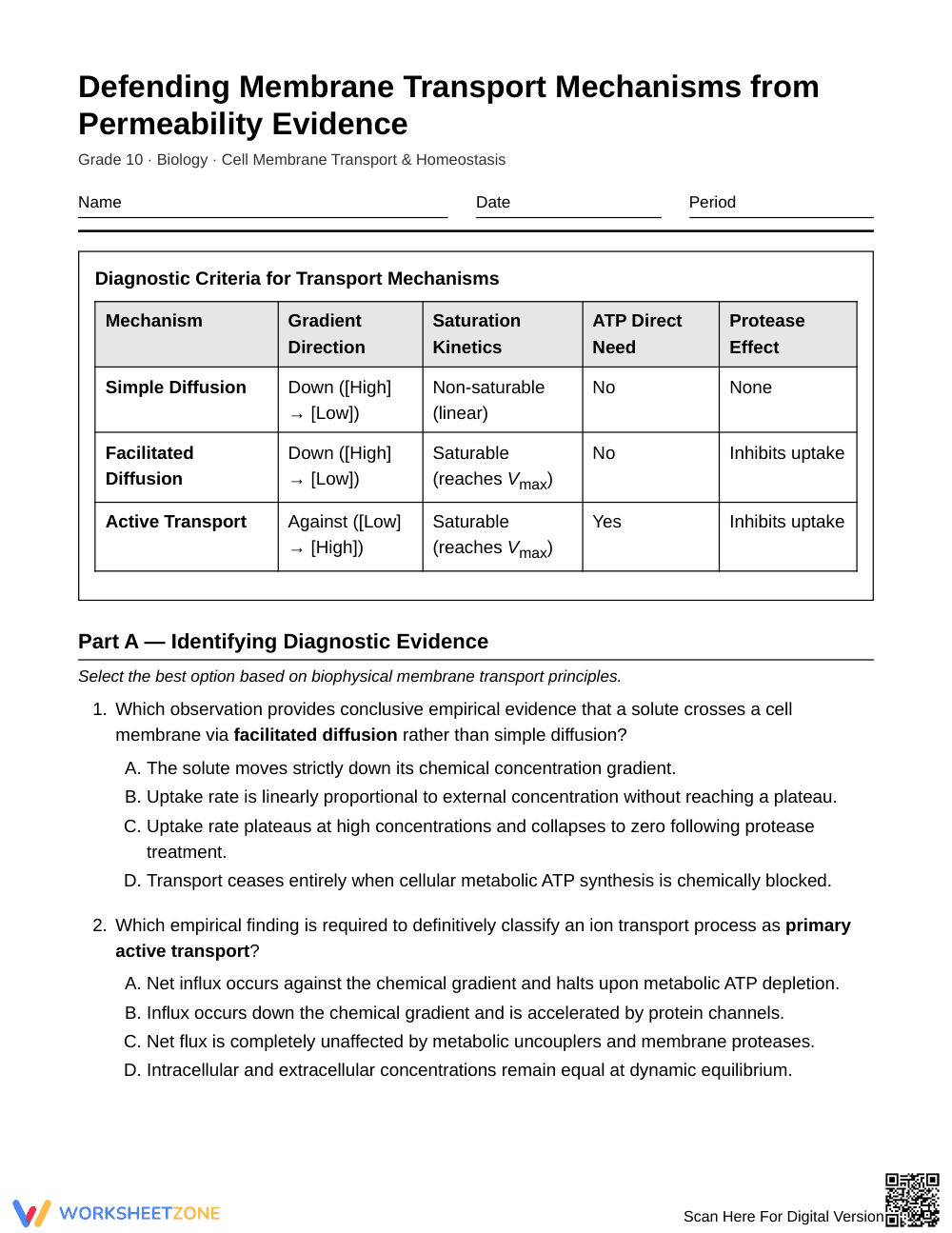
This Grade 10 biology worksheet guides students to defend membrane transport mechanisms using quantitative permeability data. Learners evaluate experimental assays to distinguish simple diffusion, facilitated diffusion, and active transport based on saturation kinetics, metabolic inhibitors, and protease sensitivity. Students translate empirical observations into rigorous scientific arguments that demonstrate a mastery of cell homeostasis.
At a Glance
- Grade: 10 · Subject: Biology
- Standard:
Cell Transport Standards— Defend membrane transport mechanisms using empirical permeability assay data- Skill Focus: Defend a Mechanism from Permeability Evidence
- Format: 4 pages · 8 problems · Answer key included · PDF
- Best For: High school cellular transport unit assessment
- Time: 45–50 minutes
What's Inside
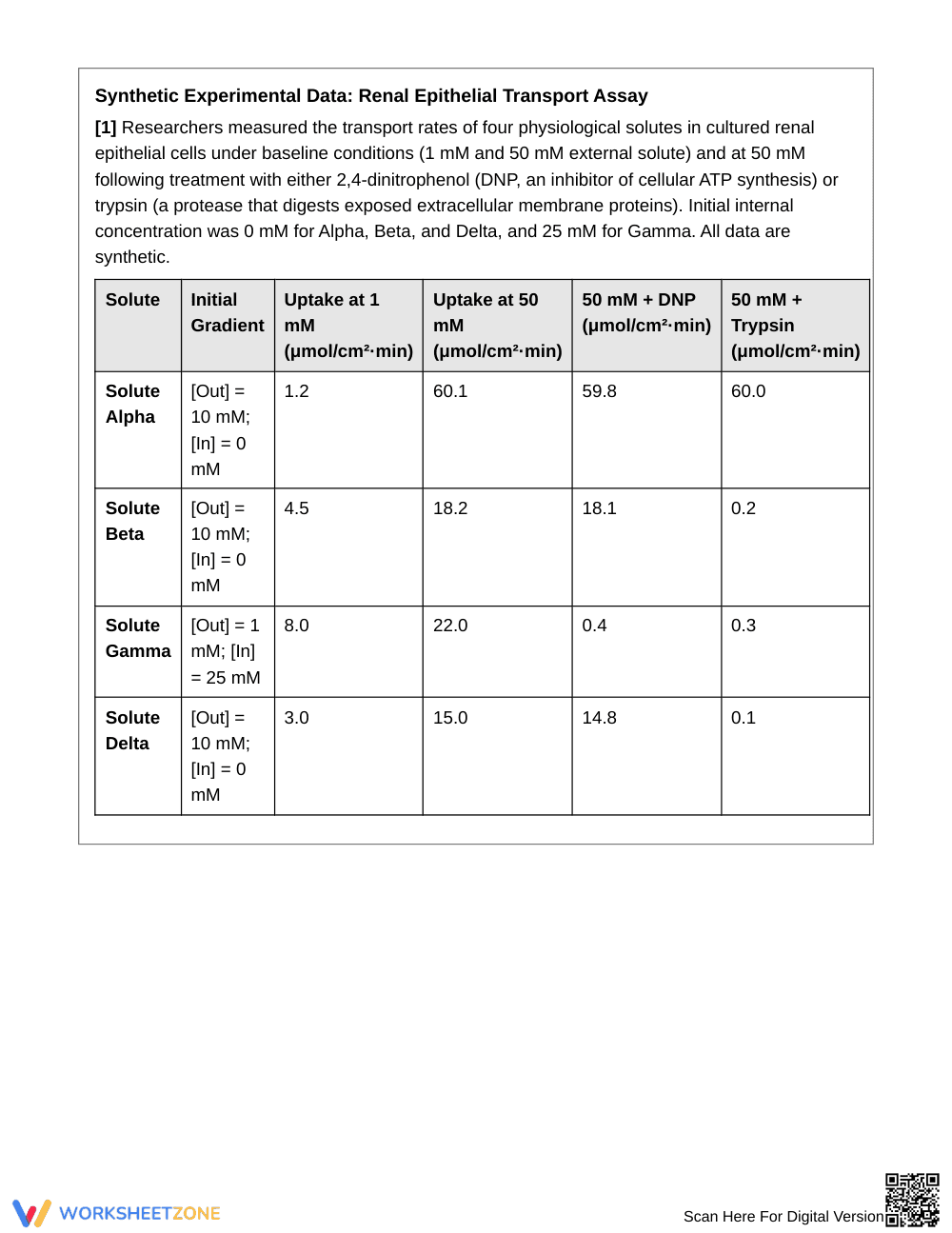
Across 4 instructional pages, students engage with 8 analytical tasks built around a diagnostic criteria reference matrix and synthetic renal epithelial transport assays. The activity incorporates multiple-choice diagnostic items, quantitative explanatory justifications, and error-analysis rebuttal prompts. A complete 3-page teacher answer key provides targeted benchmark explanations and numeric data citations for every item.
Skill Progression
- Guided Practice: Part A features 2 targeted items where students identify conclusive empirical diagnostic criteria using the provided biophysical mechanism reference table.
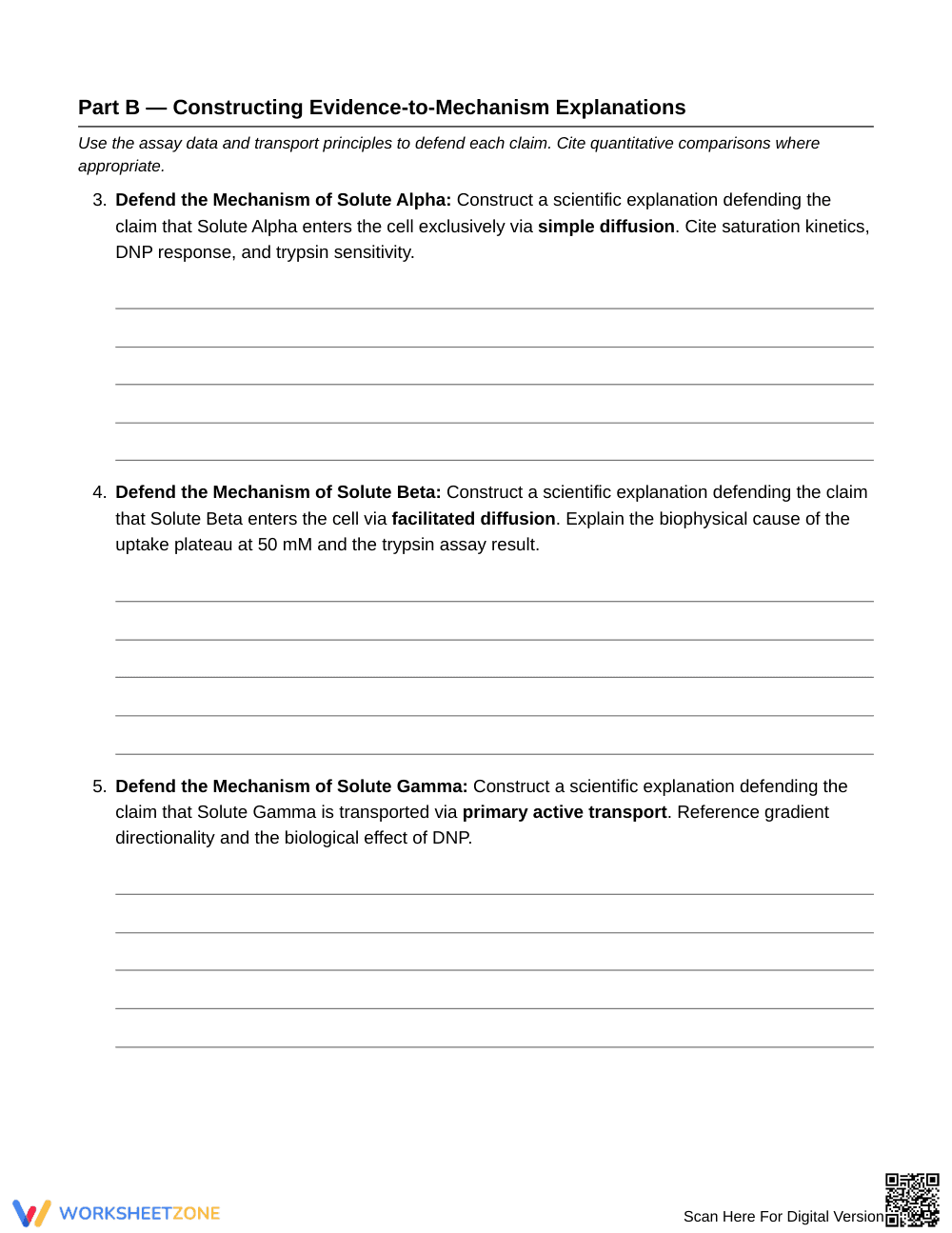
- Supported Practice: Part B presents 4 structured scientific explanations where students analyze tabular assay data across concentrations, DNP metabolic uncouplers, and trypsin protease treatments.
- Independent Practice: Part C challenges learners with 2 complex claim-refutation prompts requiring multi-variable evidence synthesis and rebuttal of kinetic misconceptions.
This scaffolded sequence follows the gradual-release model, transitioning students from foundational criteria recall to sophisticated, independent scientific justification.
Standards Alignment
This resource aligns with high school cell biology standards requiring students to develop and use models or empirical data to explain how cell membranes maintain homeostasis through active and passive transport. Both standard codes can be copied directly into lesson plans, IEP goals, or district curriculum mapping tools.
How to Use It
Deploy this worksheet after direct instruction on membrane structure and transport kinetics to solidify conceptual transfer. For formative assessment, observe whether students identify protease sensitivity in Solute Beta as evidence of protein-mediated transport rather than simple diffusion. Expect completion within 45 to 50 minutes of focused analytical classwork.
Who It's For
This worksheet serves general and honors Grade 10 Biology students mastering cellular transport mechanisms. Scaffolded tables support developing analytical readers, while advanced multi-variable refutations challenge high achievers. It pairs naturally with laboratory investigations of dialysis tubing osmolarity or membrane permeability modeling.
Membrane transport analysis represents a vital milestone in Grade 10 biological literacy. By analyzing kinetic saturation curves, metabolic uncouplers, and enzymatic digestion data, high school students learn to defend physiological transport mechanisms using robust quantitative evidence rather than rote memorization. According to Fisher & Frey (2014), structured argumentation and evidence-based justification in science classrooms significantly deepen conceptual retention and promote rigorous inquiry. This 4-page, 8-problem worksheet systematically builds analytical competency through guided release, moving from diagnostic criteria recognition to multi-point claim refutation. Grounded in state cell biology standards, the activity equips students to interpret empirical data, assess membrane permeability, and connect molecular transport directly to cellular homeostasis. Its structured design ensures that learners cultivate authentic scientific literacy while critically evaluating competing mechanistic claims. Such disciplined practice prepares tenth graders for advanced laboratory coursework and assessments requiring empirical defense.


