


























Views
Downloads




Proven Fraction Division Reasoning Worksheet | Grade 6 Math
Paste this activity's link or code into your existing LMS (Google Classroom, Canvas, Teams, Schoology, Moodle, etc.).
Students can open and work on the activity right away, with no student login required.
You'll still be able to track student progress and results from your teacher account.
This Grade 6 math worksheet guides students to conceptually justify why dividing by a fraction less than one produces a quotient larger than the dividend. Students evaluate claims, utilize measurement models, and construct counterexamples across 8 rigorous tasks to build structural reasoning about fraction operations.
At a Glance
- Grade: 6 · Subject: Math
- Standard:
6.NS.A.1— Compute and interpret quotients of fractions in mathematical problems- Skill Focus: Justify Why Division Can Increase a Number
- Format: 5 pages · 8 problems · Answer key included · PDF
- Best For: Conceptual fraction division mastery practice
- Time: 40–50 minutes
Across 5 instructional and solution pages, this resource delivers 8 structured analytical prompts. Students engage with measurement organizers, common denominator algorithms, reciprocal properties, and unit rate models. A complete 2-page answer key provides full step-by-step mathematical justifications and conceptual proofs for every problem.
Skill Progression
- Guided practice (Part A — 2 tasks): Students evaluate common misconceptions by testing numerical claims like 4 ÷ 1/3 to show why division does not always reduce value.
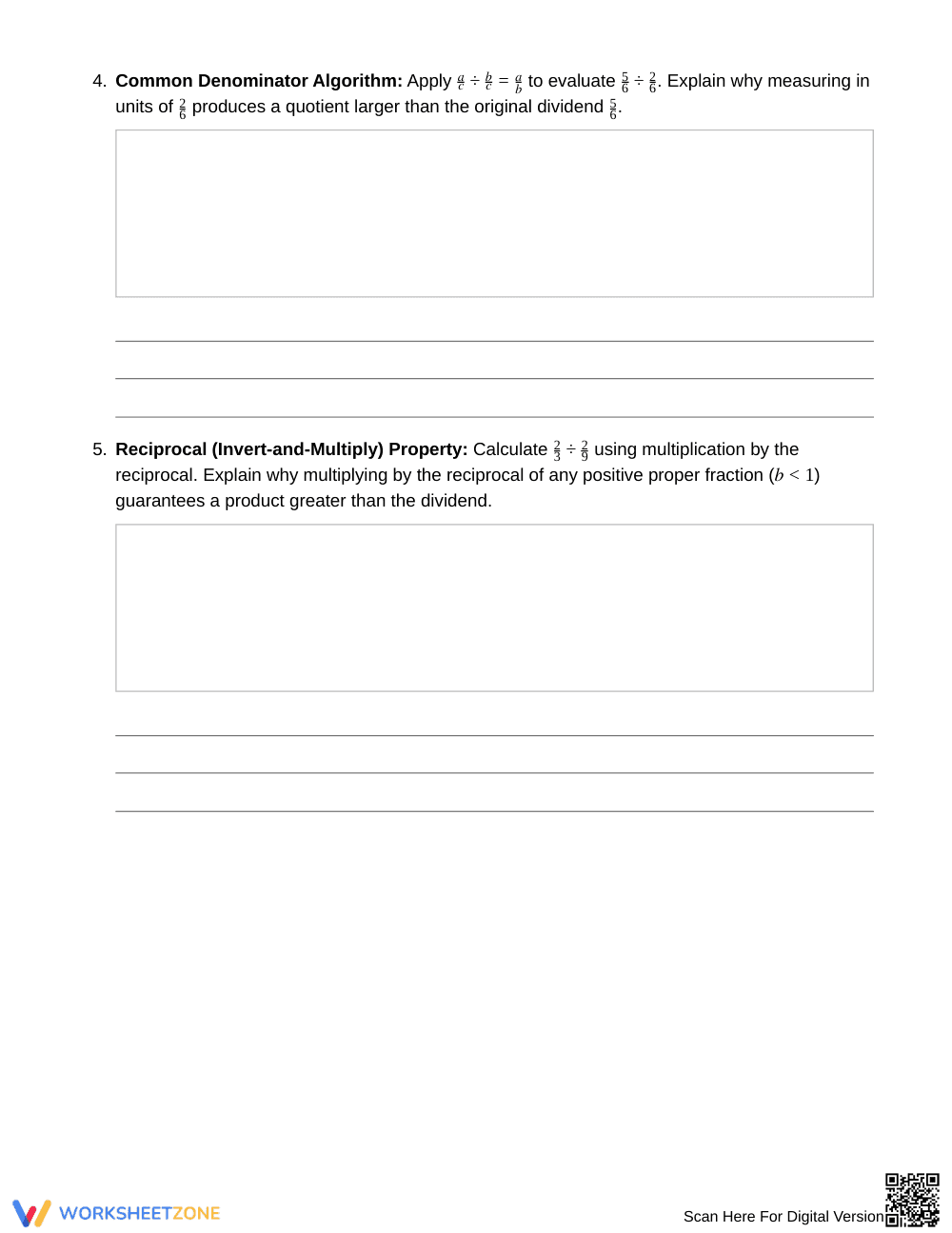
- Supported practice (Part B — 4 tasks): Learners apply measurement organizers, common denominators, unit rates, and reciprocal scaling to prove why dividing by proper fractions yields larger quotients.
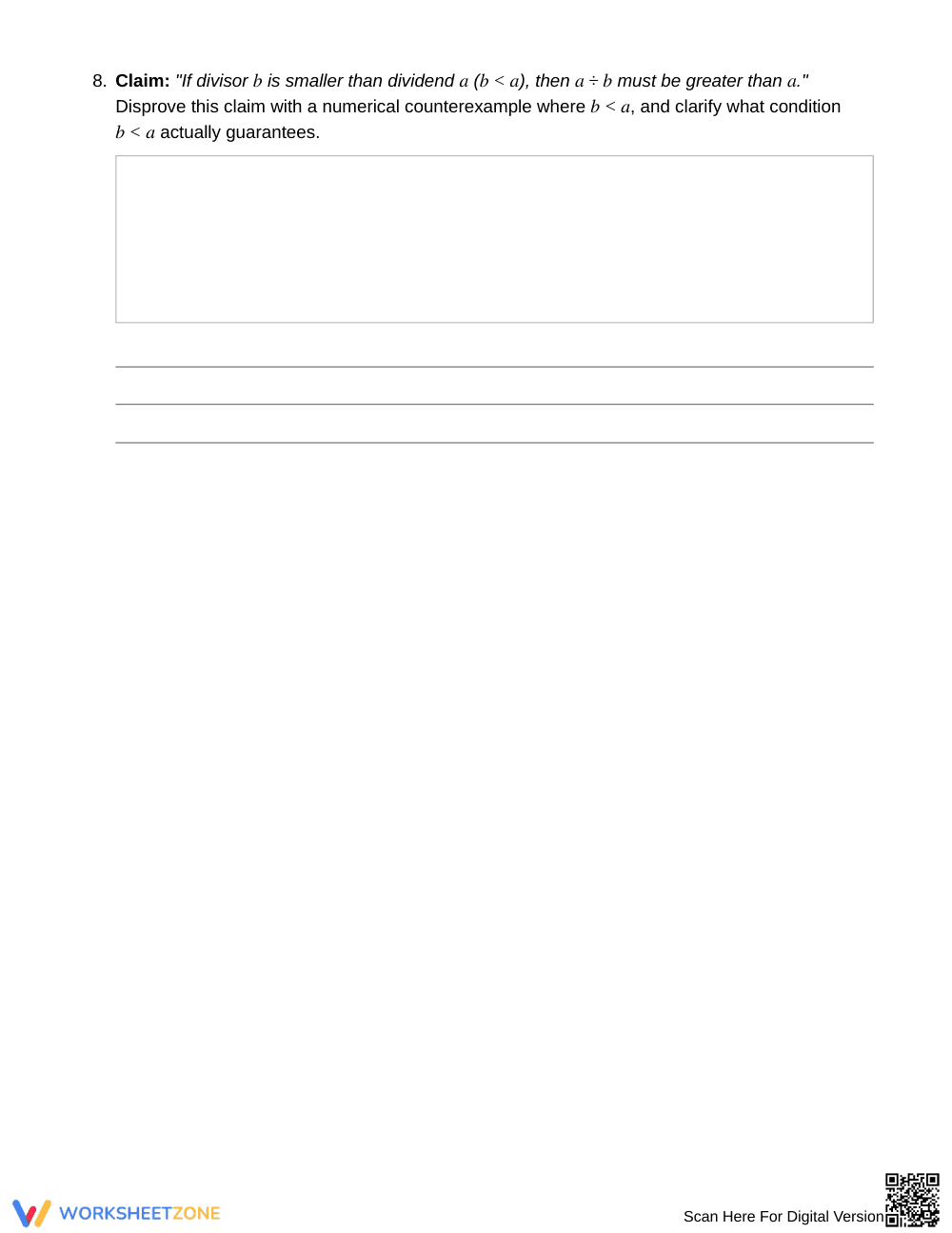
- Independent practice (Part C — 2 tasks): Students formulate counterexamples and algebraic conditions to define when division increases a value.
This structured sequence utilizes the gradual-release framework to move students from guided claim evaluation to independent mathematical justification.
Standards Alignment
Primary Standard: 6.NS.A.1 — Interpret and compute quotients of fractions, and solve word problems involving division of fractions. Supporting alignment includes mathematical practice standards MP3 (Construct viable arguments) and MP7 (Look for structure). Both standard codes can be copied directly into lesson plans, IEP goals, or district curriculum mapping tools.
How to Use It
Deploy this worksheet after initial direct instruction on fraction division algorithms. Students work in pairs on Part B's multi-model proofs to articulate their reasoning. For formative assessment, check whether students explain divisor group size rather than merely computing answers in Part A. Expected completion time is 40 to 50 minutes.
Who It's For
This worksheet is ideal for Grade 6 math classrooms, advanced Grade 5 students, and Tier 2 intervention groups addressing fraction operation misconceptions. Pair this resource with visual fraction tiles or a number line lesson to reinforce measurement division concepts.
According to Fisher & Frey (2014), structured mathematical tasks that transition from concrete claim analysis to independent justification foster durable conceptual understanding and prevent persistent algorithmic misunderstandings. Standard 6.NS.A.1 requires Grade 6 learners to interpret and compute quotients of fractions, moving beyond rote procedural execution to explain what division means conceptually in real-world and mathematical contexts. When students examine why dividing a positive dividend by a proper fraction less than one scales the value upward, they engage deeply with the multiplicative relationship between group sizes, units, and reciprocals. This worksheet provides intentional scaffolding across multiple representations—including measurement subdivision models, common denominators, and reciprocal properties—enabling students to construct robust mathematical arguments and counterexamples. Systematic practice with these 8 targeted justification prompts equips learners to internalize foundational number sense principles that directly support rational number mastery and future algebraic thinking.


