




























Views
Downloads




Proven Expansion Claims Worksheet | Grade 12 Science

Paste this activity's link or code into your existing LMS (Google Classroom, Canvas, Teams, Schoology, Moodle, etc.).
Students can open and work on the activity right away, with no student login required.
You'll still be able to track student progress and results from your teacher account.
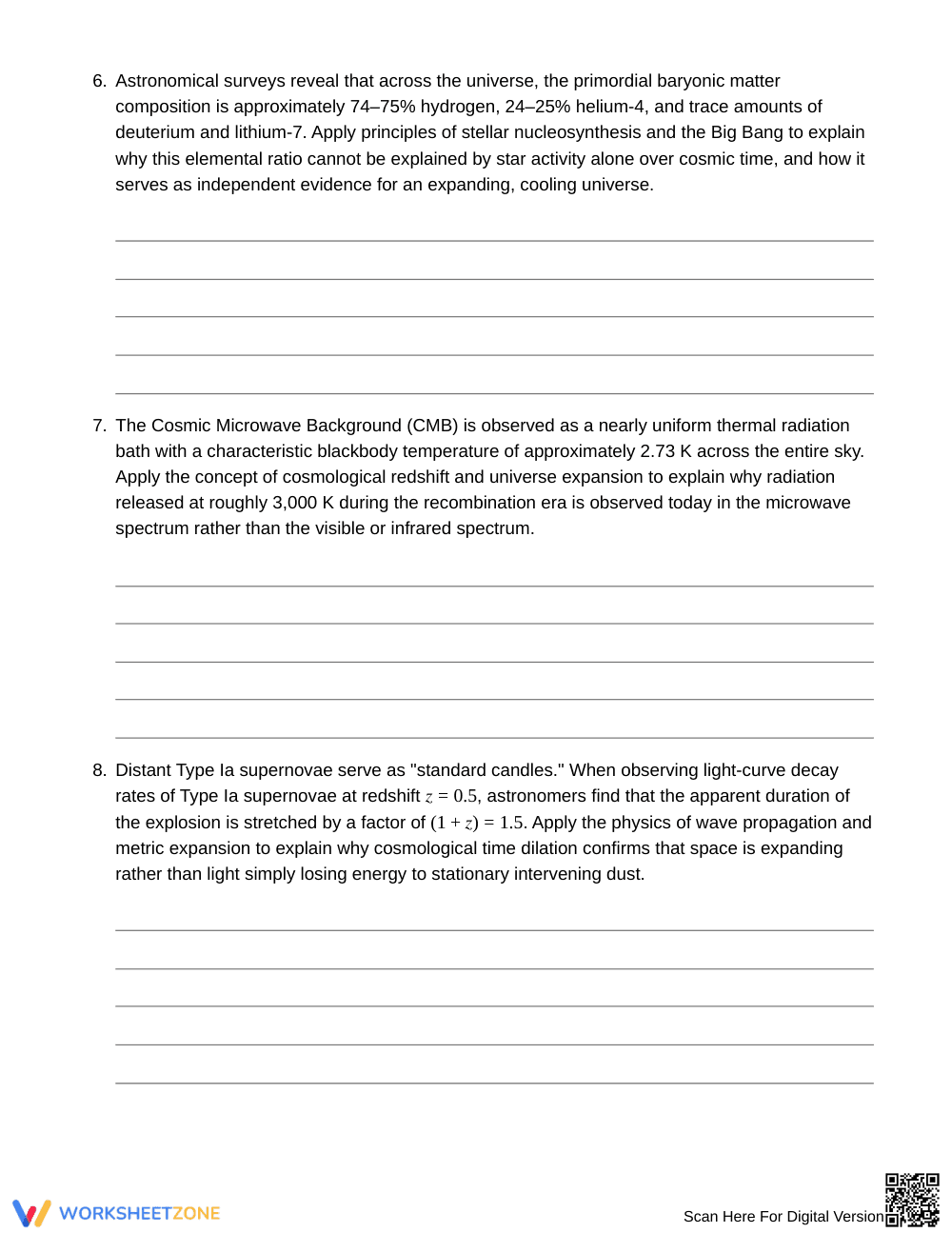
This Grade 12 Earth and space science worksheet guides students to critically evaluate scientific claims regarding cosmological metric expansion and Big Bang theory. High school seniors analyze spectroscopic redshift data, apply Hubble's Law, and critique non-standard cosmological models using multiple converging lines of empirical evidence, including cosmic background radiation and primordial nucleosynthesis.
At a Glance
- Grade: 12 · Subject: Earth & Space Science
- Standard: Advanced Earth & Space Sciences — Evaluate observational evidence supporting cosmological expansion models
- Skill Focus: Evaluate an Expansion-Evidence Claim
- Format: 5 pages · 10 problems · Answer key included · PDF
- Best For: Advanced astronomy and physics units
- Time: 45–60 minutes
What's Inside
Across 5 print-ready student pages, learners encounter 10 rigorous analytical tasks organized into three distinct parts. The resource provides complete reference formulas, physical constants, and laboratory wavelength benchmarks for hydrogen-alpha and calcium absorption lines. Students work through bounded spectroscopic data sets to calculate redshift parameters and proper recession distances before critiquing an alternative steady-state hypothesis. A comprehensive 5-page answer key provides complete mathematical solutions and model scientific arguments.
Skill Progression
- Guided practice (Part A, 2 tasks): Students examine foundational theoretical boundaries, identifying why linear Doppler velocity approximations break down at high redshifts and why local gravitational binding produces blueshifted spectra in nearby galaxies without contradicting cosmic expansion.
- Supported practice (Part B, 6 tasks): Learners apply Hubble's Law to synthetic deep-field spectroscopic surveys, calculate recession metrics, correlate redshift magnitude with cosmic lookback time, and connect light-element nucleosynthesis with cosmic microwave background data.
- Independent practice (Part C, 2 tasks): Working without prompts, students construct a multi-faceted critique of a static universe tired-light model, leveraging supernova time dilation and empirical spectra to demonstrate why redshift alone cannot substantiate the Big Bang without converging cosmic evidence.
This structured sequence follows a gradual-release architecture, transitioning students from formulaic physics constraints to sophisticated, multi-evidence scientific argumentation.
Standards Alignment
This resource aligns with high school Earth and space science standards requiring students to evaluate astronomical evidence of the Big Bang, including galactic red shifts, cosmic light-element abundances, and cosmic microwave background radiation. Standard descriptions can be copied directly into lesson plans, IEP goals, or district curriculum mapping tools.
How to Use It
Assign this worksheet after direct instruction on Hubble's Law and cosmological redshift as a summative analysis activity. During completion, conduct formative checks on whether students mistakenly treat cosmological expansion as physical velocity through static space rather than metric coordinate stretching. The full 10-task set occupies 45 to 60 minutes of active classroom work.
Who It's For
Designed for Grade 12 students in Earth and Space Science, AP Physics, or high school Astronomy courses, this activity offers rigorous data analysis for college-bound learners. Pair this worksheet directly with astronomical spectrogram charts or telescope deep-field imagery to anchor theoretical mathematics in visible astronomical observations.
According to Fisher & Frey (2014), structured progression frameworks that scaffold complex analytical tasks allow secondary students to synthesize difficult disciplinary evidence into coherent, evidence-based scientific evaluations. This 10-problem instructional worksheet equips twelfth-grade students to evaluate expansion-evidence claims by systematically linking laboratory spectral baselines, recession calculations, and cosmic background temperature observations. Rather than treating cosmological principles as disconnected formulas, learners actively coordinate multiple observational datasets to refute unscientific alternative models. The included 5-page teacher answer key provides full mathematical verification steps and exemplar scientific critiques, ensuring educators can evaluate student reasoning with absolute precision across high school physics and astronomy units.


