


























Views
Downloads



Proven DNA Replication Models Worksheet | Grade 10 Biology
Paste this activity's link or code into your existing LMS (Google Classroom, Canvas, Teams, Schoology, Moodle, etc.).
Students can open and work on the activity right away, with no student login required.
You'll still be able to track student progress and results from your teacher account.
This Grade 10 molecular genetics worksheet trains students to evaluate theoretical predictions against empirical data across competing models of DNA replication. Learners predict isotopic duplex structures, assess experimental controls from the Meselson-Stahl experiment, and calculate generation band densities to falsify conservative and dispersive hypotheses while proving semiconservative replication.
At a Glance
- Grade: 10 · Subject: Biology
- Standard: Molecular Genetics — Evaluate competing scientific models of DNA replication using quantitative isotopic data
- Skill Focus: Compare Replication Model Predictions
- Format: 5 pages · 10 problems · Answer key included · PDF
- Best For: Meselson-Stahl inquiry and molecular genetics review
- Time: 45–60 minutes
What's Inside
This comprehensive five-page resource features ten rigorous molecular genetics tasks organized into three analytical parts. It includes explicit reference definitions for semiconservative, conservative, and dispersive models, synthetic nitrogen isotope (15N and 14N) template sequences, centrifuge density gradient scenarios, and a complete three-generation quantitative data table. A three-page explanatory answer key provides complete nucleotide sequences, density band ratios, and evidence-based justifications for immediate grading.
Skill Progression
- Guided Practice (Part A, Problems 1–2): Students apply base-pairing rules and the 5′ to 3′ antiparallel directionality rule to trace heavy and light nitrogen isotopes through round one replication, establishing baseline model predictions.
- Supported Practice (Part B, Problems 3–8): Learners evaluate experimental variables within cesium chloride centrifugation, predict density band positions across successive generations, and complete comparative decision tables analyzing intermediate hybrid bands.
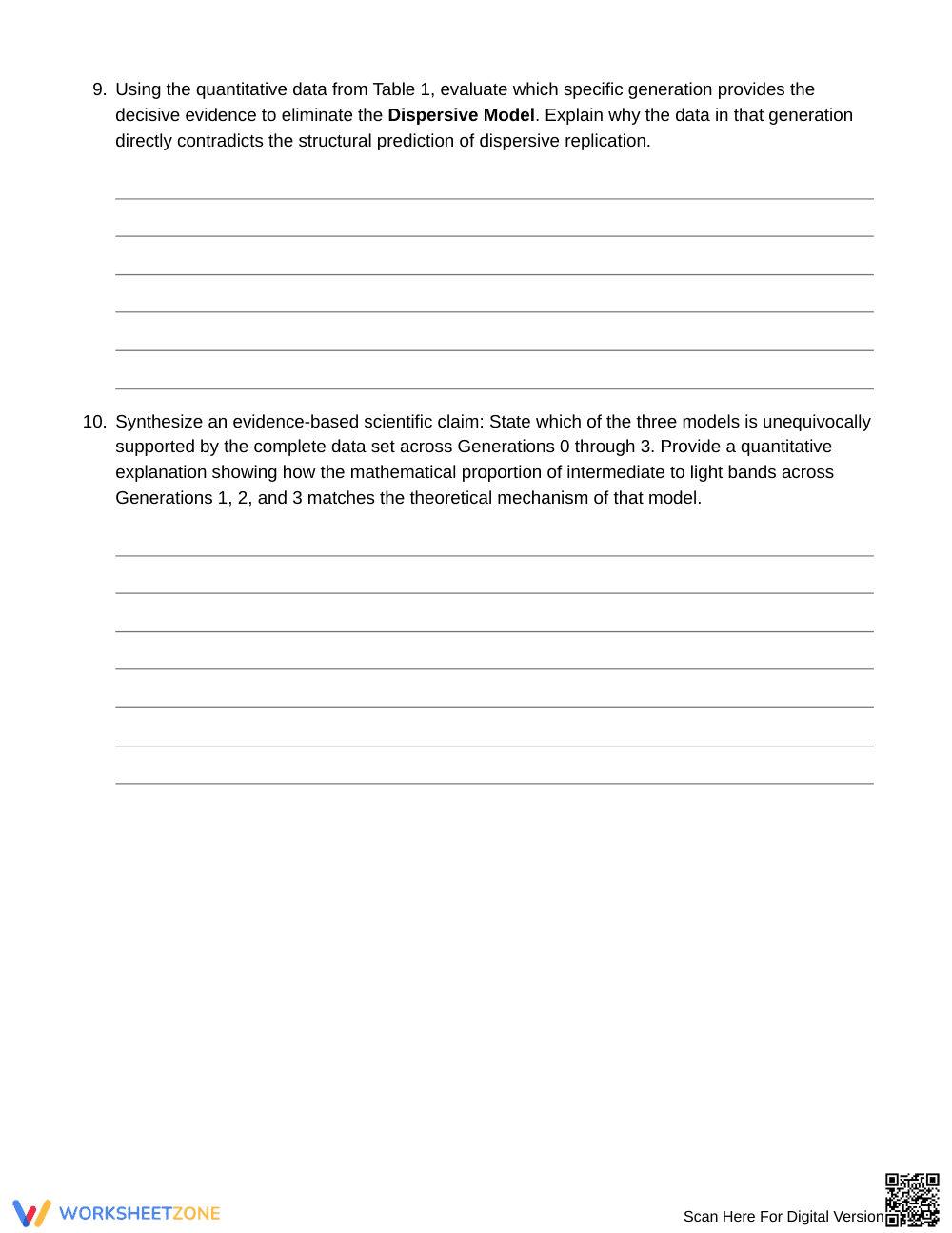
- Independent Practice (Part C, Problems 9–10): Students synthesize empirical evidence from a multi-generation quantitative density table to systematically falsify alternative hypotheses and construct an evidence-based claim for semiconservative replication.
This structured progression reflects the gradual-release instructional model, moving learners systematically from foundational strand modeling to complex empirical hypothesis testing.
Standards Alignment
This activity aligns with high school molecular biology curriculum standards requiring students to construct explanations of DNA synthesis and analyze the historical evidence that established the semiconservative mechanism. Students demonstrate how scientific models change when subjected to rigorous experimental data, directly supporting scientific inquiry benchmarks. Both standard codes can be copied directly into lesson plans, IEP goals, or district curriculum mapping tools.
How to Use It
Deploy this worksheet after direct instruction on DNA structure and polymerase directionality, either as the core analysis activity during a Meselson-Stahl lesson or as targeted test preparation before an advanced genetics assessment. During independent work, conduct a brief formative check on Problem 5: verify whether students correctly identify that a single intermediate band after Generation 1 rules out conservative replication but remains consistent with both dispersive and semiconservative models. Allocate 45 to 60 minutes for student completion.
Who It's For
Designed for tenth-grade general biology, honors biology, and introductory AP Biology students, this resource includes a foundational rule box to support emerging learners while challenging advanced students with rigorous quantitative data analysis. Pair this practice with an interactive density-gradient animation or a physical tube-banding demonstration to reinforce spatial visualization.
Fisher & Frey (2014) highlight that structured problem sets utilizing gradual-release frameworks significantly enhance high school students' ability to evaluate competing scientific claims. This Grade 10 genetics resource operationalizes that research by guiding learners through 10 sequenced analytical tasks to compare replication model predictions. By juxtaposing theoretical models against centrifuge density data, students build deep conceptual understanding of antiparallel synthesis and isotope tracing. The included three-page key provides complete molecular structures, isotopic labels, and explanatory rationales, giving secondary educators a scientifically rigorous assessment asset that requires no extra preparation time.


