


























Views
Downloads


Proven Decomposition Methods Worksheet | Grade 10 Geometry
Paste this activity's link or code into your existing LMS (Google Classroom, Canvas, Teams, Schoology, Moodle, etc.).
Students can open and work on the activity right away, with no student login required.
You'll still be able to track student progress and results from your teacher account.
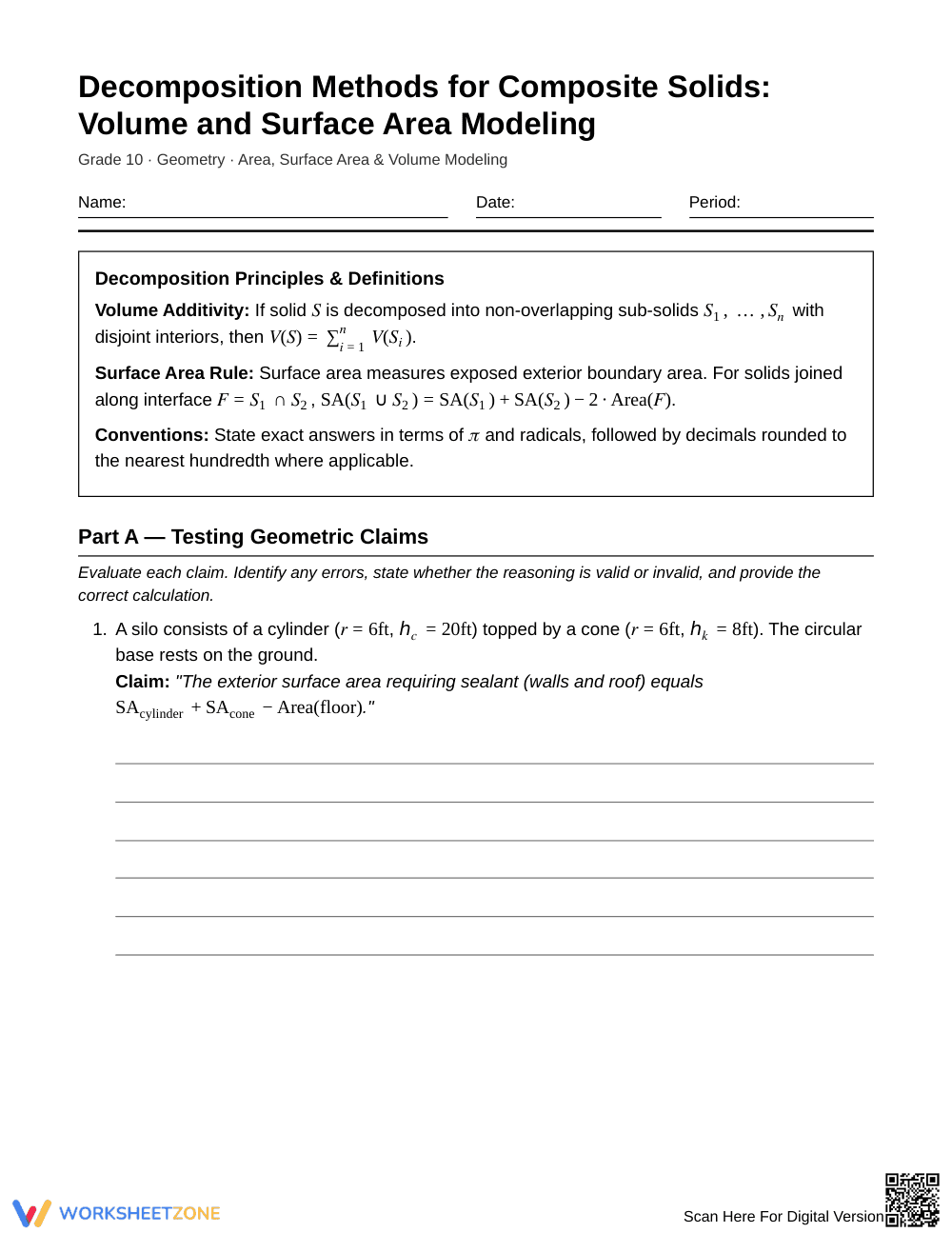
This Grade 10 geometry worksheet equips students to justify and calculate composite solid volume and surface area. Learners evaluate geometric claims, verify additive and subtractive decomposition models, and construct counterexamples, building the mathematical reasoning required to solve spatial problems with precision.
At a Glance
- Grade: 10 · Subject: Geometry
- Standard: HS Geometry — Justify volume additivity and exterior surface area for composite solids
- Skill Focus: Justify a Decomposition Method
- Format: 5 pages · 8 problems · Answer key included · PDF
- Best For: High school geometry composite solids unit
- Time: 45–60 minutes
What's Inside
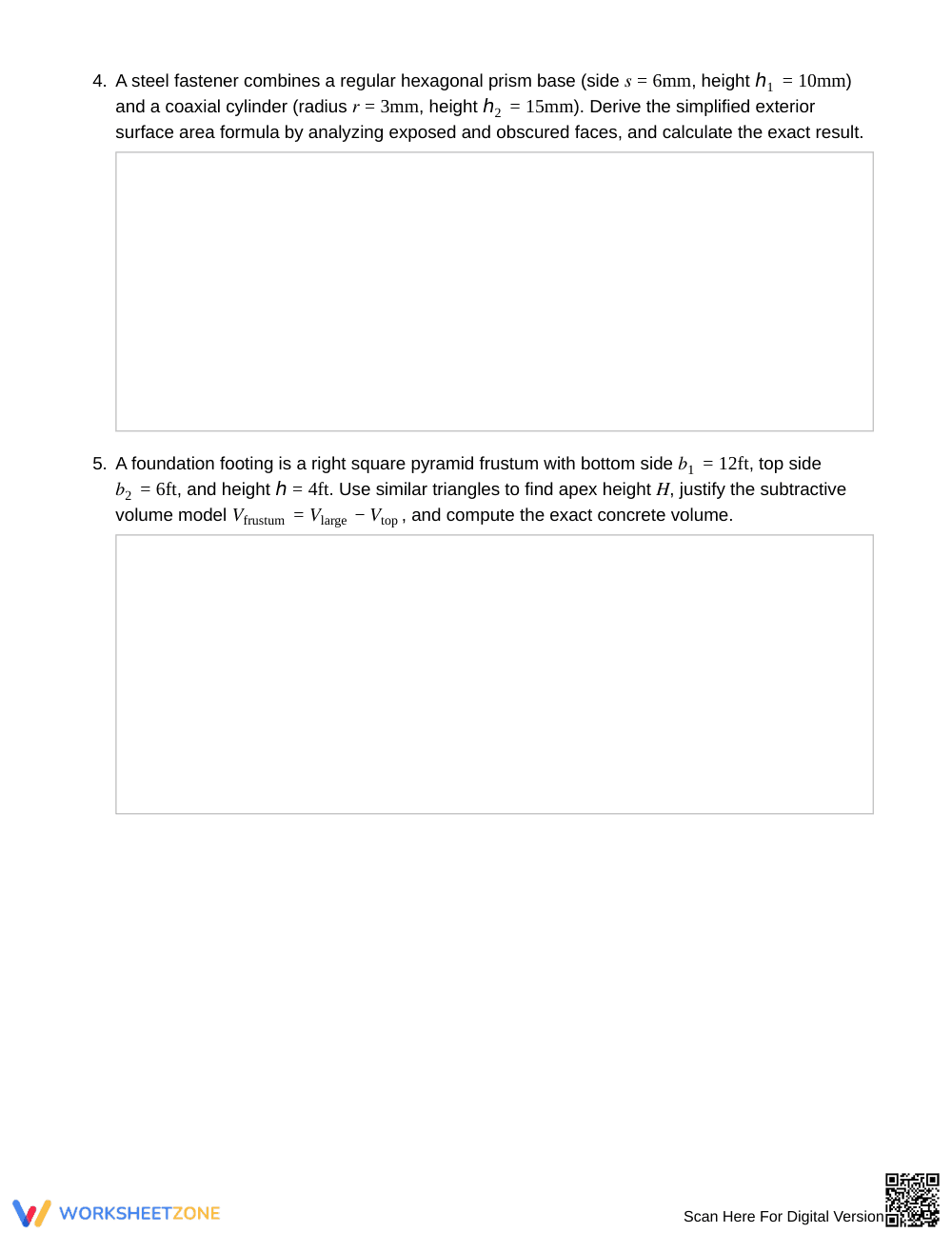
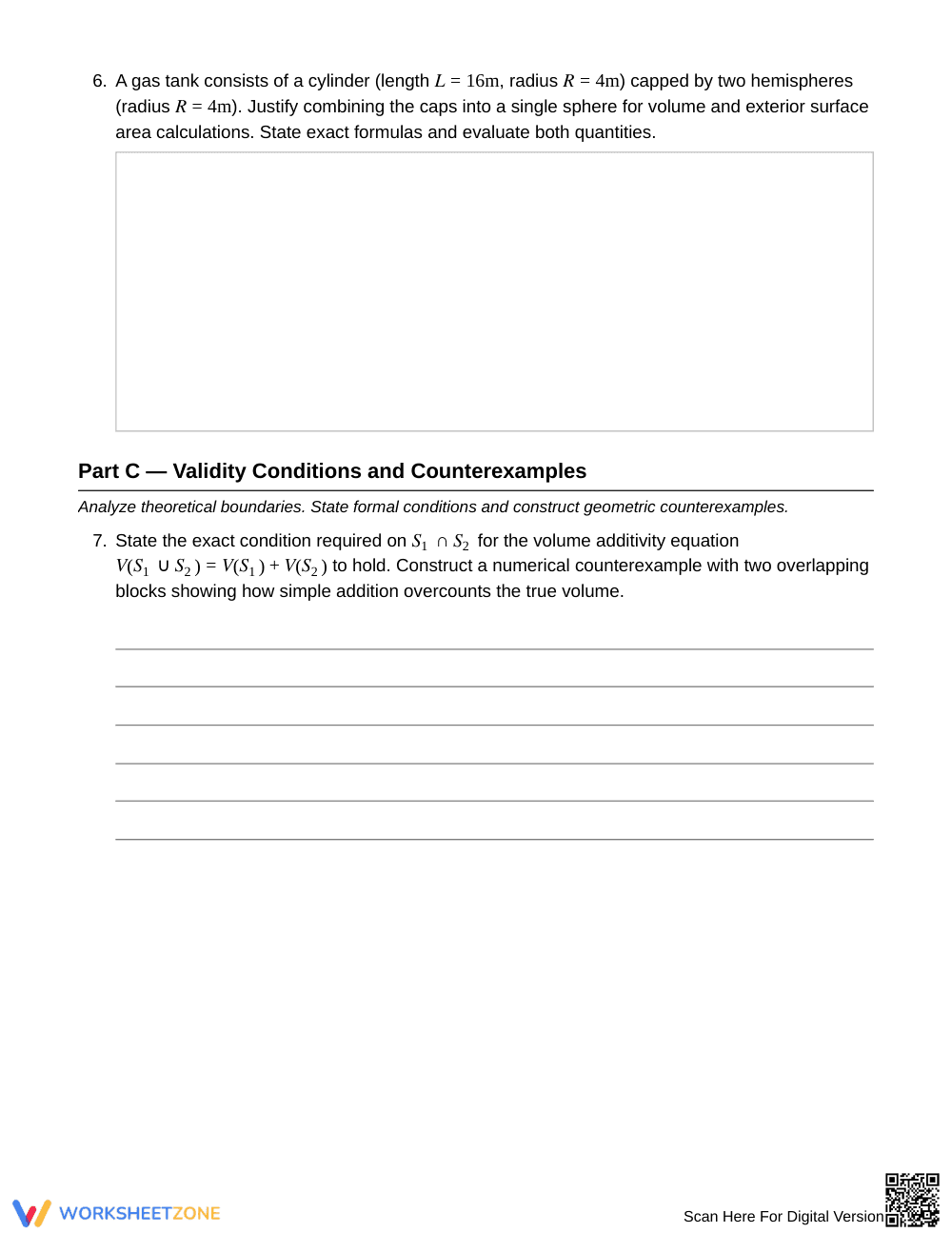
This 5-page worksheet provides 8 multi-step problems supported by a complete 3-page worked answer key. Students reference definitions of volume additivity and boundary area before working with cross-section diagrams and algebraic proofs involving silos, hollow prisms, fasteners, frustums, and storage tanks.
Skill Progression
- Guided practice (Part A, 2 problems): Students critique geometric claims regarding cylinder-cone and hollow prism composites, finding errors in surface area boundary counting.
- Supported practice (Part B, 4 problems): Learners justify decomposition methods and compute exact values for L-shaped prisms, hexagonal fasteners, frustums, and spherical tank caps.
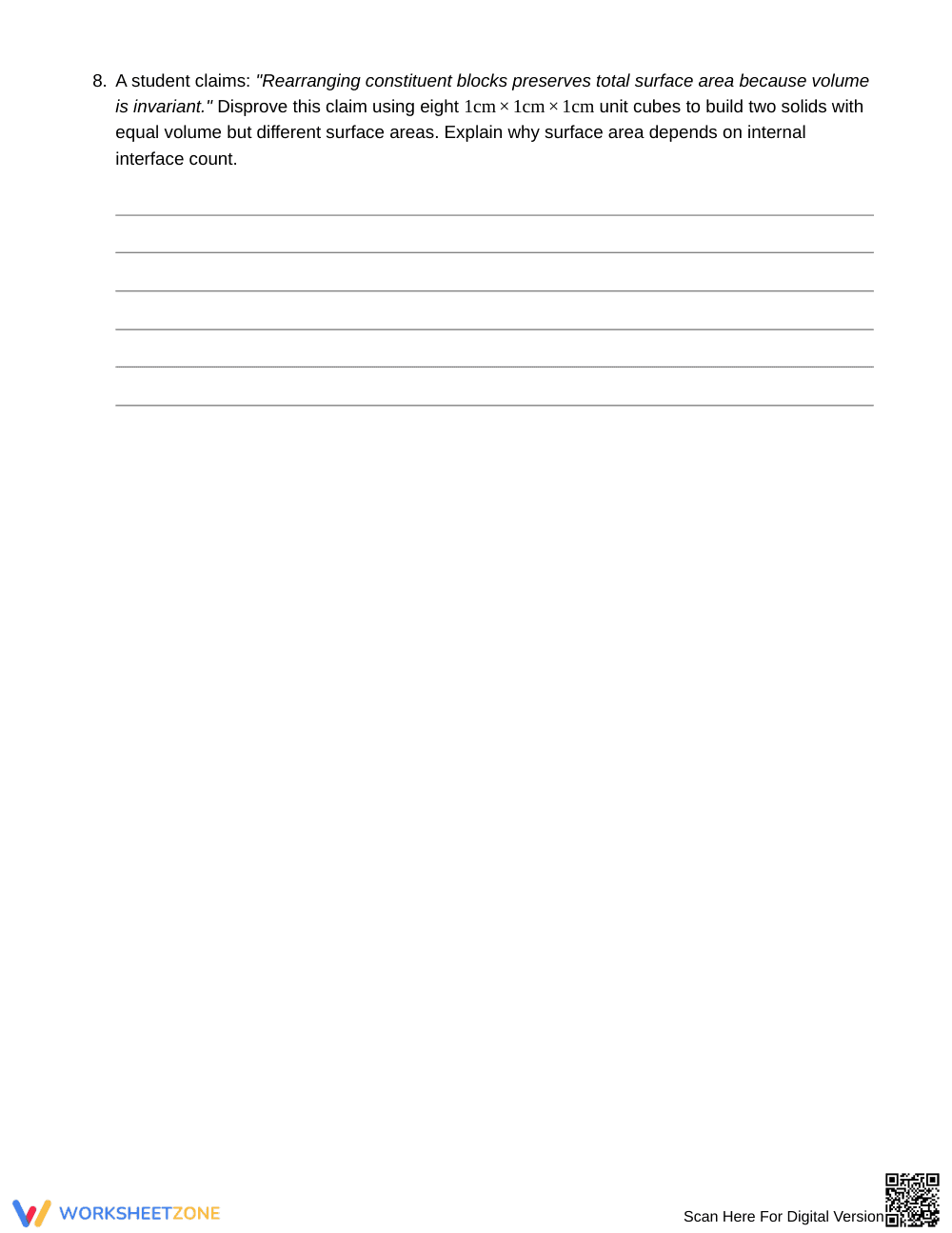
- Independent practice (Part C, 2 problems): Students formally state intersection conditions and construct counterexamples disproving volume-invariance misconceptions.
This sequence implements gradual release, moving from error analysis to formal derivation and counterexample proof.
Standards Alignment
This worksheet aligns with high school geometry modeling standards requiring students to apply volume formulas and solve composite design problems. Learners verify boundary subtractions and prove volume additivity. Both standard codes can be copied directly into lesson plans, IEP goals, or district curriculum mapping tools.
How to Use It
Assign this worksheet following direct instruction on 3D geometry for paired problem-solving or independent practice. Use Part A as a quick formative check to verify whether students double-count shared boundary faces. The full set takes 45 to 60 minutes.
Who It's For
Designed for Grade 10 geometry students mastering composite solids, this resource scaffolds algebraic justification for developing learners while challenging advanced students with frustum derivations. Pair it with physical unit cube manipulatives or a 3D cross-section lesson.
According to Fisher & Frey (2014), structuring instructional tasks across intentional gradual-release phases accelerates mathematical independence and sharpens analytical precision. When high school geometry students justify a decomposition method for composite solids, they move beyond rote computation to master the fundamental distinction between interior volume additivity and boundary surface area interactions. This worksheet embodies this research-backed pedagogical architecture by guiding learners through claim evaluation, formal algebraic modeling, and counterexample construction across 8 rigorous tasks. Evaluating common geometric misconceptions reinforces foundational spatial properties before students independently derive volume and area formulas for complex industrial and architectural shapes. By requiring students to articulate why subtractive and additive models function geometrically, this resource fosters robust mathematical communication and deep conceptual fluency, ensuring that learners achieve enduring mastery in three-dimensional geometric modeling and spatial analysis.


