


























Views
Downloads

Proven Composite Surface Area Worksheet | Grade 10 Geometry
Paste this activity's link or code into your existing LMS (Google Classroom, Canvas, Teams, Schoology, Moodle, etc.).
Students can open and work on the activity right away, with no student login required.
You'll still be able to track student progress and results from your teacher account.
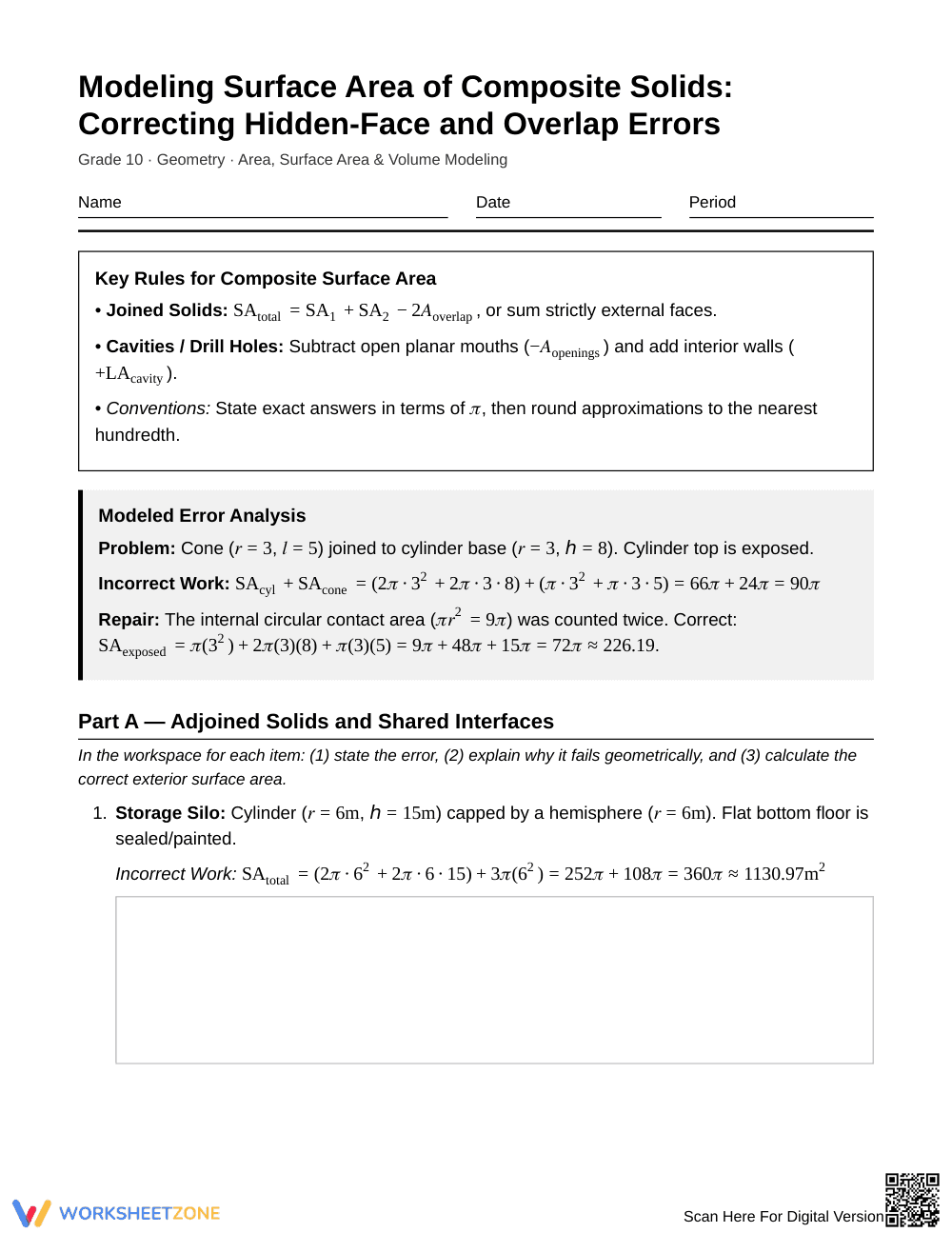
This high school geometry worksheet strengthens geometric modeling by training students to identify and correct hidden-face and internal overlap errors in composite three-dimensional figures. Through targeted error analysis, learners critique flawed solutions, isolate shared interface boundaries, and calculate accurate exterior surface area values in exact and rounded forms.
At a Glance
- Grade: 10 · Subject: Geometry
- Standard:
HSG-MG.A.1— Apply geometric concepts in modeling situations to describe real-world physical objects- Skill Focus: Composite surface area overlap and cavity error correction
- Format: 4 pages · 10 problems · Answer key included · PDF
- Best For: Geometry intervention or post-lesson mastery check
- Time: 45–60 minutes
What's Inside
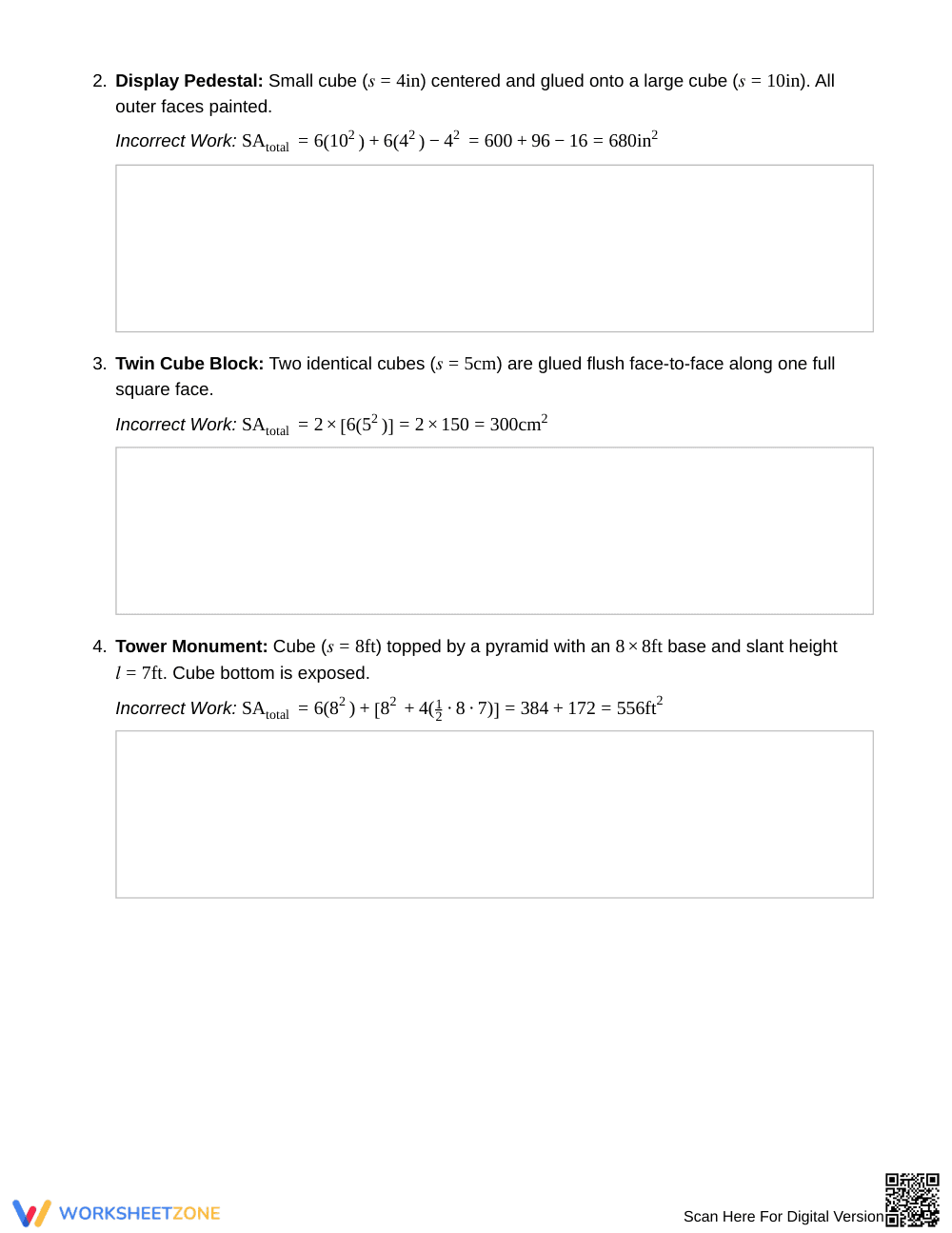
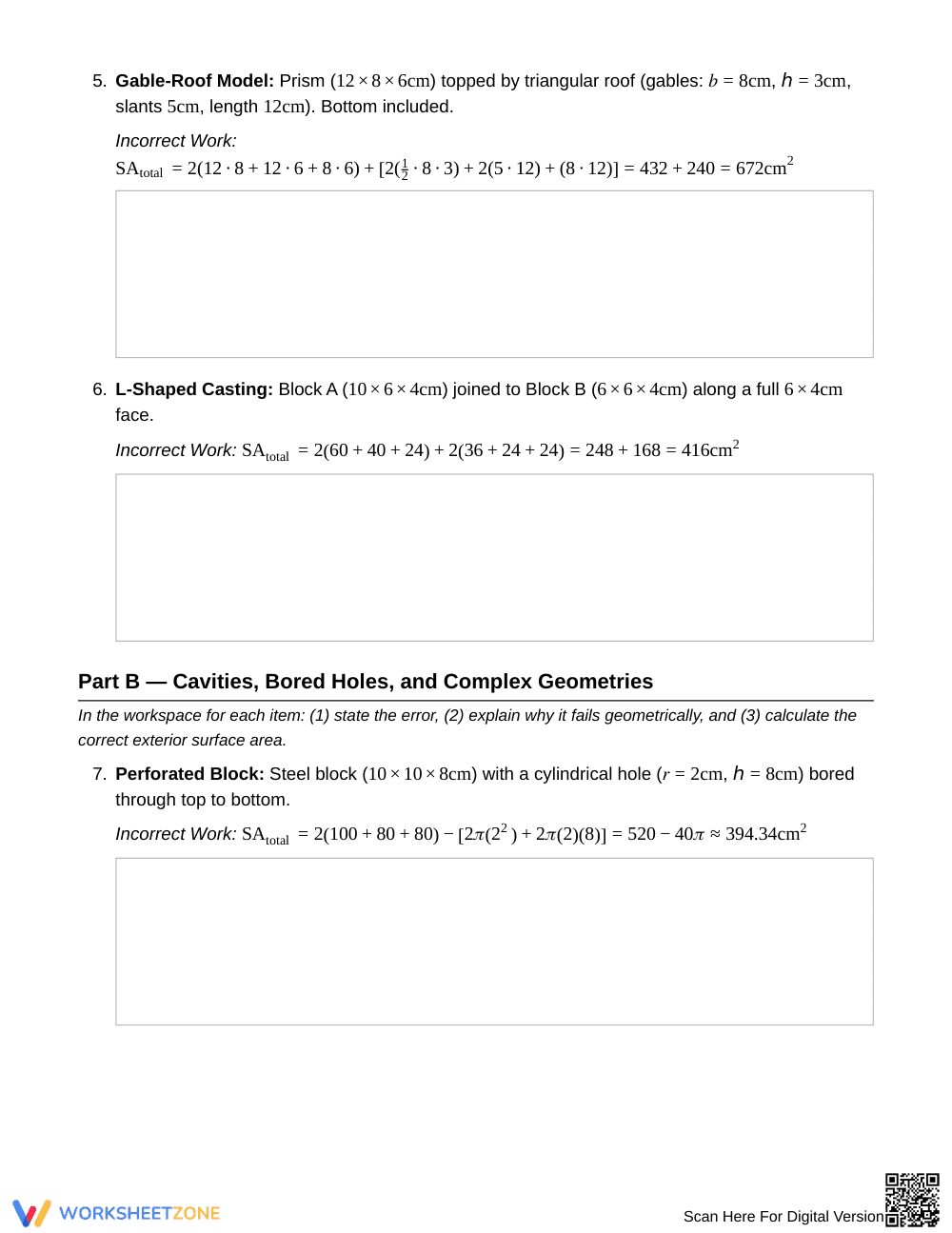
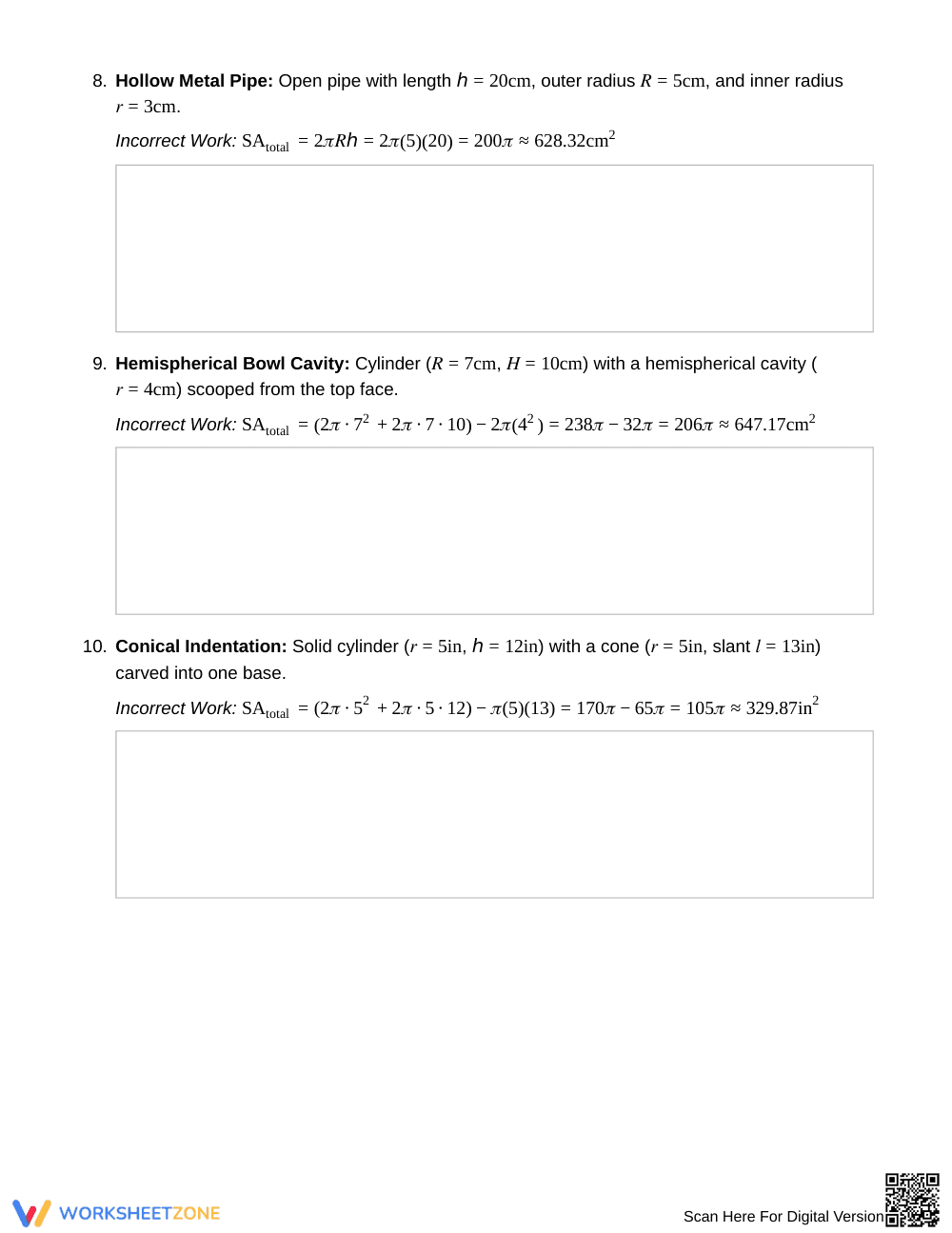
This 4-page printable resource includes a foundational rule summary, a fully worked error-analysis model, and 10 structured geometric tasks divided into two distinct sections. Part A targets adjoined solids with shared interfaces such as silos, pedestals, and roof models. Part B presents hollow pipes, bored holes, and internal hemispherical cavities. A complete 2-page answer key provides step-by-step mathematical breakdowns and exact geometric justifications for every problem.
Skill Progression
- Guided Practice: A top-of-page rule box and modeled cone-cylinder problem demonstrate how to diagnose double-counted contact planes and structure written corrections.
- Supported Practice (Part A, 6 problems): Students analyze exterior composite solids, stating the specific geometric error, explaining why internal boundary faces must be subtracted, and computing true surface area.
- Independent Practice (Part B, 4 problems): Students tackle complex internal voids and bored cylinders, determining when to subtract open planar mouths and add interior lateral walls without scaffolding.
This structured progression follows a gradual-release instructional model, building student independence from initial conceptual review through multi-step solid modeling.
Standards Alignment
Primary Standard: `HSG-MG.A.1` — Use geometric shapes, their measures, and their properties to describe objects (e.g., modeling a tree trunk or a human torso as a cylinder). Students apply geometric properties to calculate surface areas of realistic manufactured items, storage structures, and mechanical parts. Both standard codes can be copied directly into lesson plans, IEP goals, or district curriculum mapping tools.
How to Use It
Deploy this worksheet after direct instruction on surface area formulas for prisms, cylinders, cones, and spheres. Use Part A for collaborative paired error analysis during class, and assign Part B as independent practice or a formative exit ticket. During work time, check whether students correctly distinguish between subtracting open circular bases and adding interior lateral areas on cavity problems. Expected completion time is 45 to 60 minutes.
Who It's For
This worksheet is designed for Grade 10 Geometry students preparing for end-of-course exams or requiring targeted remediation on three-dimensional measurement. It pairs naturally with three-dimensional wooden geometric solids or dynamic visualization software.
According to research in Fisher & Frey (2014), engaging secondary students in structured error analysis significantly deepens conceptual understanding compared to repetitive procedural drill. By requiring learners to justify why mathematical steps fail geometrically, this resource operationalizes standard HSG-MG.A.1, shifting surface area calculation from blind formula memorization to authentic geometric modeling. Students must visually unpack complex composite solids, separate exposed external faces from hidden internal boundaries, and account for subtracted openings and added cavity walls across 10 multi-step problems. The included 2-page answer key models rigorous spatial reasoning, giving teachers an efficient, high-impact tool for formative assessment, math intervention, or targeted test preparation.


