


























Views
Plays
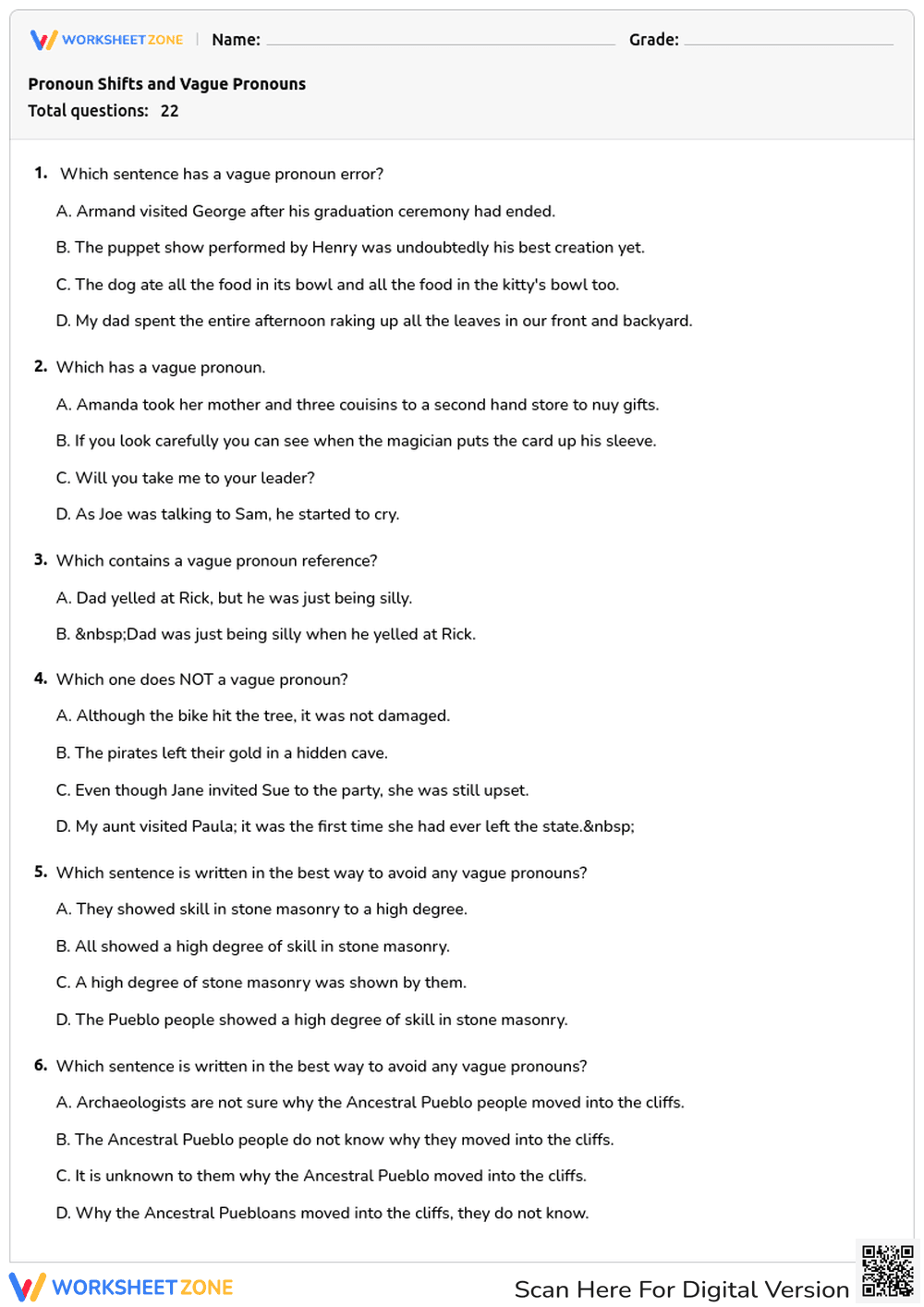


Pronoun Shifts & Vague Pronouns | Grade 6 Essential
Paste this activity's link or code into your existing LMS (Google Classroom, Canvas, Teams, Schoology, Moodle, etc.).
Students can open and work on the activity right away, with no student login required.
You'll still be able to track student progress and results from your teacher account.
This Grade 6 grammar worksheet provides targeted practice for identifying and correcting pronoun shifts and vague pronoun references. Students analyze 22 multiple-choice questions to determine which sentences contain ambiguous antecedents and select the most clear, grammatically correct alternatives. This resource ensures students can maintain clarity in their writing by mastering complex pronoun-antecedent relationships.
At a Glance
- Grade: 6 · Subject: ELA Grammar
- Standard:
CCSS.ELA-LITERACY.L.6.1.D— Recognize and correct vague pronouns with unclear or ambiguous antecedents- Skill Focus: Pronoun-Antecedent Clarity
- Format: 3 pages · 22 problems · Answer key included · PDF
- Best For: Independent practice or formative assessment
- Time: 20–30 minutes
What's Inside
This comprehensive 3-page PDF features 22 distinct multiple-choice items. The first section requires students to identify sentences with vague pronoun errors among four options. The middle section uses fill-in-the-blank contexts involving historical figures like Nefertiti to test pronoun selection. The final section challenges students to replace incorrect pronouns in existing sentences to restore grammatical accuracy. A full answer key is provided for rapid evaluation.
Zero-Prep Workflow
- Print: Generate copies of the three-page document in under 30 seconds.
- Distribute: Hand out to students for independent work, center rotations, or as a quiet sub plan activity.
- Review: Use the included answer key to review responses as a whole class or for quick individual grading in approximately 1 minute.
Standards Alignment
The primary focus is `CCSS.ELA-LITERACY.L.6.1.D`, which requires students to recognize and correct vague pronouns. By evaluating sentences where a pronoun could refer to more than one noun, students develop the precision required for middle-school writing. Both standard codes can be copied directly into lesson plans, IEP goals, or district curriculum mapping tools.
How to Use It
Use this worksheet as a formative assessment after a direct instruction lesson on pronoun-antecedent agreement. It is particularly effective during the independent practice phase of a gradual release model. Teachers should observe if students struggle with questions 8-10, which specifically ask who a pronoun refers to, as this indicates a need for more intensive modeling of antecedent identification. Expected completion time is 25 minutes.
Who It's For
This resource is ideal for general education 6th-grade students, but it also serves as an excellent scaffolded review for 7th and 8th graders who demonstrate persistent clarity issues in their essays. It pairs naturally with a mentor text analysis where students highlight pronouns and draw arrows to their specific antecedents to visualize the connections practiced here.
According to Fisher & Frey (2014), the ability to recognize and correct vague pronouns is a critical component of the gradual release of responsibility in literacy instruction, moving students from basic parts-of-speech identification to sophisticated syntactical control. This worksheet aligns with CCSS.ELA-LITERACY.L.6.1.D by providing 22 structured opportunities for students to resolve ambiguous antecedents, a skill that directly impacts the coherence of student-generated informational and narrative texts. Research indicates that targeted grammar practice, when isolated from the cognitive load of drafting, allows students to internalize mechanics that they can later apply during the revision phase of the writing process. By focusing on pronoun shifts and vague references, this resource addresses a common bottleneck in middle-school writing development. The inclusion of multiple-choice distractors helps students develop the metalinguistic awareness necessary to evaluate their own prose for clarity and precision.


