


























Views
Downloads
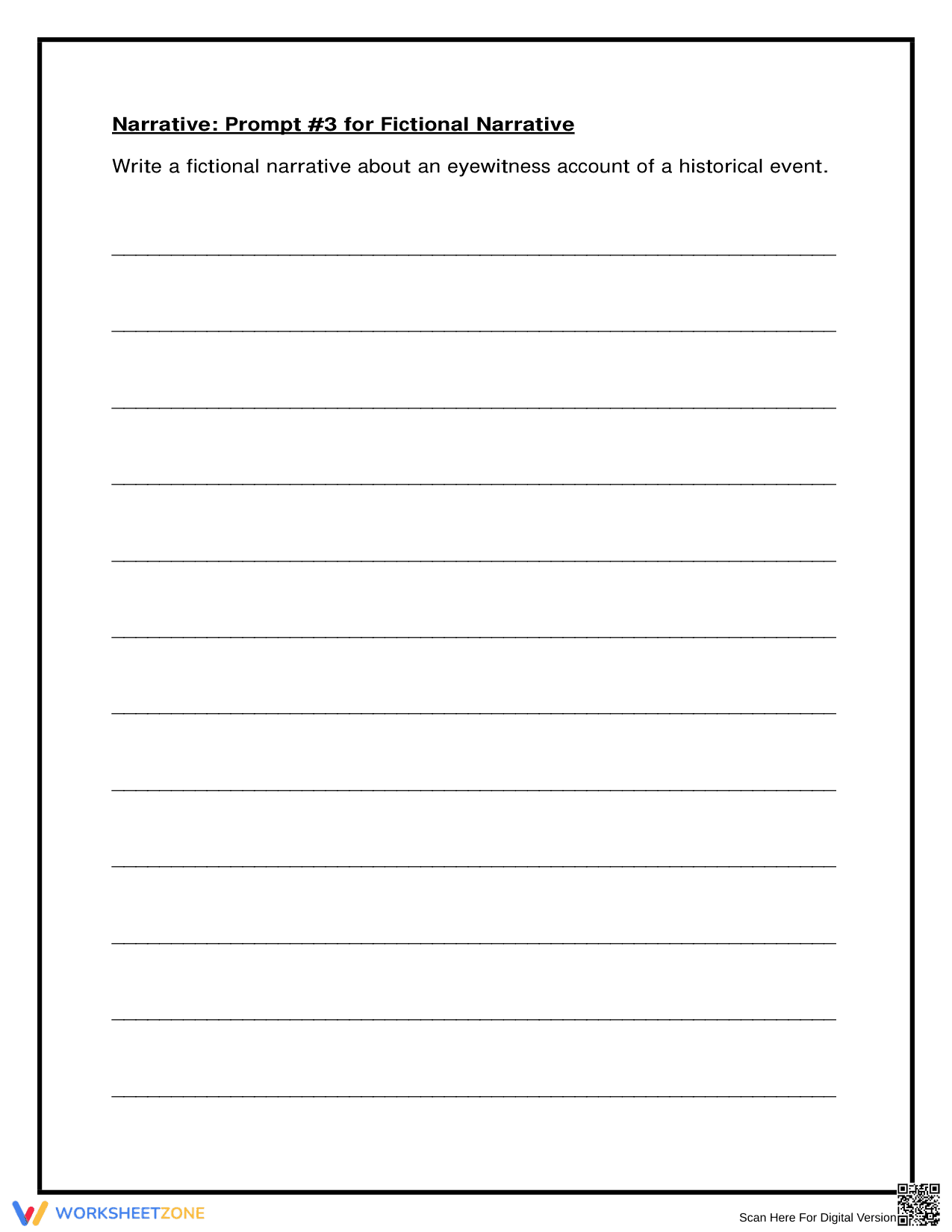

Essential Grade 7 Historical Narrative Writing Prompt
Paste this activity's link or code into your existing LMS (Google Classroom, Canvas, Teams, Schoology, Moodle, etc.).
Students can open and work on the activity right away, with no student login required.
You'll still be able to track student progress and results from your teacher account.
This Grade 7 historical narrative writing worksheet prompts students to draft an eyewitness account of a significant past event. By blending factual historical contexts with creative storytelling, learners develop their ability to establish a clear point of view and organize sequence logically. This resource facilitates immediate student engagement with complex narrative structures through a focused, single-task writing environment.
At a Glance
- Grade: 7 · Subject: ELA Writing
- Standard:
CCSS.ELA-LITERACY.W.7.3— Write narratives to develop imagined experiences using effective technique and well-structured sequences- Skill Focus: Historical Narrative Writing
- Format: 1 page · 1 prompt · Answer key not applicable · PDF
- Best For: Quick creative writing or sub plans
- Time: 30–45 minutes
What's Inside
This printable resource features a single, high-interest writing prompt focused on fictional historical narrative construction. The layout provides ample ruled lines for student responses, ensuring a clean and professional workspace. The worksheet is delivered in a standard one-page PDF format, making it easy to distribute for individual writing sessions or as a structured assessment of narrative craft.
Zero-Prep Workflow
The zero-prep workflow for this resource is designed for maximum teacher efficiency. First, print the single-page PDF in under 30 seconds. Second, distribute the copies to students and explain the historical eyewitness objective. Finally, review the student narratives using your standard writing rubric. Total teacher preparation time is under two minutes, making this an ideal solution for emergency sub plans or bell-ringer activities.
Standards Alignment
This worksheet is aligned to CCSS.ELA-LITERACY.W.7.3, which requires students to write narratives to develop real or imagined experiences using effective technique and well-structured event sequences. It specifically targets the ability to engage the reader by establishing a context and point of view. Both standard codes can be copied directly into lesson plans, IEP goals, or district curriculum mapping tools.
How to Use It
Use this worksheet as a formative assessment after a unit on historical periods to see how well students can synthesize historical facts with narrative elements. A great observation tip is to watch for students who struggle to maintain a consistent eyewitness perspective throughout their story. The expected completion time is 35 minutes for a first draft, allowing for a focused and productive writing period.
Who It's For
This resource is for Grade 7 students, but it can be easily adapted for Grade 6 or Grade 8 depending on the depth of historical detail required. It is an excellent pairing with a primary source document or a historical anchor chart. For students needing more support, teachers can provide a list of historical events to choose from before they begin writing on the provided lines.
The CCSS.ELA-LITERACY.W.7.3 standard emphasizes the development of imagined experiences through organized sequences, a skill fundamental to advanced literacy. According to Fisher & Frey (2014), the use of specific writing prompts that ground students in a particular perspective, such as an eyewitness account, significantly enhances their ability to utilize sensory details and clear event transitions. This historical narrative worksheet provides exactly this type of structured scaffolding, encouraging students to bridge the gap between historical knowledge and creative expression. By focusing on a single, compelling task, the resource minimizes cognitive load and allows students to concentrate on the mechanics of storytelling. This approach is supported by the RAND AIRS 2024 findings, which suggest that focused, printable writing tasks remain a cornerstone of effective classroom practice for building writing stamina and fluency in middle school learners.


