


























Views
Plays
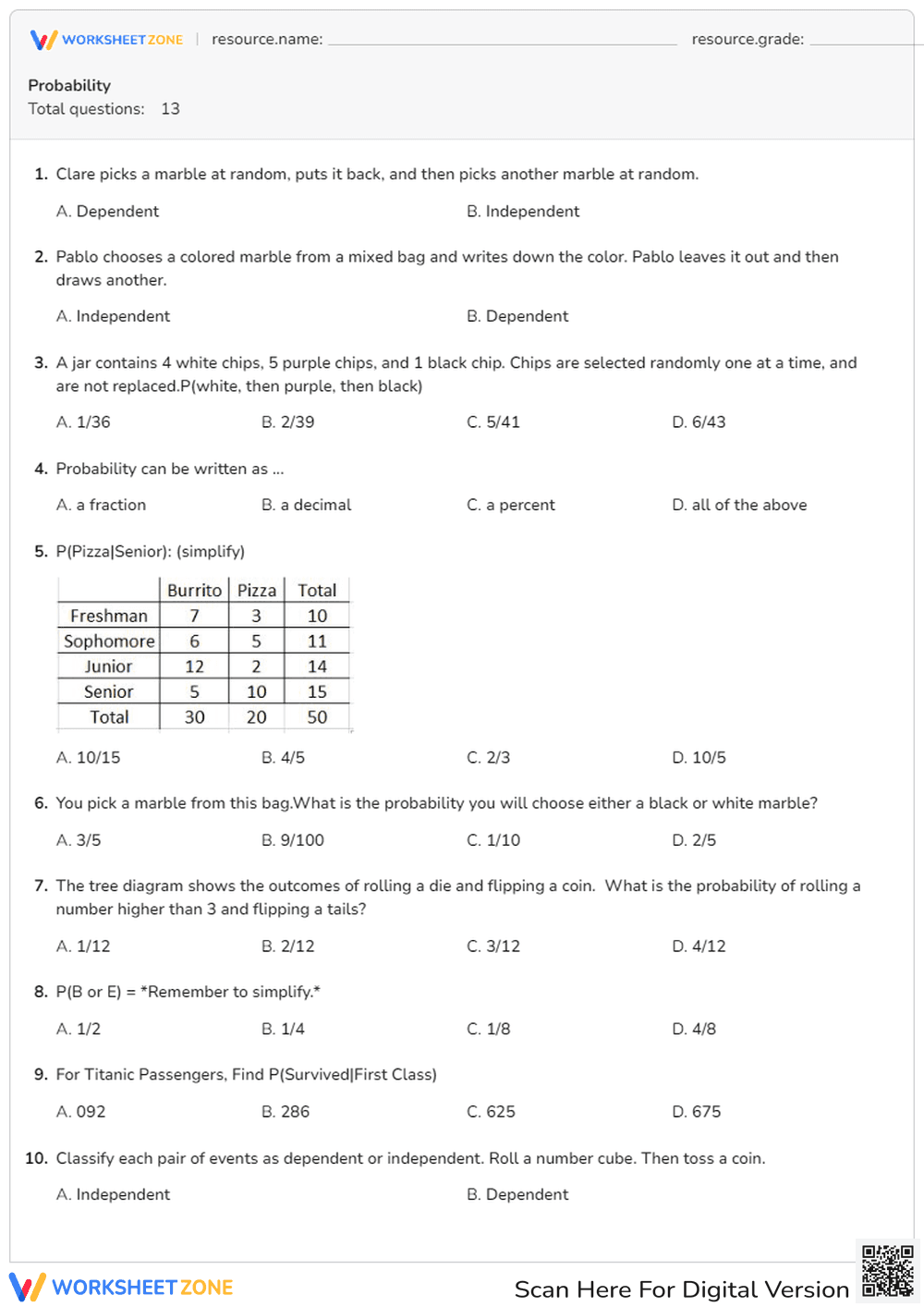


Essential Probability Worksheet | Grade 7 Math
Paste this activity's link or code into your existing LMS (Google Classroom, Canvas, Teams, Schoology, Moodle, etc.).
Students can open and work on the activity right away, with no student login required.
You'll still be able to track student progress and results from your teacher account.
This Grade 7 probability worksheet provides a comprehensive assessment of student understanding regarding simple and compound events. Students will calculate odds, identify independent versus dependent variables, and interpret conditional probability tables. It is designed to bridge the gap between basic chance and complex statistical analysis through rigorous practice.
At a Glance
- Grade: 7 · Subject: Math
- Standard:
CCSS.MATH.CONTENT.7.SP.C.8— Find probabilities of compound events using lists, tables, and tree diagrams- Skill Focus: Conditional and Compound Probability
- Format: 2 pages · 13 problems · Answer key included · PDF
- Best For: Formative assessment or unit test prep
- Time: 25–35 minutes
The resource contains 13 multiple-choice questions spread across two pages. It features a mix of conceptual questions, such as identifying mutually exclusive formulas, and calculation-heavy tasks involving frequency tables and tree diagrams. A clear layout ensures students have ample space to annotate their logic and show work before selecting a final answer.
Skill Progression
- Guided Practice: Questions 1-4 establish foundational concepts, such as identifying independent events and understanding basic probability notation and formats.
- Supported Practice: Questions 5-9 utilize visual aids like frequency tables and tree diagrams to scaffold conditional probability calculations for students.
- Independent Practice: Questions 10-13 require students to apply specific formulas for mutually exclusive and compound events without external prompts or hints.
This structure follows a gradual-release model, moving students from simple identification to the application of complex mathematical formulas.
Standards Alignment
This worksheet is primary aligned to `CCSS.MATH.CONTENT.7.SP.C.8`, which focuses on finding probabilities of compound events. It also supports `CCSS.MATH.CONTENT.7.SP.C.5` by requiring students to understand that the probability of a chance event is a number between 0 and 1. Both standard codes can be copied directly into lesson plans, IEP goals, or district curriculum mapping tools.
How to Use It
Assign this worksheet as a mid-unit check during your statistics and probability module. It works best after students have been introduced to tree diagrams and the concept of replacement in sampling. For a formative assessment tip, observe how students handle the conditional probability table in question 5; difficulty here often indicates a need for more practice with ratios. The expected completion time is 30 minutes.
Who It's For
This resource is ideal for Grade 7 and 8 students mastering middle school math standards. It provides necessary rigor for advanced learners while offering clear multiple-choice options to support students who benefit from structured response formats. Pair this with a probability anchor chart or a direct instruction lesson on dependent events for maximum student success.
According to the RAND AIRS 2024 report, high-quality instructional materials that integrate multiple representations—such as the frequency tables and tree diagrams found in this worksheet—significantly improve student retention of abstract statistical concepts. This resource targets `CCSS.MATH.CONTENT.7.SP.C.8`, requiring students to find probabilities of compound events through systematic analysis. By moving from simple independent events to complex conditional scenarios, the worksheet aligns with the Fisher & Frey (2014) model of scaffolded instruction. Research indicates that structured multiple-choice assessments help identify specific misconceptions in probabilistic reasoning, such as the difference between mutually exclusive and independent events. This 13-question set provides the necessary data points for teachers to adjust instruction in real-time. The inclusion of formula-based questions ensures that students are prepared for the rigorous demands of high school algebra and statistics.


