




























Views
Downloads

Printable Variables and Data Word Search | Grades 4–5 ELA

Paste this activity's link or code into your existing LMS (Google Classroom, Canvas, Teams, Schoology, Moodle, etc.).
Students can open and work on the activity right away, with no student login required.
You'll still be able to track student progress and results from your teacher account.
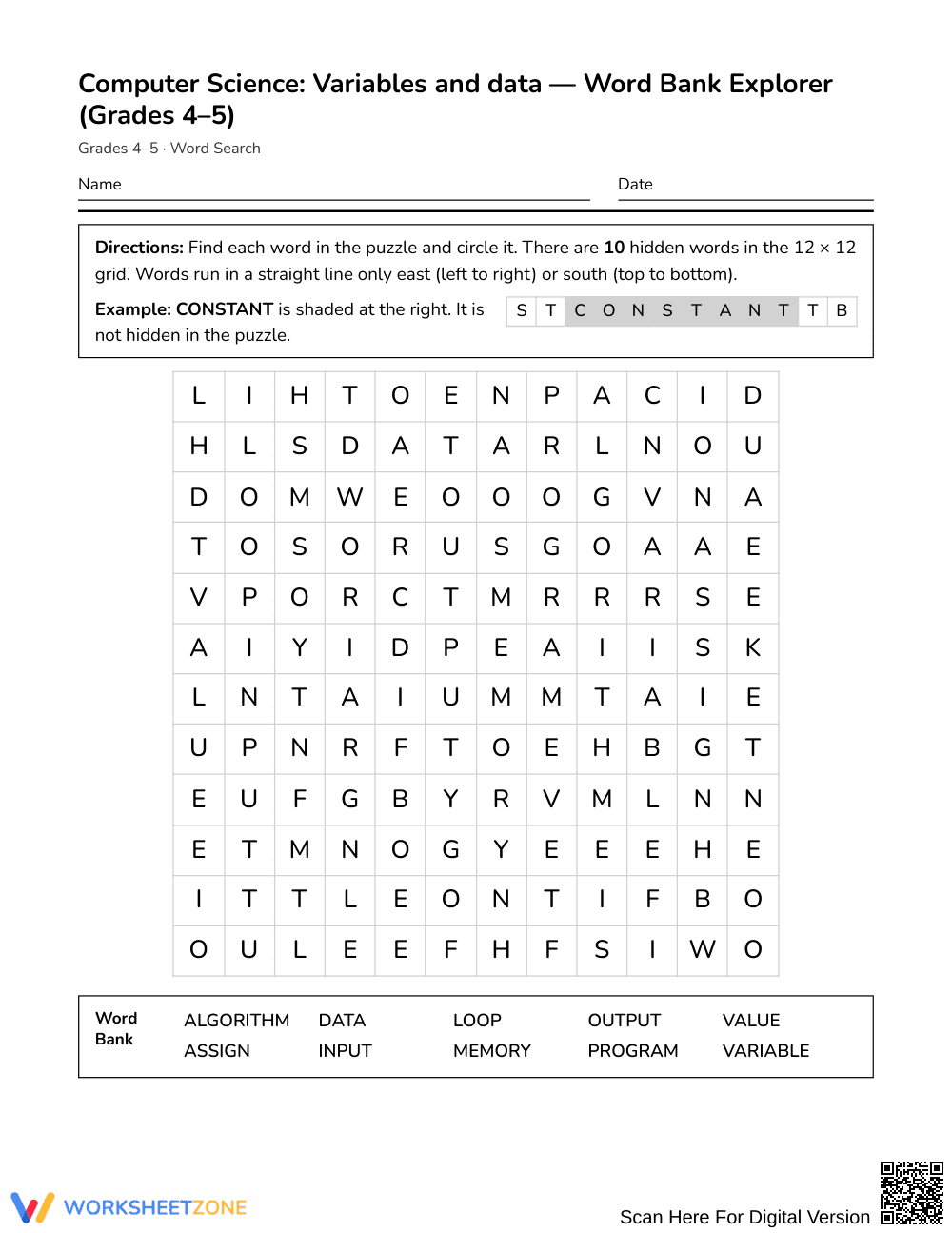
This vocabulary word search reinforces computer science concepts focused on variables and data for Grades 4–5 learners. Students locate foundational computing terms to build technical literacy, strengthen letter pattern recognition, and connect core programming concepts with precise definitions across 10 targeted vocabulary terms.
At a Glance
- Grade: Grades 4–5 · Subject: English Language Arts (ELA)
- Standard: Not standards-assessed — vocabulary enrichment
- Skill Focus: Variables and data vocabulary recognition in foundational computer science
- Format: 1 page · 10 words · Complete answer key included · Printable PDF document
- Best For: Independent vocabulary enrichment, STEM learning stations, sub plans, and early finishers
- Time: 15–20 minutes
What's Inside
This single-page word search features 10 words embedded within the puzzle grid, accompanied by an alphabetical word bank that pairs each computing term with a student-friendly definition. The document includes a full two-page answer key showing exact letter coordinates, enabling quick checking without teacher preparation.
Puzzle Mechanics
The activity utilizes a 12 x 12 letter grid tailored for intermediate elementary students. All 10 vocabulary terms run exclusively in East (horizontal left-to-right) and South (vertical top-to-bottom) directions. Students reference an alphabetical word bank listing essential terms such as ALGORITHM, MEMORY, and VARIABLE, reading each concept's definition as they locate the corresponding words in the grid.
Standards Alignment
This activity provides targeted vocabulary enrichment in computer science concepts and is not aligned to a formal academic standard. It reinforces domain-specific terminology to support informational reading comprehension and technical literacy across Grades 4–5 English Language Arts and STEM instruction.
How to Use It
Use this word search before direct instruction to introduce key terminology prior to a coding lesson, or assign it after direct instruction to consolidate newly acquired vocabulary. During independent seatwork, observe whether students cross-reference definitions in the word bank or search strictly for letter sequences to assess conceptual familiarity. Expected completion time is 15–20 minutes.
Who It's For
This puzzle is designed for Grades 4–5 students developing academic vocabulary in computer science. For differentiated support, have learners highlight definitions in the word bank before locating each term. Pair this resource with a classroom anchor chart illustrating real-world examples of inputs, outputs, variables, and loops.
This computer science vocabulary enrichment word search supports Grades 4–5 students in developing fluency with variables and data terminology. As established by Fisher & Frey (2014), intentional exposure to domain-specific vocabulary across repeated contexts accelerates academic language acquisition and deepens reading comprehension in technical disciplines. Rather than relying on isolated memorization, this 10-word puzzle pairs precise computer science definitions, including concepts such as algorithms, inputs, outputs, memory, and loops, with focused visual search across an accessible 12 by 12 grid. Students encounter key terms in East and South orientations, reinforcing orthographic mapping and structural spelling patterns while establishing the foundational conceptual lexicon necessary for introductory programming. The accompanying two-page answer key facilitates immediate corrective feedback and student self-assessment, making this resource an effective, low-stakes tool for cross-curricular STEM literacy integration and purposeful independent vocabulary practice during literacy rotations.


