




























Views
Downloads



Printable Trace a Light Path Worksheet | Grade 6 Science

Paste this activity's link or code into your existing LMS (Google Classroom, Canvas, Teams, Schoology, Moodle, etc.).
Students can open and work on the activity right away, with no student login required.
You'll still be able to track student progress and results from your teacher account.
This printable Grade 6 Science worksheet builds students' ability to trace light rays through reflection, refraction, and absorption across 10 structured problems. Students move from guided model cases to independent applications and written explanation checks.
At a Glance
- Grade: 6 · Subject: Science
- Skill Focus: Tracing simple light paths using the Law of Reflection and qualitative refraction rules
- Format: 4 pages · 10 problems · Answer key included · PDF
- Best For: Guided practice during light-unit instruction
- Time: 35–50 minutes
The worksheet spans 4 student-facing pages organized into three parts. A rule box on page one defines straight-line propagation, the normal line, the Law of Reflection, qualitative refraction, and opaque absorption — giving students a built-in reference throughout. Two fully worked model cases anchor the guided section before students work independently.
Skill Progression
- Guided practice (Part A, 3 tasks): Students calculate angle of incidence from a surface angle, complete a boundary-behavior reference table, and trace a shadow geometry problem — each step supported by the rule box and model cases.
- Supported practice (Part B, 5 tasks): Students apply reflection and refraction independently to a periscope, an underwater source, a coordinate-geometry mirror problem, a glass-plate entry-and-exit scenario, and an opaque-vs.-transparent obstacle comparison.
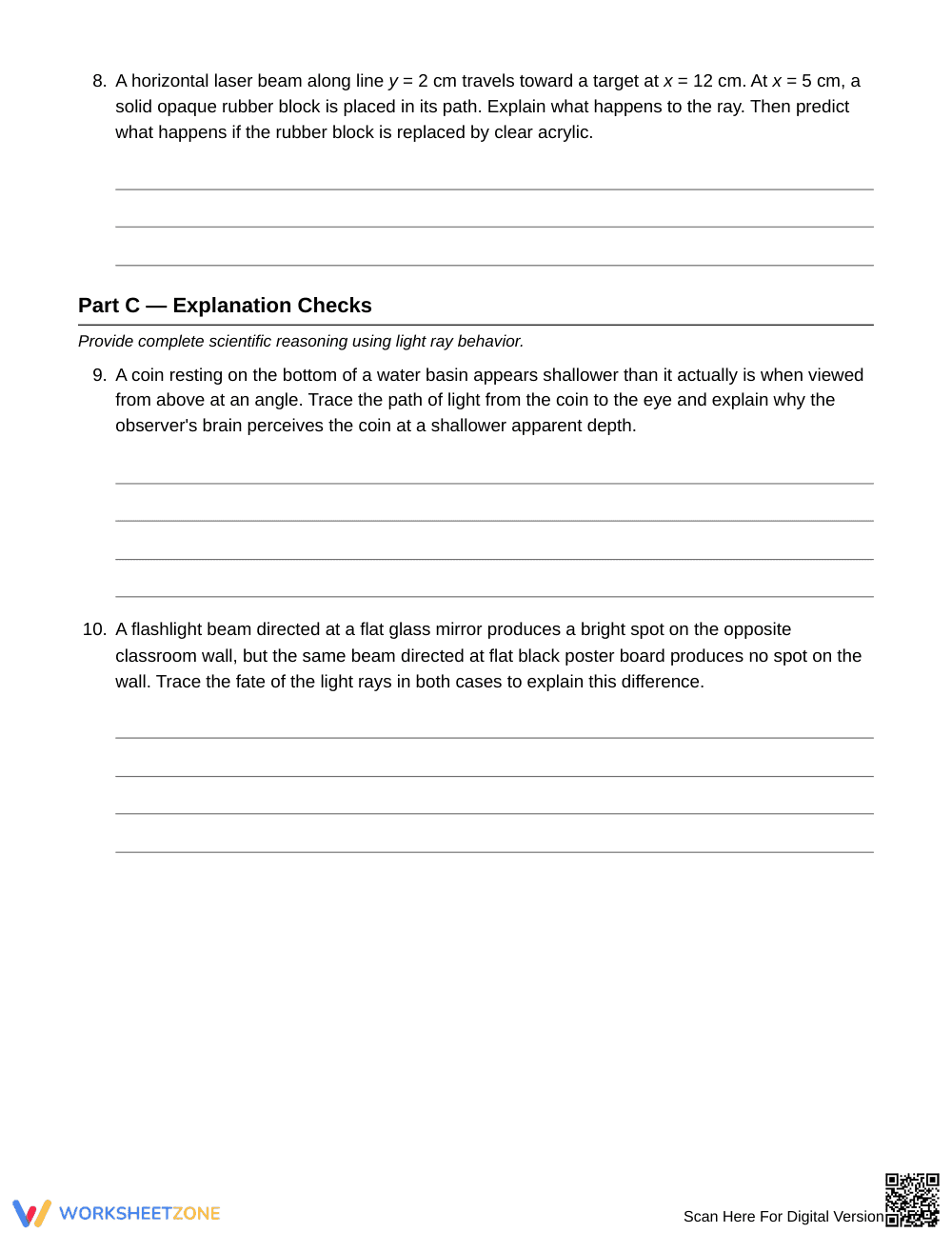
- Independent practice (Part C, 2 tasks): Students write extended scientific explanations — apparent depth of a coin in water and mirror-vs.-black-poster-board reflection — requiring them to trace complete ray paths and connect geometry to perception.
How to Use It
Assign Part A immediately after direct instruction on the Law of Reflection and qualitative refraction — the rule box lets students self-check vocabulary before applying it. Parts B and C work well as next-day independent practice or formative assessment; circulate during Part C and note which students reverse the bending direction when light moves from water to air, a reliable indicator of a persistent misconception. Expected completion time is 35–50 minutes for most sixth graders.
Who It's For
This resource is designed for on-grade sixth-grade science students studying light and wave behavior. Students who need additional support can use the rule box and model cases as a reference throughout all three parts; students ready for extension can add quantitative refraction angles using Snell's Law as a challenge layer. The worksheet pairs naturally with a ray-diagram anchor chart or a laser pointer and water tank demonstration.
This four-page, 10-task worksheet targets the Grade 6 Science skill of tracing light ray paths through reflection, refraction, and absorption. Students apply the Law of Reflection, qualitative refraction rules, and shadow geometry across scaffolded, independent, and explanation-level tasks. Research supports the effectiveness of structured, multi-step practice for building scientific reasoning: Fisher & Frey (2014) demonstrate that gradual-release frameworks — moving students from modeled examples to guided and then independent work — significantly improve conceptual retention in middle school science. This worksheet operationalizes that framework across three explicit parts, with a built-in rule box reducing cognitive load during initial practice. A detailed answer key is included, making the resource suitable for formative assessment, sub-plan use, or homework review without additional teacher preparation.


