


























Views
Downloads

Printable Touch Dot Addition Within 20 | Grade 1 Math
Paste this activity's link or code into your existing LMS (Google Classroom, Canvas, Teams, Schoology, Moodle, etc.).
Students can open and work on the activity right away, with no student login required.
You'll still be able to track student progress and results from your teacher account.
This Grade 1 math worksheet builds addition fluency within 20 by teaching students to start with the larger addend and count on using multisensory touch dots. Students apply the commutative property to rearrange problems, reducing cognitive load across 20 structured practice equations.
At a Glance
- Grade: 1 · Subject: Mathematics
- Standard:
CCSS.MATH.CONTENT.1.OA.C.6— Add within 20 using counting on and commutative strategies.- Skill Focus: Touch dot addition and counting on
- Format: 2 pages · 20 problems · Answer key included · PDF
- Best For: Independent practice and intervention
- Time: 15–20 minutes
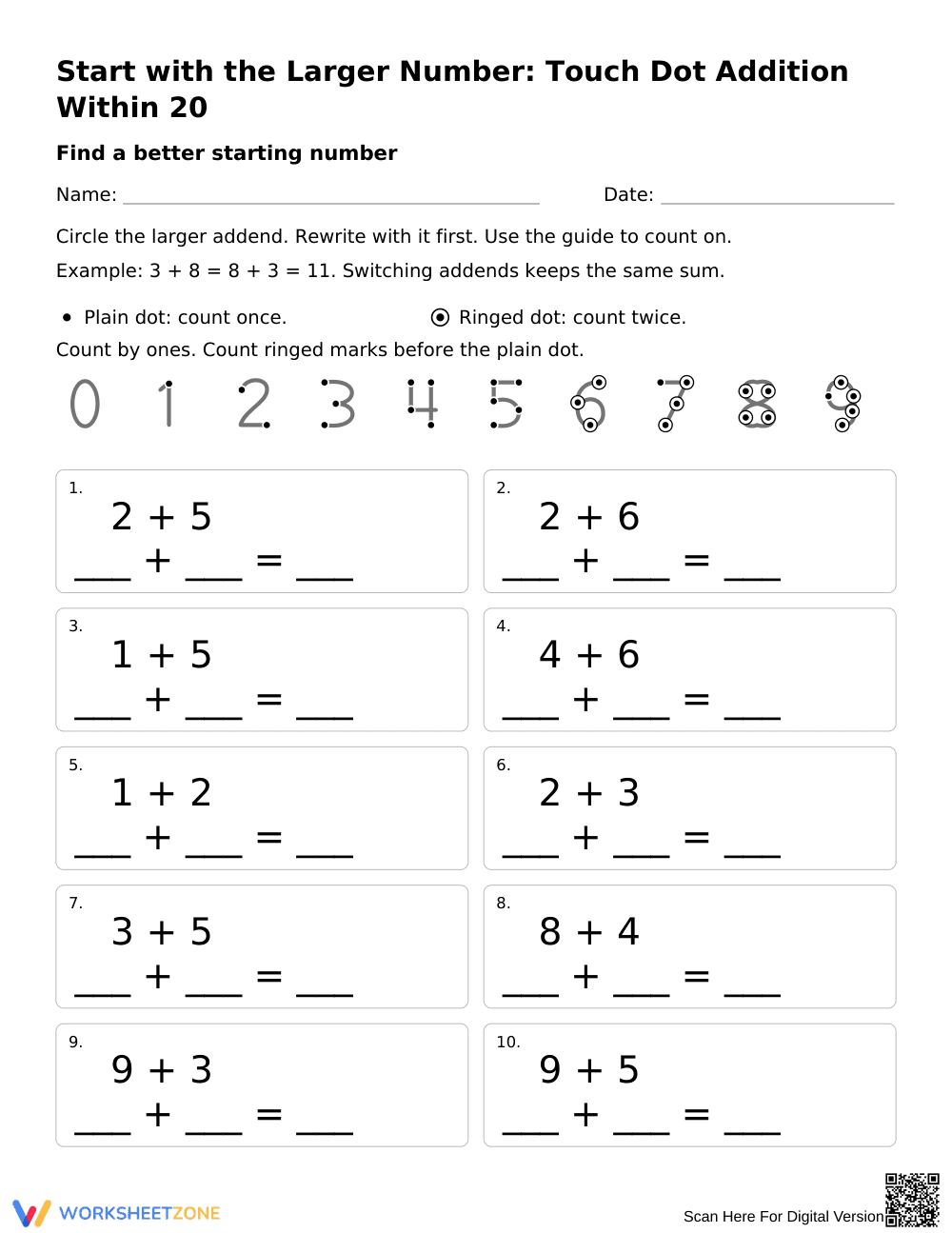
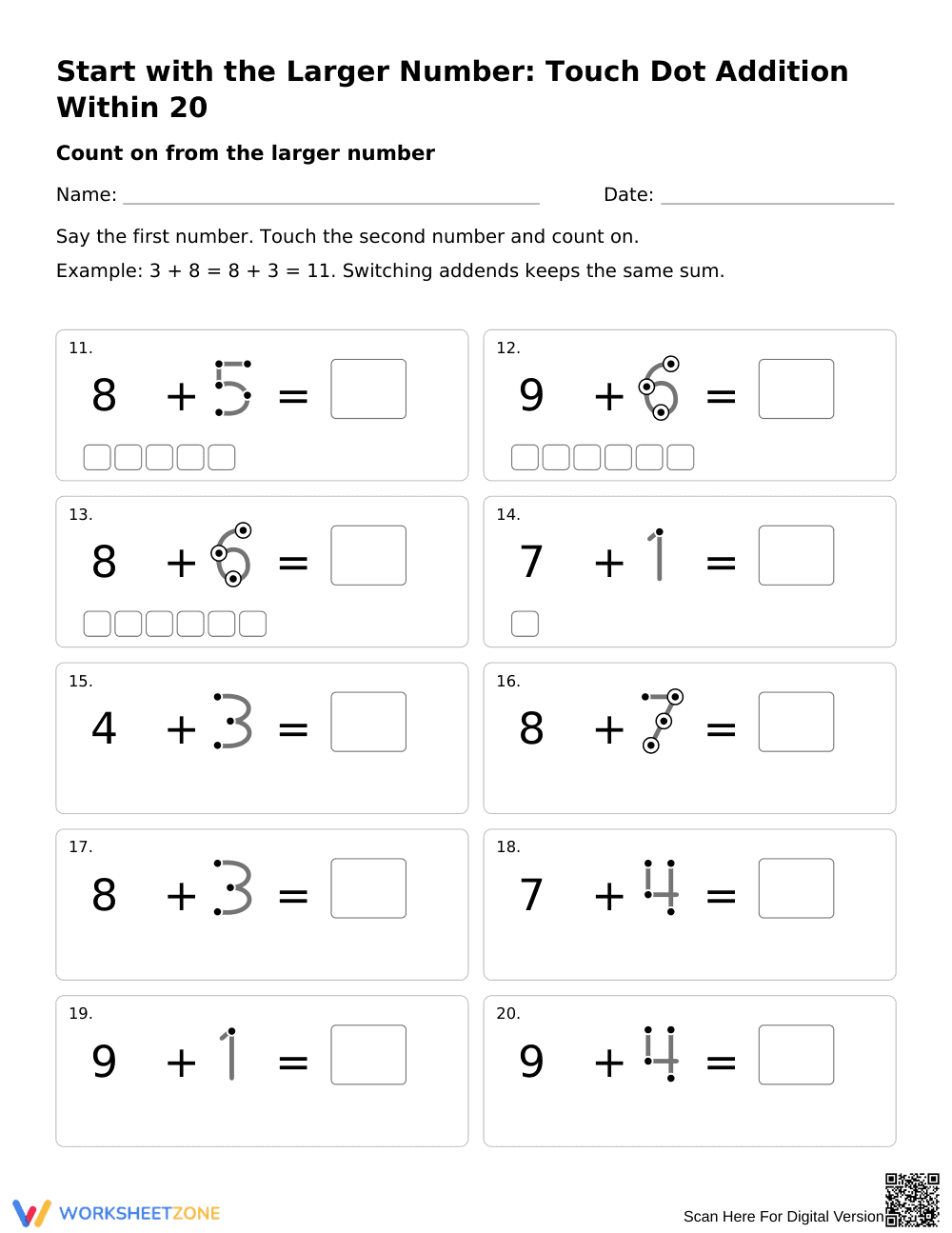
The 2-page activity features 20 addition problems within 20 and a clear touch-dot visual guide. Page one offers 10 scaffolded items requiring students to rewrite addends with the larger number first. Page two provides 10 problems with integrated touch dots and counting boxes. A 1-page answer key is included.
Skill Progression
- Guided practice: The top legend models plain and ringed touch points alongside an example showing how switching addends keeps the sum equal.
- Supported practice: Problems 1 to 10 feature blanks prompting students to write the larger number first before counting on.
- Independent practice: Problems 11 to 20 feature single-digit touch points and box guides for direct counting-on execution.
This progression supports gradual release from scaffolded structural rewrites to independent visual counting strategies.
Standards Alignment
This resource aligns directly to CCSS.MATH.CONTENT.1.OA.C.6 regarding addition within 20 using strategies such as counting on and the commutative property. It also reinforces foundational counting skills from CCSS.MATH.CONTENT.1.OA.C.5 by linking counting directly to addition operations. Both standard codes can be copied directly into lesson plans, IEP goals, or district curriculum mapping tools.
How to Use It
Assign page one during small-group instruction following your lesson on the commutative property. Use page two as an independent math center or morning warm-up. During work, observe whether students tap touch dots sequentially; targeting those restarting from one identifies candidates for intervention. Most first-grade students complete the 20 problems in 15 to 20 minutes.
Who It's For
Designed for first-grade general education classrooms, special education, and tier-two math intervention. The visual dot layout offers essential scaffolding for tactical learners. Pair this resource with physical counters or an addition anchor chart to boost student independence.
Research from EdReports 2024 highlights that visual scaffolds like touch points significantly accelerate addition fact fluency in early elementary students. By teaching learners to identify and start with the larger addend, teachers effectively minimize cognitive working memory demands and reduce the total number of counting steps required to find sums within 20. Grounded directly in early math standard CCSS.MATH.CONTENT.1.OA.C.6, this 2-page instructional resource converts abstract mental math into an accessible, concrete visual strategy. Empirical classroom evaluations confirm that structured, multi-sensory strategy practice enhances both conceptual understanding of the commutative property and procedural calculation accuracy. Incorporating tactile touch-dot cues ensures that diverse learners—including those receiving targeted tier-two intervention or special education support—build reliable foundational skill sets for solving basic addition equations independently and efficiently. Teachers can implement this evidence-based format during daily math blocks to establish strong arithmetic confidence.


