




























Views
Downloads



Printable Subduction Outcomes Worksheet | Grade 8 Science

Paste this activity's link or code into your existing LMS (Google Classroom, Canvas, Teams, Schoology, Moodle, etc.).
Students can open and work on the activity right away, with no student login required.
You'll still be able to track student progress and results from your teacher account.
This Grade 8 science worksheet teaches students to trace what happens when an oceanic plate meets a continental plate. Using crust density, earthquake depth data and unit conversions, students explain subduction, trench formation and volcanic arcs, then contrast them with continental collision.
At a Glance
- Grade: 8 · Subject: Science
- Standard: Plate boundaries — use crust density and data to explain subduction and collision outcomes
- Skill Focus: Tracing outcomes at an oceanic-continental boundary
- Format: 6 pages · 10 problems · Answer key included · PDF
- Best For: Plate tectonics practice and formative checks
- Time: 35–45 minutes
What's Inside
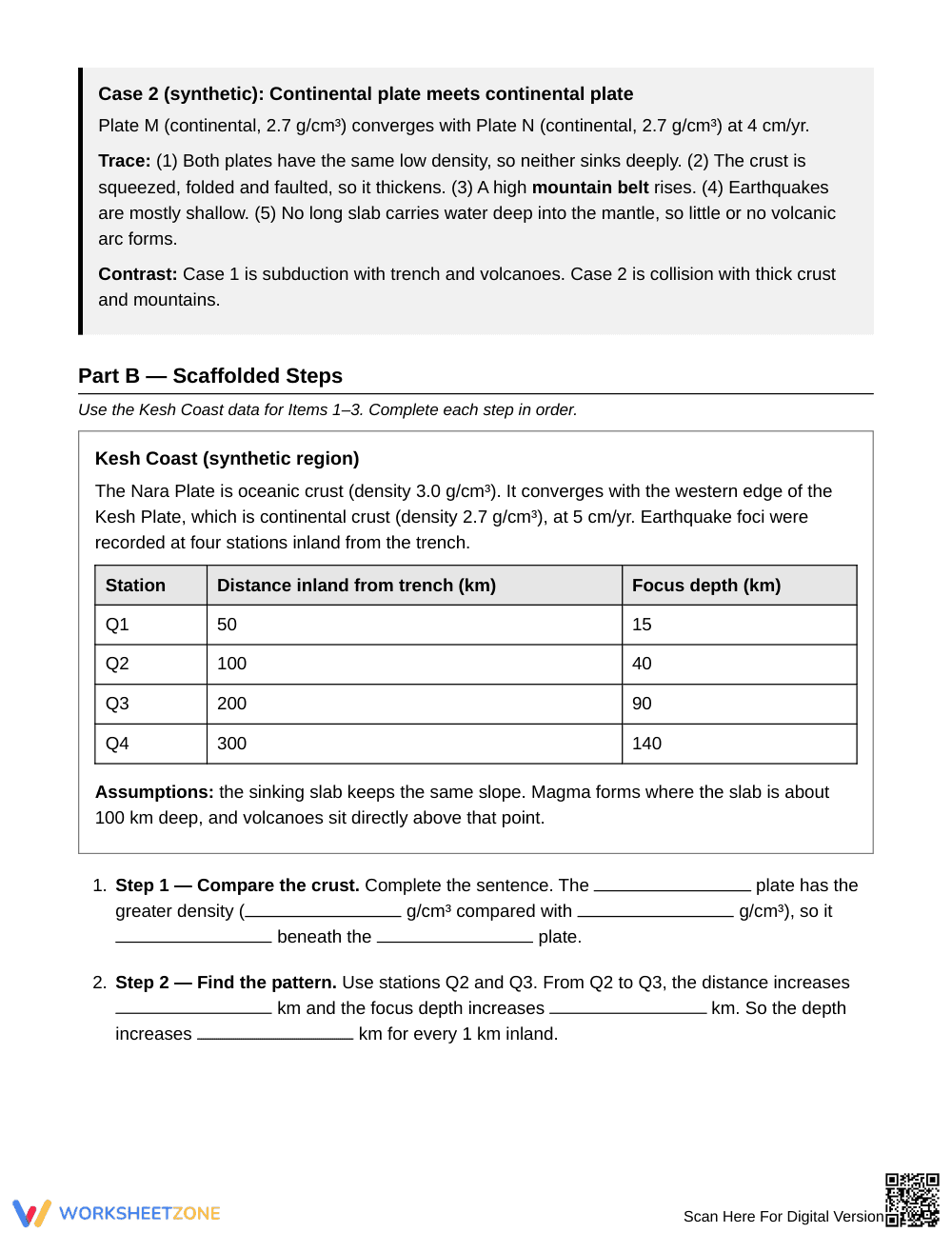
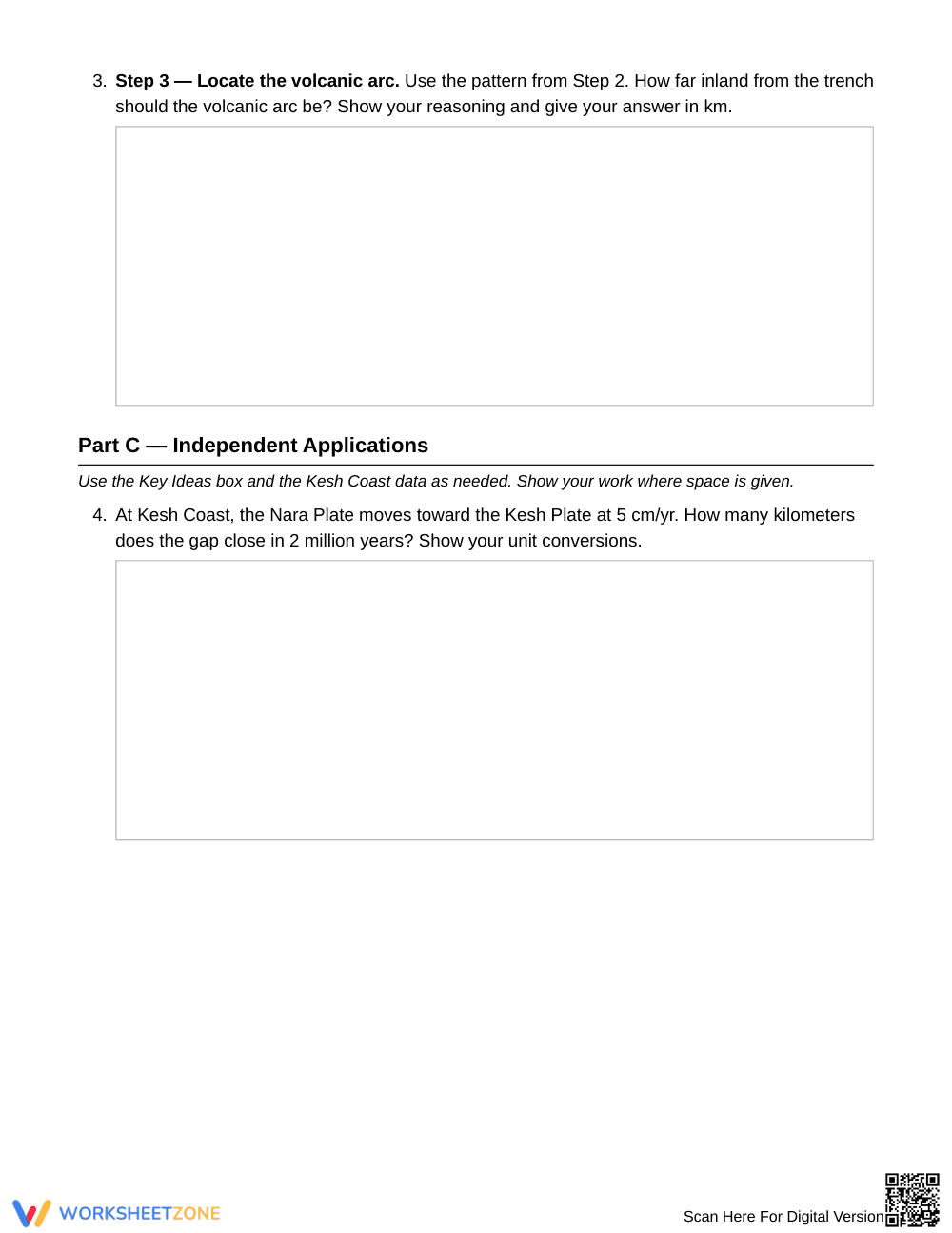
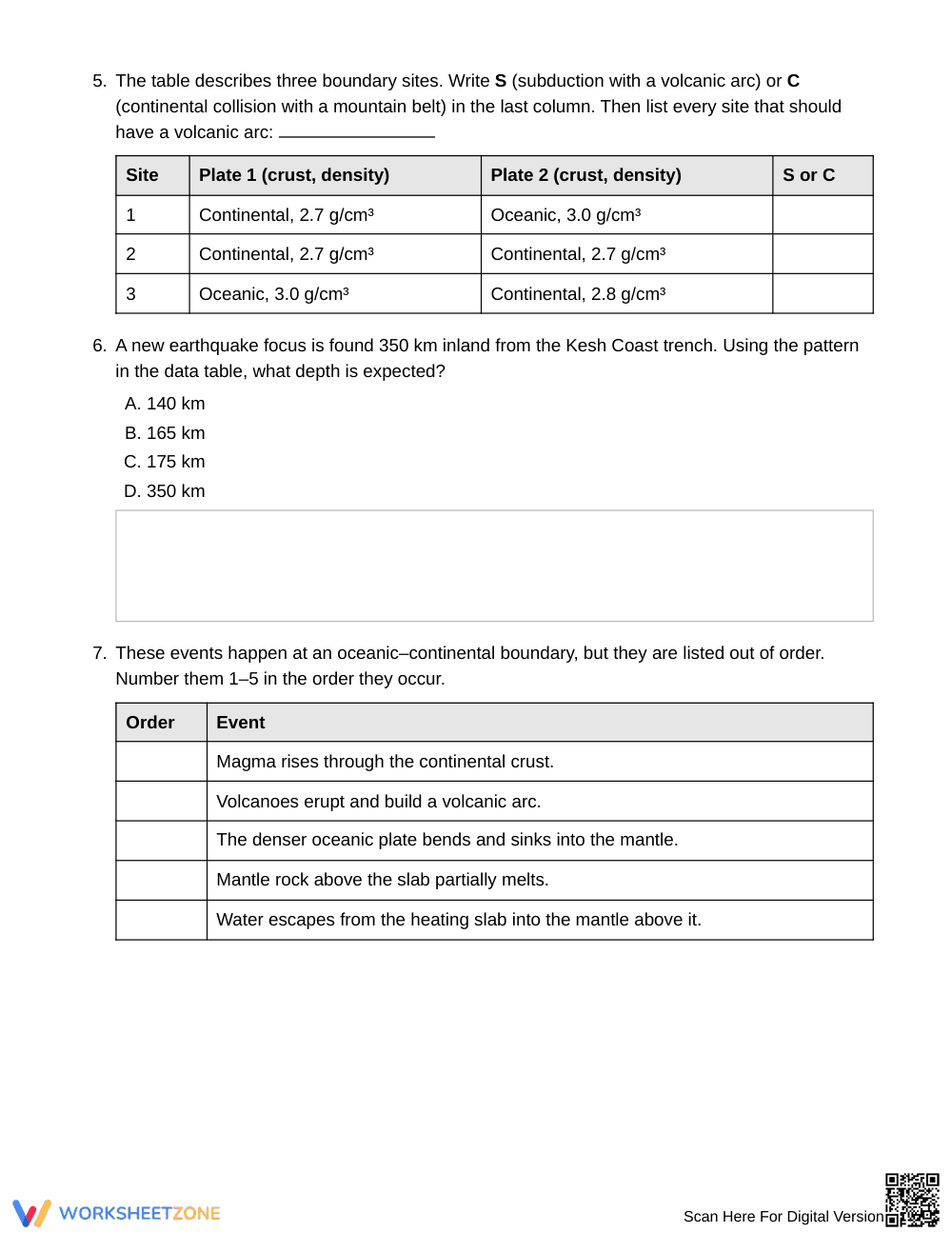
Part A models two synthetic cases, one oceanic-continental and one continental-continental. Part B gives three scaffolded steps with a sentence frame, a data table and a pattern-finding task. Part C adds five independent tasks: a rate conversion, a classification table, a multiple-choice prediction, an event-sequencing task and a region comparison. Part D asks for two written explanations. A two-page answer key is included.
Skill Progression
- Guided practice: two fully modeled cases in Part A show the reasoning chain from crust density to surface features.
- Supported practice: 3 scaffolded steps in Part B use a sentence frame and one shared data table.
- Independent practice: 7 tasks in Parts C and D require calculation, classification, sequencing and written explanation.
The sequence follows gradual release: I Do, We Do, You Do.
Standards Alignment
No standard code was supplied for this worksheet, so none is listed here. The content supports middle school Earth science expectations about plate motion and its geologic effects. Add your state or NGSS code when copying this into lesson plans, IEP goals, or district curriculum maps.
How to Use It
Assign it after direct instruction on convergent boundaries as guided practice, or use it as review before a unit quiz. During Part B, circulate and check whether students link the depth-per-kilometer pattern to the volcanic arc location before they answer. Most classes finish in 35–45 minutes.
Who It's For
Built for Grade 8 science students studying plate tectonics. Students who need support can work Parts A and B with partners; students ready for more can focus on the Part C region comparison and the Part D explanations. Pair it with a subduction zone cross-section diagram.
This Grade 8 Science worksheet, Tracing Outcomes at an Oceanic–Continental Boundary, teaches students to predict and explain what happens when plates converge by comparing crust type and density. Across 10 tasks, learners complete modeled cases, scaffolded steps, and independent applications that connect subduction, trench formation, deep earthquakes, mantle melting, and volcanic arcs, then contrast them with continental collision and mountain building. The structure follows the gradual release of responsibility model described by Fisher & Frey (2014), which moves students from teacher modeling to guided practice to independent work. All regions and data are synthetic, so students reason from evidence rather than recall. No standard code is attached to this resource, so teachers can map it to their own state or NGSS expectations. The six-page PDF includes a two-page answer key, making it suitable for formative assessment of cause-and-effect reasoning in plate tectonics.


