




























Views
Downloads


Printable Quidditch Word Search | Grades 3–4 ELA

Paste this activity's link or code into your existing LMS (Google Classroom, Canvas, Teams, Schoology, Moodle, etc.).
Students can open and work on the activity right away, with no student login required.
You'll still be able to track student progress and results from your teacher account.
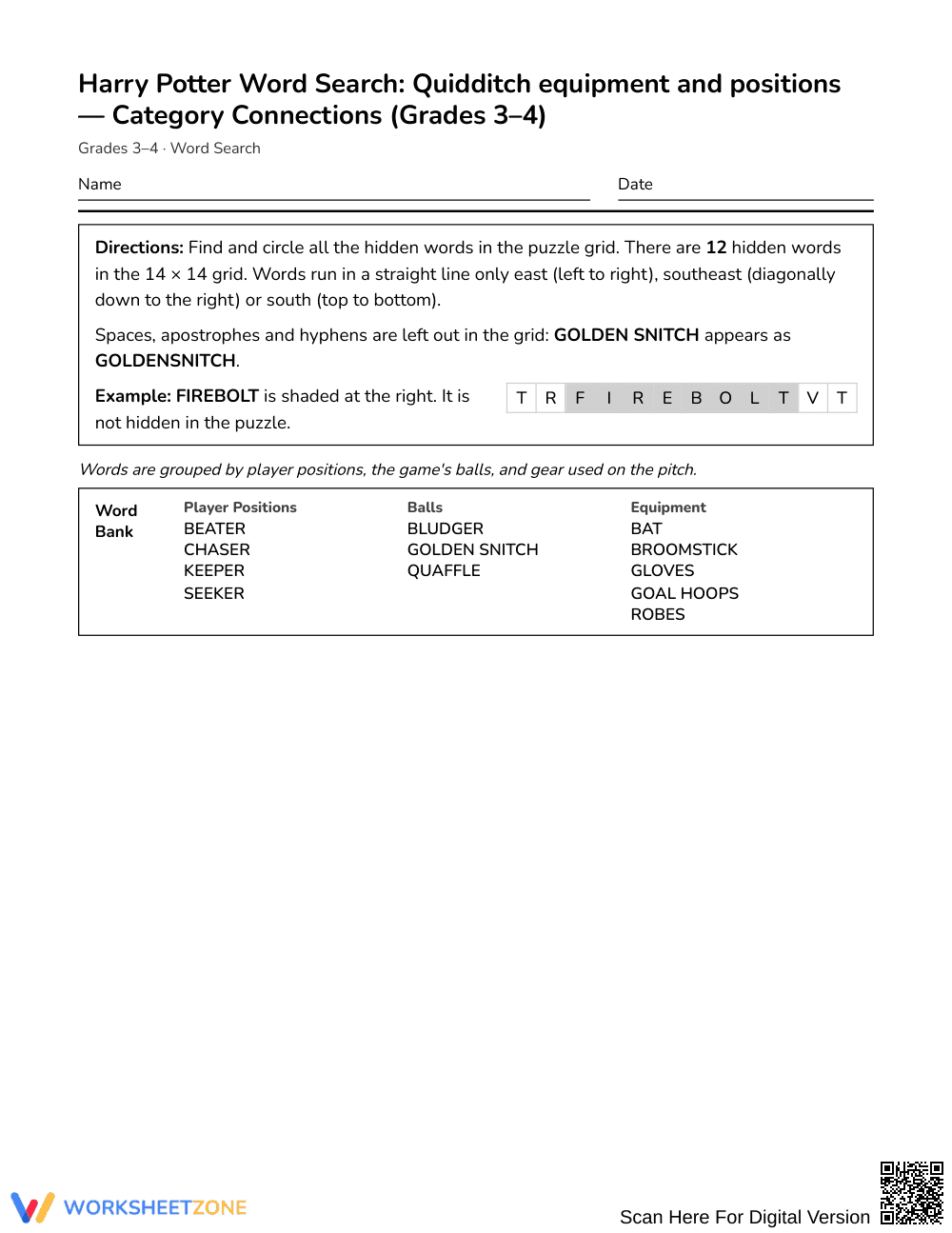
This themed word search builds vocabulary recognition and classification skills for Grades 3–4 learners through engaging literary concepts. Students locate and identify twelve distinct terms associated with the fictional sport of Quidditch, reinforcing spelling patterns and semantic grouping as they connect key player roles, ball types, and athletic equipment from fantasy literature.
At a Glance
- Grade: Grades 3–4 · Subject: English Language Arts
- Standard: Not standards-assessed — vocabulary enrichment
- Skill Focus: Quidditch equipment and positions
- Format: 2 pages · 12 words · Answer key included · PDF
- Best For: Vocabulary enrichment and fast finishers
- Time: 15–25 minutes
What's Inside
This 2-page printable activity features a clean, student-friendly puzzle layout containing twelve targeted vocabulary terms. The word bank organizes items into three conceptual categories: Player Positions, Balls, and Equipment. A complete three-page answer key provides clear visual overlays, allowing educators or students to verify letter coordinates and word paths instantly.
Puzzle Structure and Mechanics
The puzzle utilizes a clear 14 by 14 letter grid designed specifically for developing readers. Hidden terms run in three predictable directions: horizontally to the right (East), diagonally down-right (Southeast), and vertically downward (South). By excluding backward and upward letter paths, the layout maintains accessibility while reinforcing left-to-right visual tracking. Words are directly referenced against the categorized word list, prompting students to categorize concepts while scanning the grid.
Standards Alignment
This activity provides targeted vocabulary enrichment and is not aligned to a specific Common Core or state academic standard. It serves as supplemental literary engagement, supporting context-specific word recognition, orthographic awareness, and thematic classification during novel studies or free-choice literacy blocks.
How to Use It
Deploy this puzzle during independent reading rotations following direct instruction in fantasy novel analysis, or assign it to early finishers to maintain productive engagement. For formative observation, monitor whether learners systematically scan grid rows by initial consonant clusters or match terms using thematic categories. Most students will finish the puzzle within 15 to 25 minutes.
Who It's For
This word search is designed for Grades 3–4 readers exploring narrative fiction or participating in whole-class novel studies. The forward-only search directions offer built-in differentiation for emerging decoders. Pair this activity naturally with a chapter read-aloud of fantasy literature or an interactive classroom vocabulary wall.
According to research synthesized by Fisher & Frey (2014), intentional exposure to specialized domain vocabulary strengthens students' word consciousness and supports deeper reading comprehension across diverse literary genres. While this printable word search is designed specifically for non-standards-assessed vocabulary enrichment rather than formal assessment benchmarks, structured puzzle tasks actively reinforce orthographic mapping, letter recognition, and visual scanning skills for elementary learners. Locating twelve themed words categorized by player positions, balls, and athletic equipment encourages students to examine semantic connections rather than memorizing isolated vocabulary terms. Furthermore, the forward-only letter orientations across the fourteen-by-fourteen grid provide an accessible cognitive challenge that eliminates visual frustration for emerging readers. By integrating themed activities into independent literacy stations, educators establish motivating classroom routines where Grades 3–4 students build confidence, reinforce spelling patterns, and strengthen literary vocabulary retention.


