


























Views
Downloads



Printable Particle Changes Freezing Worksheet | Grade 7
Paste this activity's link or code into your existing LMS (Google Classroom, Canvas, Teams, Schoology, Moodle, etc.).
Students can open and work on the activity right away, with no student login required.
You'll still be able to track student progress and results from your teacher account.
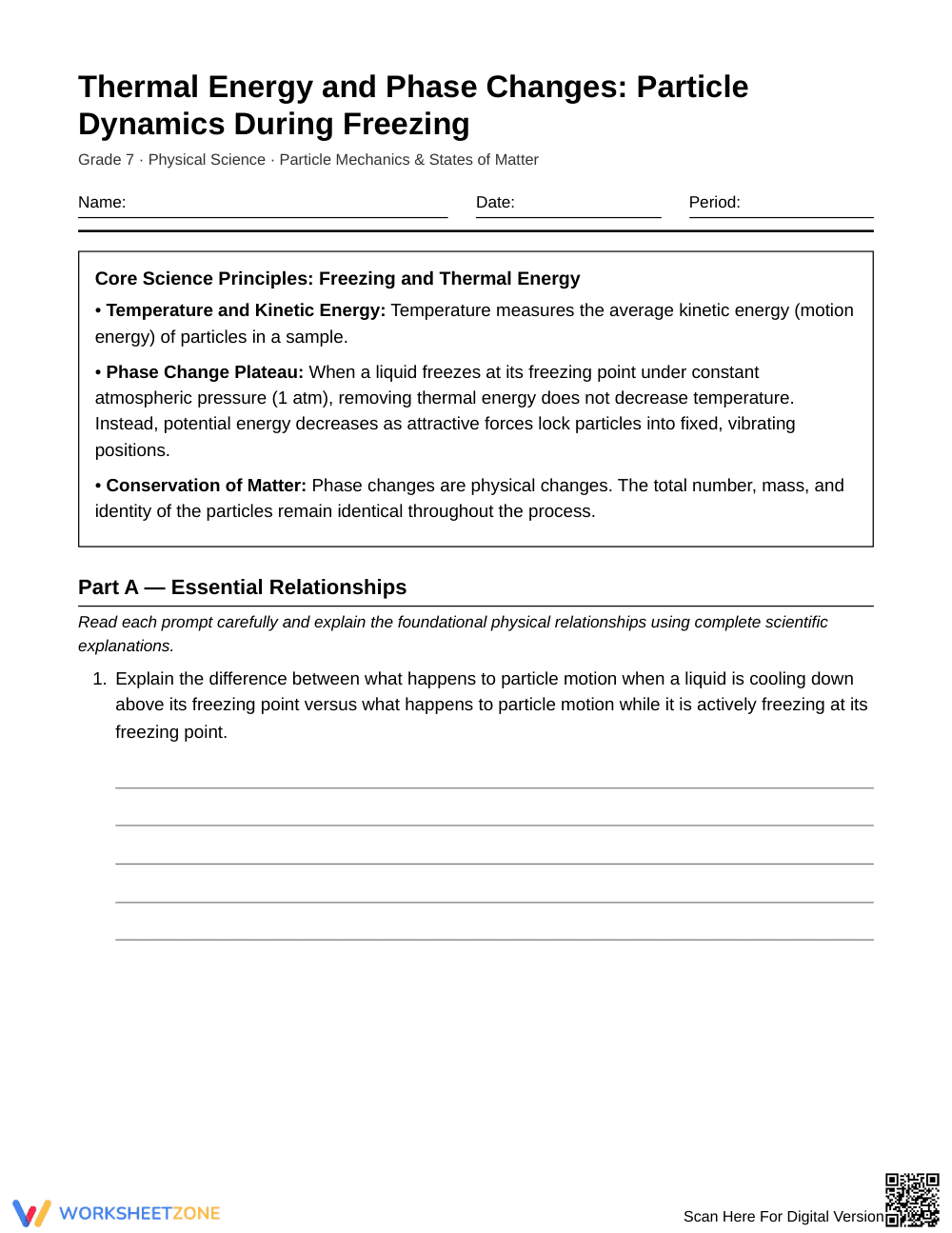
This Grade 7 Science worksheet builds students' ability to explain what happens to particle motion, kinetic energy, and intermolecular forces as a liquid freezes — moving from foundational concept questions through data analysis to scenario-based predictions across 12 structured tasks and 5 pages.
At a Glance
- Grade: 7 · Subject: Science (Physical Science)
- Standard: Thermal Energy & Phase Changes — Particle energy and arrangement
- Skill Focus: Particle dynamics, kinetic vs. potential energy, and intermolecular forces
- Format: 5 pages · 12 problems · Answer key included · PDF
- Best For: Guided practice after direct instruction on phase changes
- Time: 35–50 minutes
Skill Progression
- Guided Practice (Part A, 3 tasks): A rule box defines temperature, kinetic energy, the freezing plateau, and matter conservation. Students use these anchors to write complete scientific explanations.
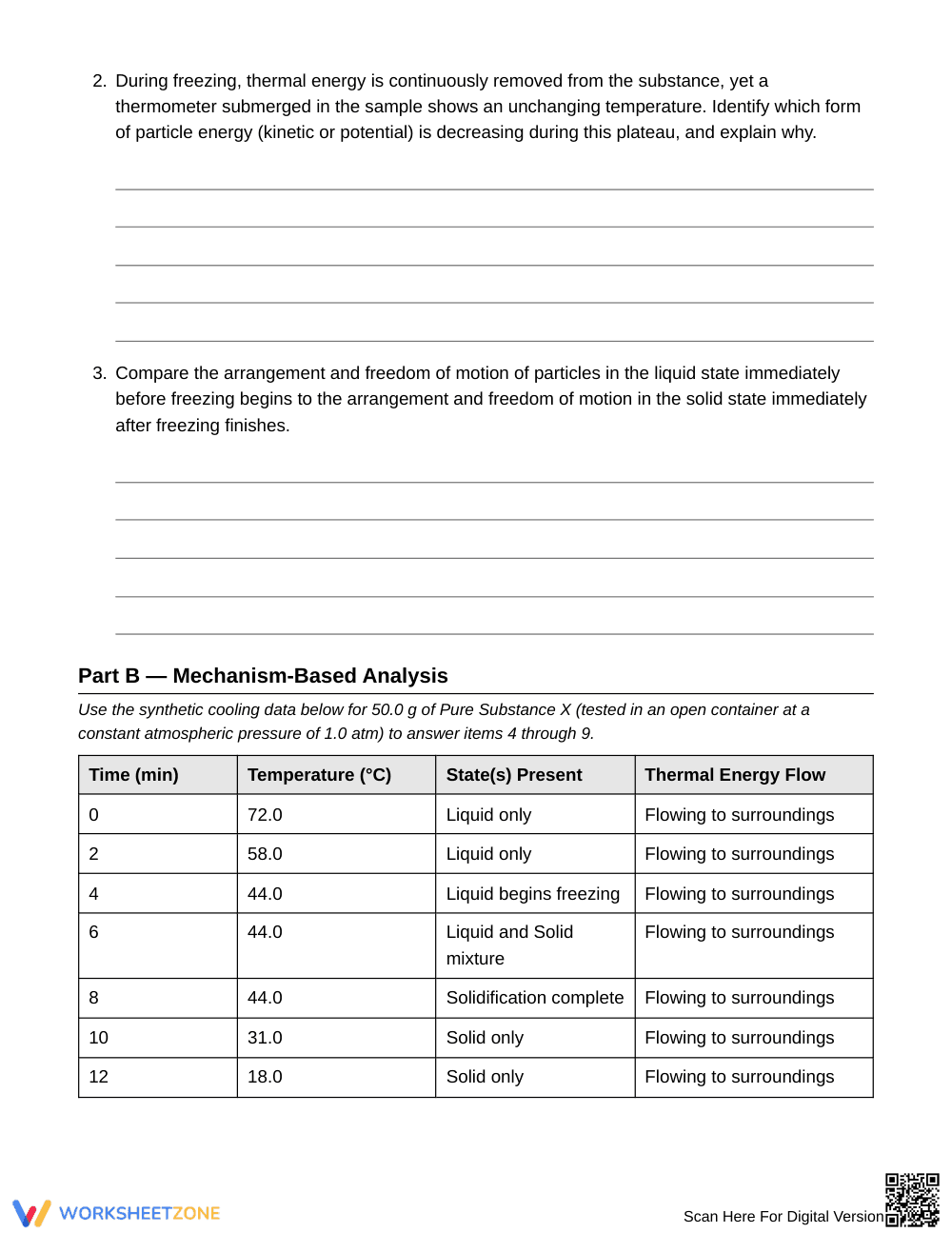
- Supported Practice (Part B, 6 tasks): A cooling-curve data table for 50.0 g of Substance X supplies numerical evidence. Students analyze attractive forces, evaluate misconceptions, and explain lattice formation.
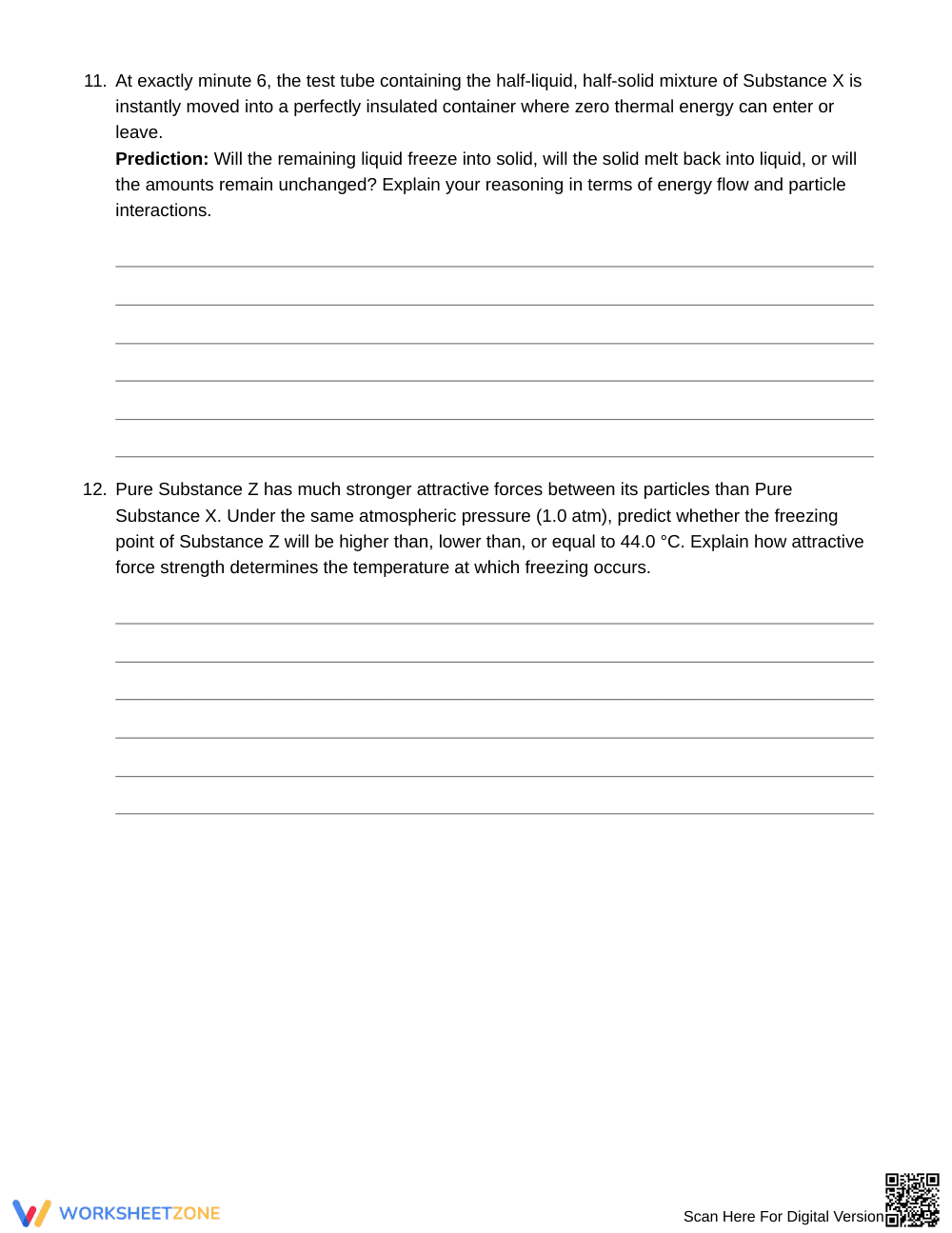
- Independent Practice (Part C, 3 tasks): Students transfer understanding to novel scenarios without scaffolding, generating and justifying predictions about cooling rates and intermolecular forces.
How to Use It
Assign Parts A and B during or immediately after direct instruction on cooling curves and particle kinetics. Use student responses to Part B's peer-claim item as a quick formative checkpoint to ensure learners connect temperature directly to average kinetic energy. Assign Part C as a post-instruction transfer check or exit assessment. Most students complete the full worksheet in 35–50 minutes, while Part C alone serves as a 15-minute independent check.
Who It's For
Designed for Grade 7 physical science students studying thermal energy and states of matter. Scaffolding supports developing learners, while open-ended prediction tasks challenge advanced students. Pairs naturally with cooling-curve demonstrations using substances that produce a visible freezing plateau.
Research consistently links structured, multi-part science worksheets to stronger conceptual retention when instructional tasks progress systematically from initial recall to complex application. Fisher & Frey (2014) demonstrate that gradual-release instructional frameworks — in which students move from teacher-supported prompts to fully independent work within a single learning resource — produce measurable gains in middle school science explanation quality. This worksheet operationalizes that effective pedagogical framework across three sequenced parts: foundational relationship questions, evidence-based cooling data analysis, and open-ended scenario prediction tasks. The core skill focus — explaining particle-level changes during freezing, including kinetic energy shifts and intermolecular forces — directly addresses a persistent conceptual gap documented in Grade 7 physical science assessment data. The structured 12-task design, complete 3-page answer key, and zero-setup PDF format make this resource immediately usable for classroom instruction, sub plans, or homework reinforcement in any physical science unit.


