




























Views
Downloads



Printable Pangaea Evidence Worksheet | Grade 8 Science

Paste this activity's link or code into your existing LMS (Google Classroom, Canvas, Teams, Schoology, Moodle, etc.).
Students can open and work on the activity right away, with no student login required.
You'll still be able to track student progress and results from your teacher account.
This Grade 8 science worksheet teaches students to reconstruct a past arrangement of landmasses from evidence. Students use fossil distributions, rock sequences, and seafloor spreading rates to decide which coasts touched, calculate when landmasses separated, and judge whether a conclusion is actually supported by the data.
At a Glance
- Grade: 8 · Subject: Science
- Standard: No code listed — students use fossil, rock, and seafloor evidence to place landmasses
- Skill Focus: Reconstructing past landmass arrangements from evidence
- Format: 5 pages · 10 problems · Answer key included · PDF
- Best For: Continental drift unit practice and review
- Time: 35–45 minutes
What's Inside
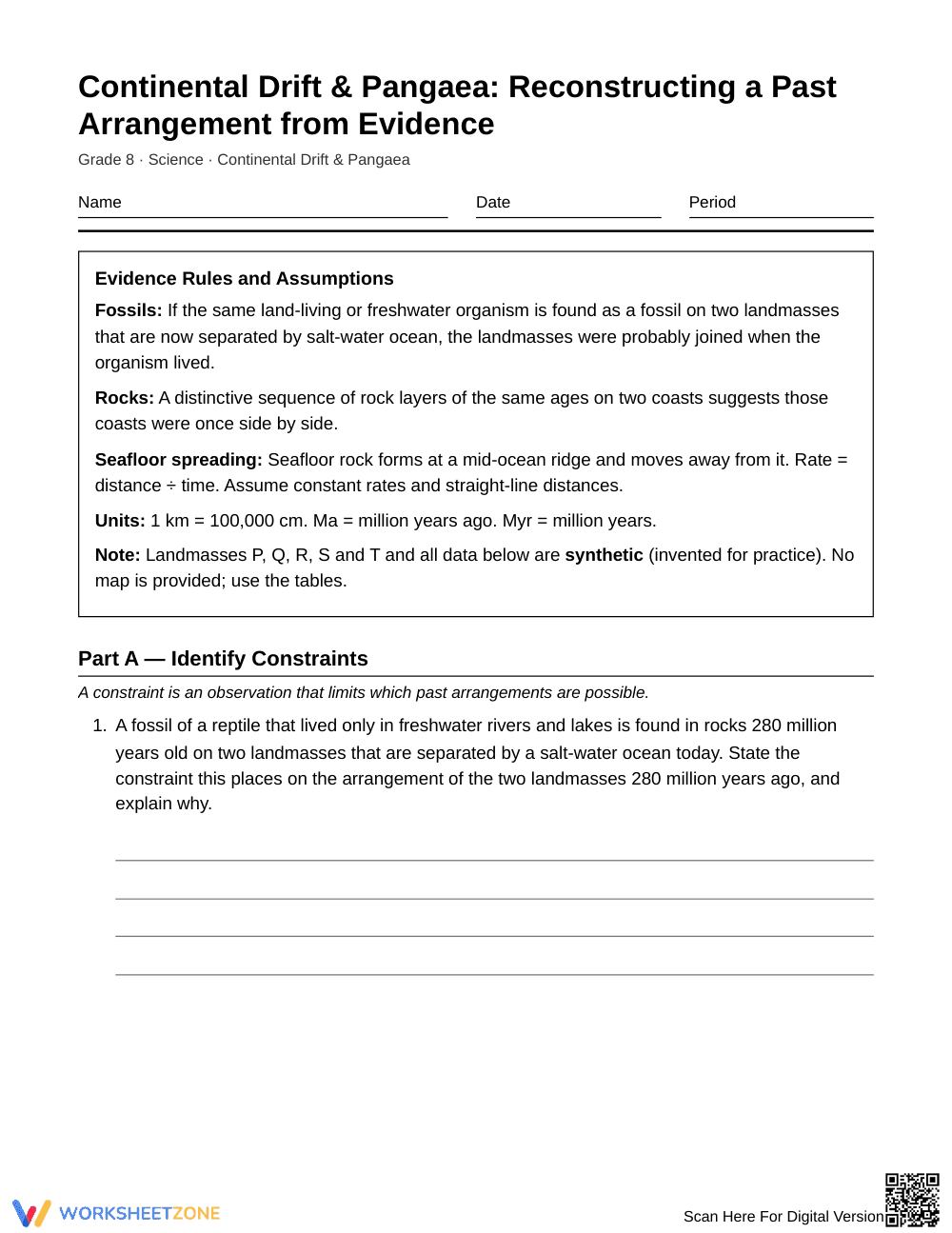
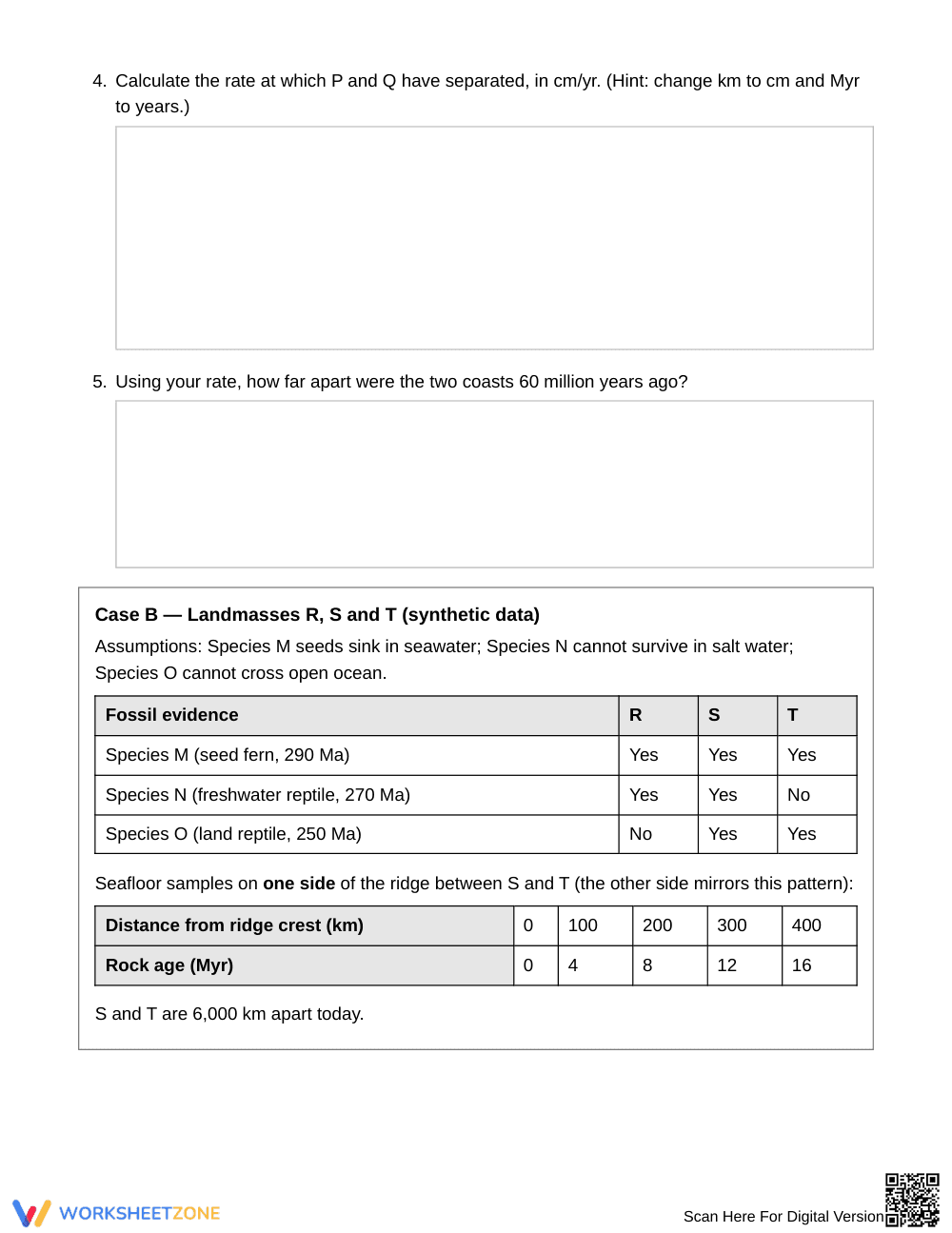
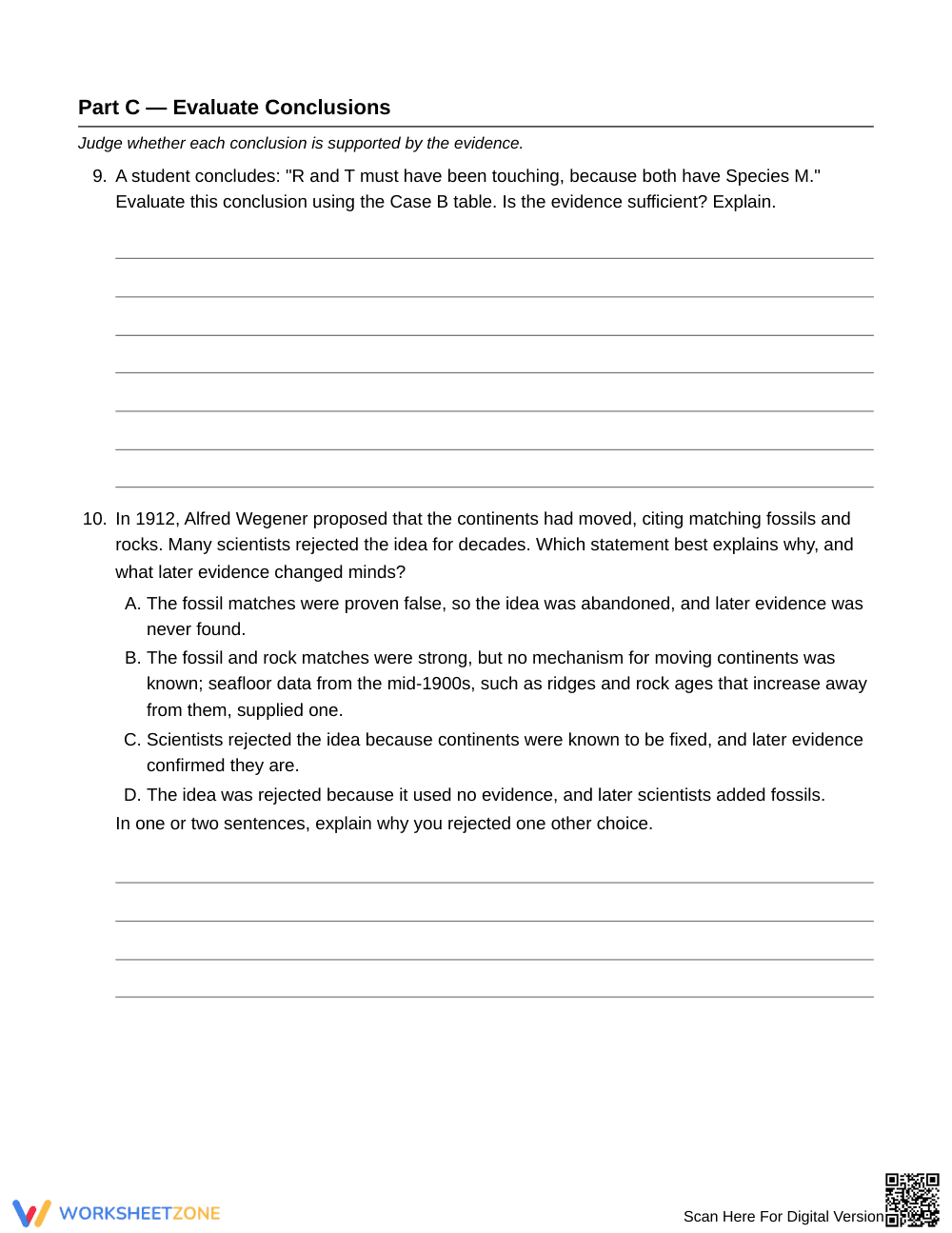
Students work through 10 tasks on 5 pages: multiple-choice constraint questions, data-table reasoning, rate calculations in cm/yr, and a claim-evaluation item with a written justification. A rule box lists evidence principles, assumptions, and unit conversions. All data are synthetic, so no map is needed. A 2-page answer key gives worked calculations and sample reasoning.
Skill Progression
- Guided practice (Part A, 2 problems): A rule box supports students as they identify constraints.
- Supported practice (Part B, 6 problems): Two bounded cases give data tables and a unit-conversion hint.
- Independent practice (Part C, 2 problems): Students evaluate conclusions and justify their choices in writing.
The sequence follows gradual release: I Do, We Do, You Do.
Standards Alignment
No standard code was supplied for this worksheet. The tasks support middle school Earth science expectations that students use evidence such as fossils, rock layers, and seafloor data to explain the motion of continents. Add your district's code to lesson plans, IEP goals, or curriculum maps.
How to Use It
- During instruction: After introducing seafloor spreading, assign Parts A and B to pairs.
- After instruction: Use Part C as an exit task or review.
Observation tip: while students work, check whether they convert km to cm before dividing. Expect 35–45 minutes.
Who It's For
Grade 8 science students studying plate tectonics. Part A suits students who need scaffolds, while Part C stretches strong reasoners. Pair it with a Pangaea anchor chart or a short lesson on seafloor spreading.
The Grade 8 Continental Drift & Pangaea worksheet on reconstructing a past arrangement from evidence asks students to use fossil distributions, matching rock sequences, and seafloor spreading rates to decide which landmasses were once joined. The 5-page set includes 10 tasks across three parts: identifying constraints, applying principles to two synthetic cases, and evaluating conclusions, plus a 2-page answer key. No standard code was supplied for this resource, so alignment should be added locally. The structure follows the gradual release model described by Fisher & Frey (2014), in which teachers move from modeled work to guided practice to independent application. Students calculate separation rates in cm/yr, test them against fossil ages, and explain why some evidence, such as present-day climate, cannot reconstruct the past. The worksheet also traces why Wegener's 1912 proposal was rejected until seafloor data supplied a mechanism. Teachers can use it for practice, review, or assessment preparation.


