


























Views
Downloads
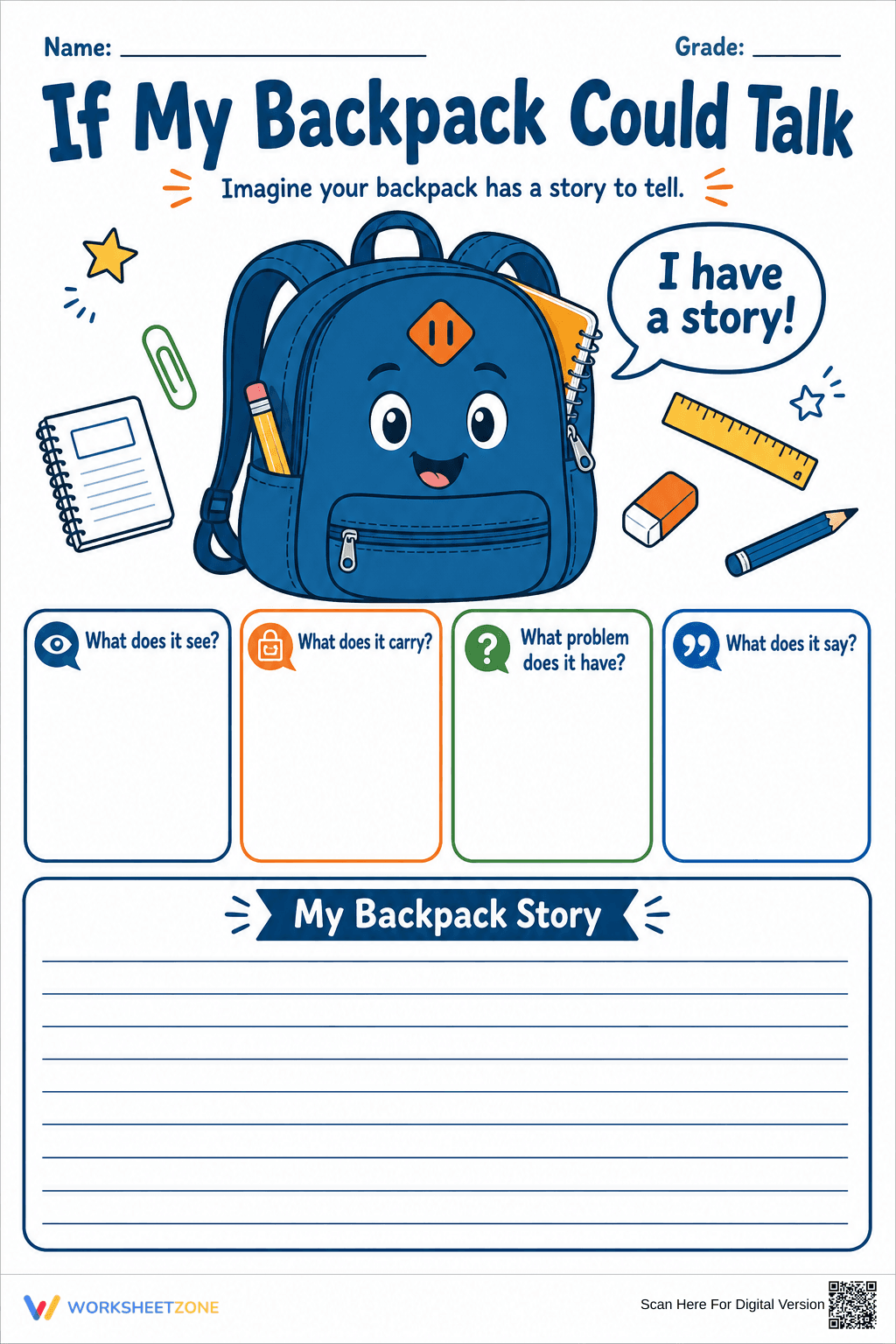

Printable Narrative Writing Worksheet | Grade 4 ELA
Paste this activity's link or code into your existing LMS (Google Classroom, Canvas, Teams, Schoology, Moodle, etc.).
Students can open and work on the activity right away, with no student login required.
You'll still be able to track student progress and results from your teacher account.
This Grade 4 narrative writing worksheet helps students develop personification and storytelling skills by imagining their backpack's perspective. Students use structured brainstorming to build a character before drafting a creative story. It provides a clear framework for transitioning from initial ideas to a cohesive narrative paragraph while encouraging imaginative thinking.
At a Glance
- Grade: 4 · Subject: ELA
- Standard:
CCSS.ELA-LITERACY.W.4.3— Write narratives to develop real or imagined experiences using effective technique- Skill Focus: Narrative Brainstorming
- Format: 1 page · 5 tasks · No answer key · PDF
- Best For: Creative writing prompts and sub plans
- Time: 25–35 minutes
What's Inside
Inside this single-page PDF, you will find four distinct brainstorming prompts designed to spark imagination. These boxes ask students to consider sensory details, internal conflict, and dialogue from the backpack's point of view. Below the planning section, a dedicated lined area titled "My Backpack Story" provides space for students to synthesize their ideas into a final draft.
Zero-Prep Workflow
The zero-prep workflow for this resource is designed for maximum efficiency. First, print the single-page PDF (30 seconds). Second, distribute the sheets to students and provide a brief 1-minute introduction to the concept of personification. Third, review student work as they write or collect the finished stories for a quick formative assessment of narrative structure. Total teacher preparation time is under 2 minutes.
Standards Alignment
This resource is aligned with `CCSS.ELA-LITERACY.W.4.3`, which requires students to write narratives to develop real or imagined experiences or events using effective technique, descriptive details, and clear event sequences. It also supports W.4.3.A by helping students establish a situation and introduce a narrator. Both standard codes can be copied directly into lesson plans, IEP goals, or district curriculum mapping tools.
How to Use It
Use this worksheet as a "hook" at the beginning of a narrative writing unit to engage reluctant writers. It also serves as an excellent formative assessment tool to check if students can maintain a consistent point of view. Expected completion time ranges from 25 to 35 minutes depending on the depth of the final story and the student's writing pace.
Who It's For
This worksheet is ideal for general education Grade 4 students, but the visual cues make it highly accessible for English Language Learners (ELLs) and students with IEPs who benefit from graphic organizers. It pairs naturally with a mentor text about personification or a direct instruction lesson on character development and sensory language.
According to the RAND AIRS 2024 report, providing structured graphic organizers for narrative tasks significantly improves the quality of student writing by reducing cognitive load during the planning phase. This worksheet targets `CCSS.ELA-LITERACY.W.4.3` by guiding students through the essential components of a story: setting the scene, identifying a problem, and developing a narrator's voice. By focusing on the plain-English skill of narrative brainstorming, the resource ensures that students have a concrete plan before they begin the drafting process. Research from Fisher & Frey (2014) emphasizes that scaffolded writing prompts allow students to practice complex literary devices like personification within a manageable framework. This 1-page resource provides exactly that balance, making it a reliable tool for elementary educators seeking to meet rigorous writing standards while maintaining high student engagement through imaginative play.


