




























Views
Downloads

Printable Farm Tools Word Search | Grades 3–4 ELA

Paste this activity's link or code into your existing LMS (Google Classroom, Canvas, Teams, Schoology, Moodle, etc.).
Students can open and work on the activity right away, with no student login required.
You'll still be able to track student progress and results from your teacher account.
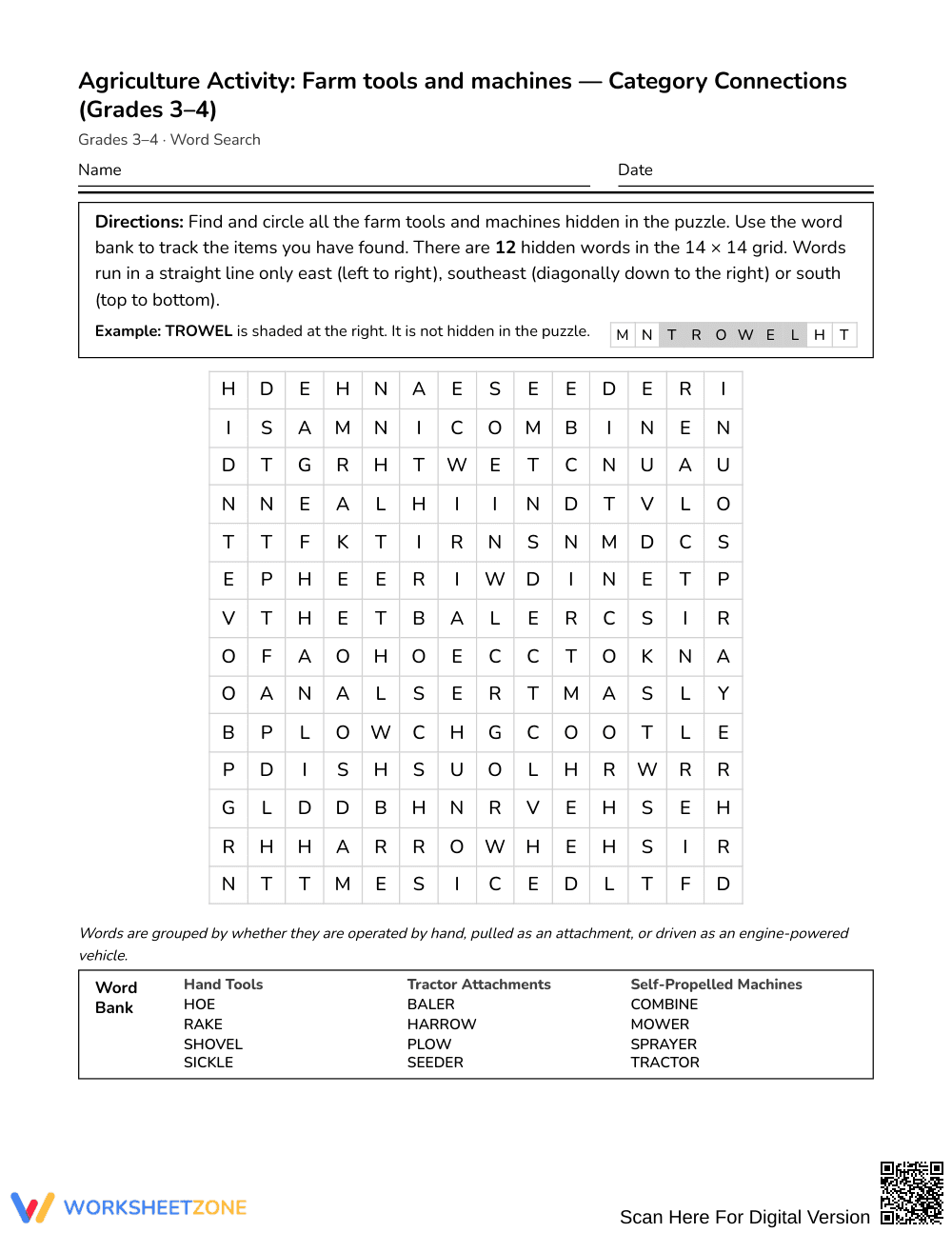
This agricultural vocabulary word search reinforces domain-specific terminology for Grades 3–4 learners through active word recognition. Students locate 12 agricultural vocabulary terms while exploring how farming equipment is classified by mechanical function, expanding functional reading vocabularies and building topical background knowledge across elementary science and English language arts units.
At a Glance
- Grade: Grades 3–4 · Subject: English Language Arts (ELA)
- Standard: Not standards-assessed — vocabulary enrichment
- Skill Focus: Farm tools and machines
- Format: 1 pages · 12 words · Answer key included · PDF
- Best For: Vocabulary centers, fast finishers, sub plans
- Time: 15–25 minutes
What's Inside
The activity sheet features a 1-page puzzle containing 12 vocabulary terms organized into a clear, categorized word bank. Vocabulary words are paired with student-friendly definitions and grouped into three operational types: hand tools, tractor attachments, and self-propelled machines. A complete 3-page solution key is included to allow effortless teacher verification or student self-checking.
Puzzle Architecture & Mechanics
Designed for third and fourth graders, the puzzle uses an accessible layout to maintain high student engagement without unnecessary frustration:
- 14 × 14 Grid Layout: A compact grid balances letter density with visual clarity, keeping search paths manageable.
- Controlled Search Directions: Words run strictly East (horizontal left-to-right), South (vertical top-to-bottom), and Southeast (diagonal downward-right), avoiding reverse-spelling confusion.
- Categorized Word Bank: Words are explicitly clustered by equipment function, reinforcing conceptual categorization as students identify each item.
Standards Alignment
This activity is designed for vocabulary enrichment and is not aligned to a specific academic standard. It provides supplementary domain-specific language practice to support cross-curricular agriculture, social studies, and informational reading units.
How to Use It
Introduce this puzzle after an informational reading lesson on agriculture, or place it at an independent literacy center. For a quick formative check, ask students to explain orally why an item belongs to its specific category (such as attachments versus hand tools) before circling it. Students typically finish the 12 words in 15 to 25 minutes.
Who It's For
This resource is tailored for Grades 3–4 students seeking vocabulary building, English learners building concrete noun schema, and independent workers needing meaningful enrichment. Pair this puzzle with an informational text or anchor chart depicting modern agricultural machinery.
Domain-specific vocabulary acquisition functions as a foundational cornerstone for reading comprehension across elementary informational texts. According to Fisher & Frey (2014), intentional exposure to technical terminology within structured categorizations significantly accelerates conceptual schema development and improves word retrieval in young readers. This word search provides structured repetition of 12 agricultural terms across a clean 14 by 14 letter matrix, directing students through horizontal, vertical, and diagonal paths. By linking concrete tool labels like baler, combine, and sickle with operational definitions, students connect written language to tangible physical functions. Research underscores that multi-sensory puzzle activities lower cognitive anxiety during independent seatwork while reinforcing orthographic memory. Incorporating categorized word banks ensures intermediate elementary students strengthen classification habits, transforming casual puzzle completion into a meaningful literacy exercise that bolsters general background knowledge across grade-level reading contexts.


