


























Views
Downloads


Printable Energy During Melting Worksheet | Grade 7 Science
Paste this activity's link or code into your existing LMS (Google Classroom, Canvas, Teams, Schoology, Moodle, etc.).
Students can open and work on the activity right away, with no student login required.
You'll still be able to track student progress and results from your teacher account.
This physical science worksheet helps middle school students master the relationship between thermal energy, particle movement, and phase changes during melting. Through quantitative thermal energy calculations and particle-level conceptual analysis, students discover why temperature remains constant during phase transitions and differentiate between kinetic temperature changes and latent phase change energy.
At a Glance
- Grade: 7 · Subject: Science
- Standard:
Middle School Physical Science— Track energy flow and particle behavior during phase transitions- Skill Focus: Tracing thermal energy during melting
- Format: 5 pages · 10 problems · Answer key included · PDF
- Best For: Guided practice and conceptual check
- Time: 35–45 minutes
What's Inside
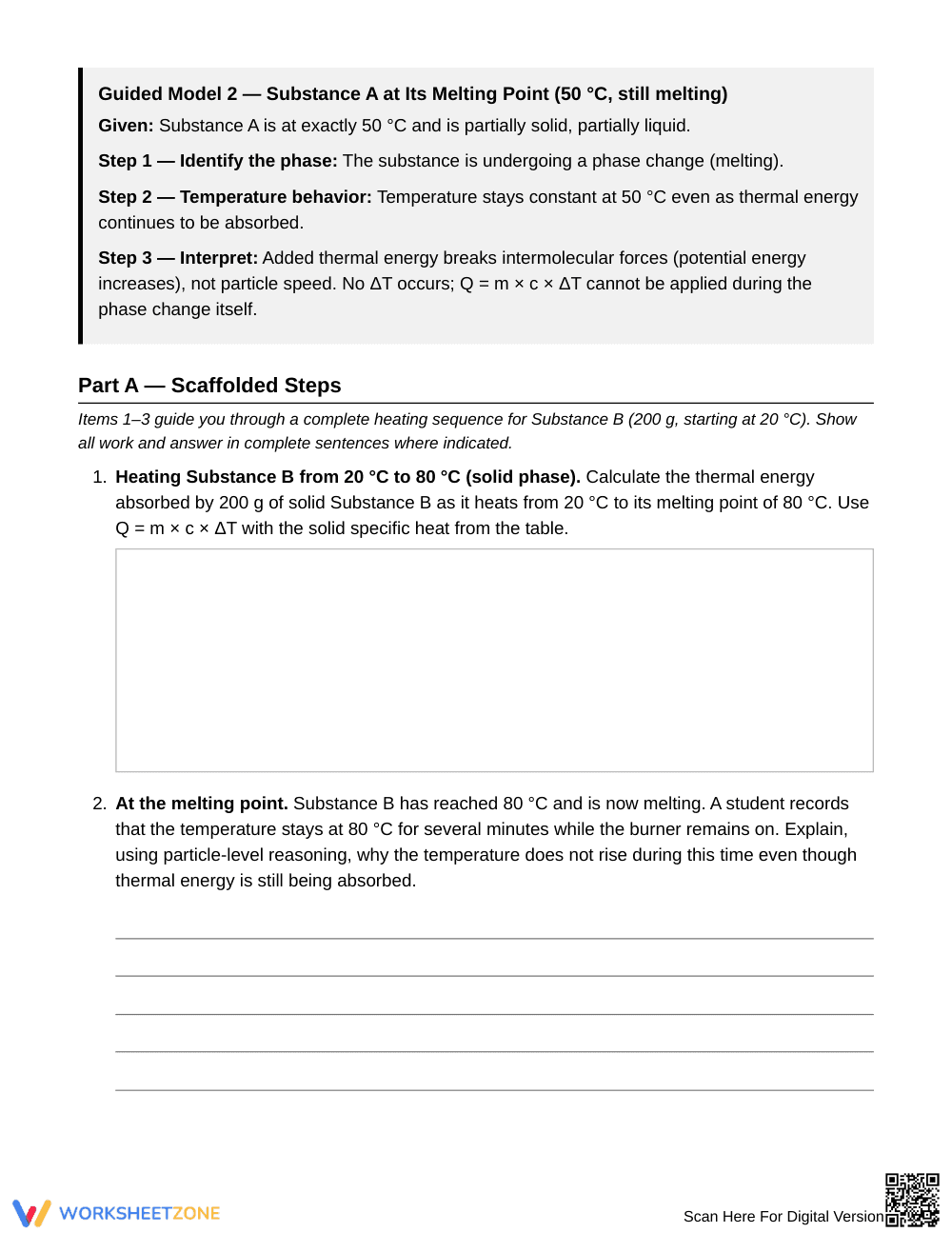
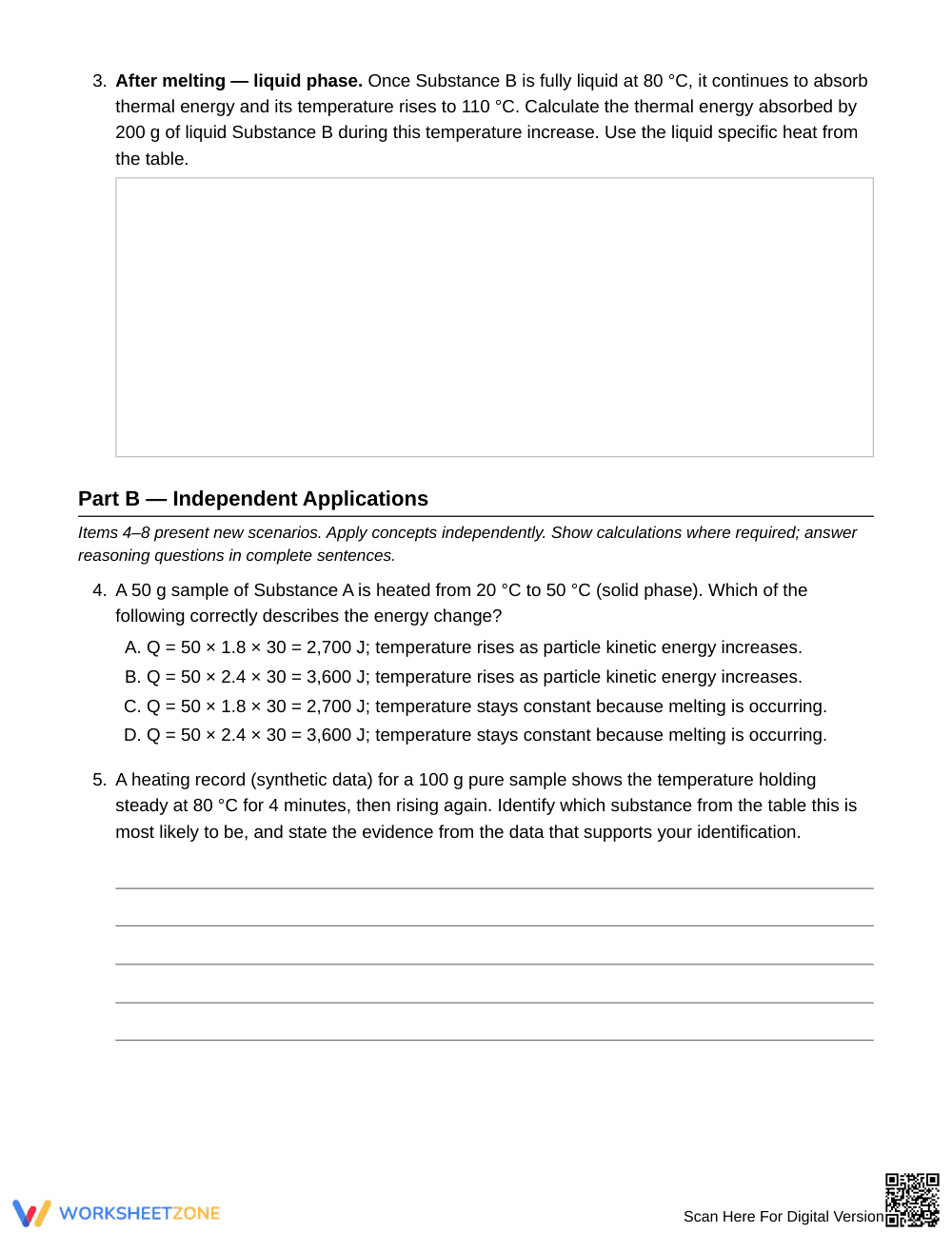
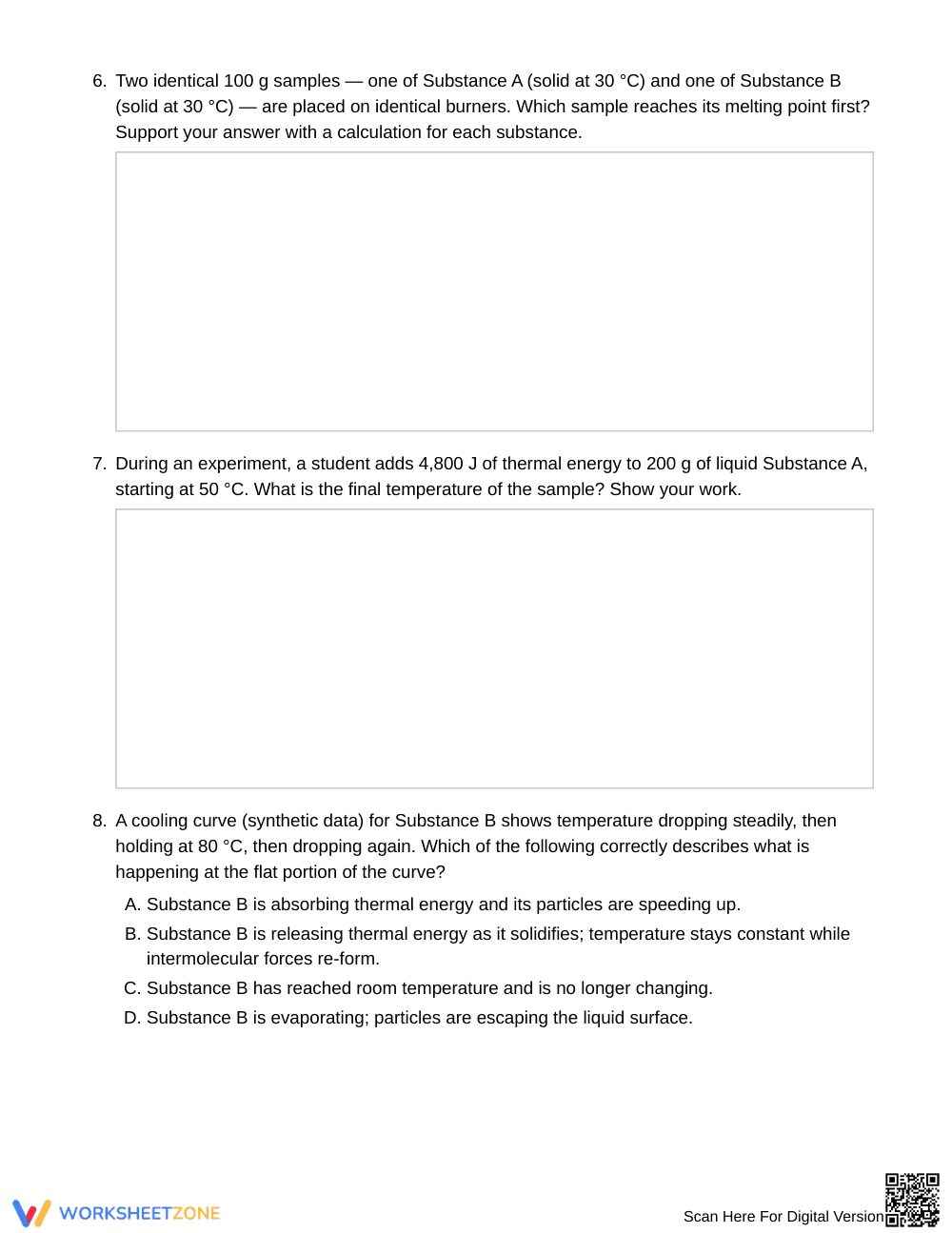
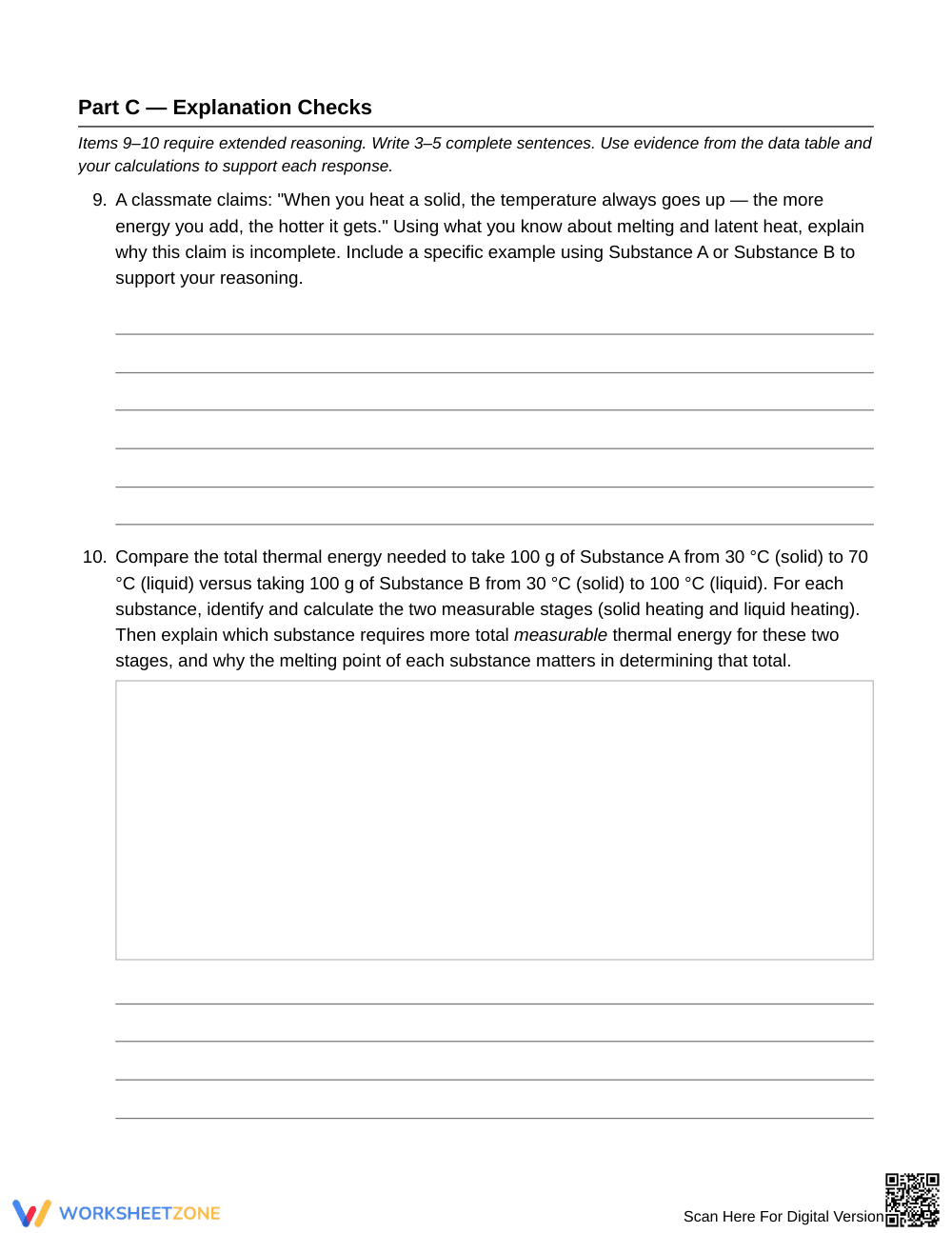
This 5-page resource contains a synthetic reference data table, two fully worked guided models, 10 structured tasks, and a complete 5-page answer key. Students analyze specific heat values, apply the thermal energy formula Q = m × c × ΔT for single-phase heating, interpret constant temperature plateaus, and evaluate extended scientific explanations.
Skill Progression
- Guided practice (Items 1–3): Direct application of thermal calculations and conceptual explanations across a sequential three-step heating scenario with explicit formulas.
- Supported practice (Items 4–8): Independent multi-step calculations, multiple-choice conceptual checks, and comparative rate analyses across two distinct substances.
- Independent practice (Items 9–10): Extended constructed-response explanation checks requiring multi-step quantitative calculations and evidence-based scientific argumentation.
This structured progression utilizes a gradual-release instructional model that transitions learners from guided computation to rigorous conceptual synthesis.
Standards Alignment
This resource aligns to middle school physical science standards requiring students to develop models showing that adding or removing thermal energy changes particle motion, temperature, and state of a pure substance. Both standard concepts and analytical skills can be copied directly into lesson plans, IEP goals, or district curriculum mapping tools.
How to Use It
Administer this worksheet directly after introducing thermal energy formulas and phase change diagrams. For guided group work, have students complete Part A in pairs before verifying calculations as a class. For formative assessment, examine Item 2 and Item 9 to check whether students recognize that absorbed energy breaks intermolecular bonds rather than increasing temperature during melting. Completion requires 35 to 45 minutes.
Who It's For
Designed for Grade 7 general science and physical science classrooms, this worksheet supports diverse learners through structured formulas and step-by-step models. It provides targeted practice for students needing reinforcement in phase changes and pairs naturally with a hands-on ice melting lab or heating curve interactive simulation.
Tracing thermal energy transfers during phase changes requires middle school science students to coordinate quantitative formulas with qualitative particle-level models. Educational research from Fisher & Frey (2014) highlights that structured gradual-release frameworks significantly enhance student mastery of complex physical science concepts by bridging worked examples and independent scientific argumentation. This 10-problem Grade 7 science worksheet guides students through the thermodynamics of melting, emphasizing that added thermal energy increases kinetic particle motion during solid heating but disrupts intermolecular forces during isothermal phase transitions. By working through guided calculations with synthetic data sets and evaluating flawed claims regarding temperature rise, students build a robust foundation in thermal energy conservation and phase change mechanics that supports ongoing success across secondary physical science curricula.


