


























Views
Downloads



Printable Dominance & Frequency Worksheet | Grade 9 Biology
Paste this activity's link or code into your existing LMS (Google Classroom, Canvas, Teams, Schoology, Moodle, etc.).
Students can open and work on the activity right away, with no student login required.
You'll still be able to track student progress and results from your teacher account.
This worksheet helps Grade 9 biology students explain what dominance means and what it does not. Students separate how alleles interact inside one organism from how common an allele is, using crosses, enzyme-activity tables, and breeding records. They finish able to justify a dominance claim with evidence.
At a Glance
- Grade: 9 · Subject: Biology
- Standard: Complete dominance in single-gene inheritance — explain dominance as allele interaction, not commonness.
- Skill Focus: Explaining dominance without frequency assumptions
- Format: 5 pages · 12 problems · Answer key included · PDF
- Best For: Genetics unit practice and review
- Time: 35–45 minutes
What's Inside
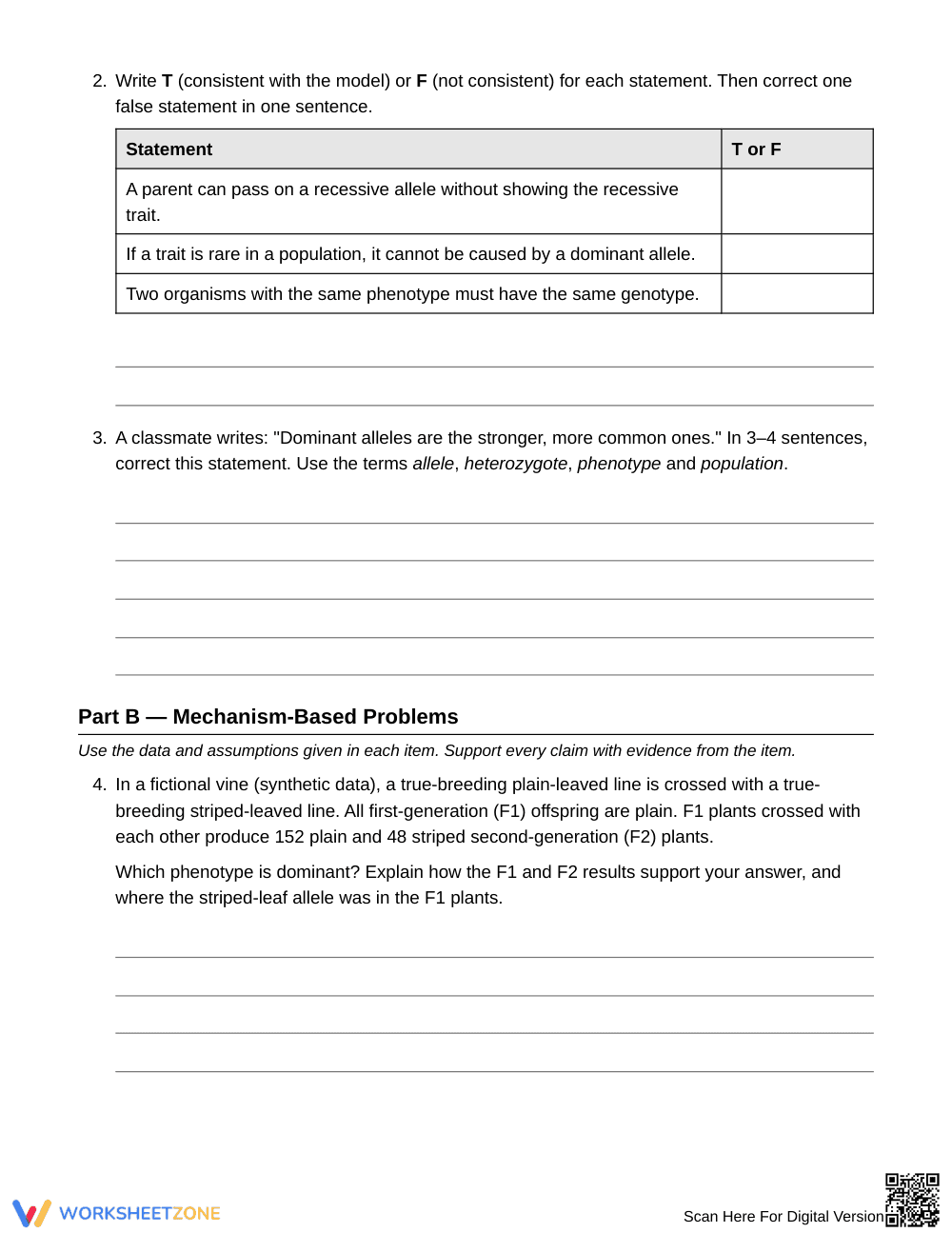
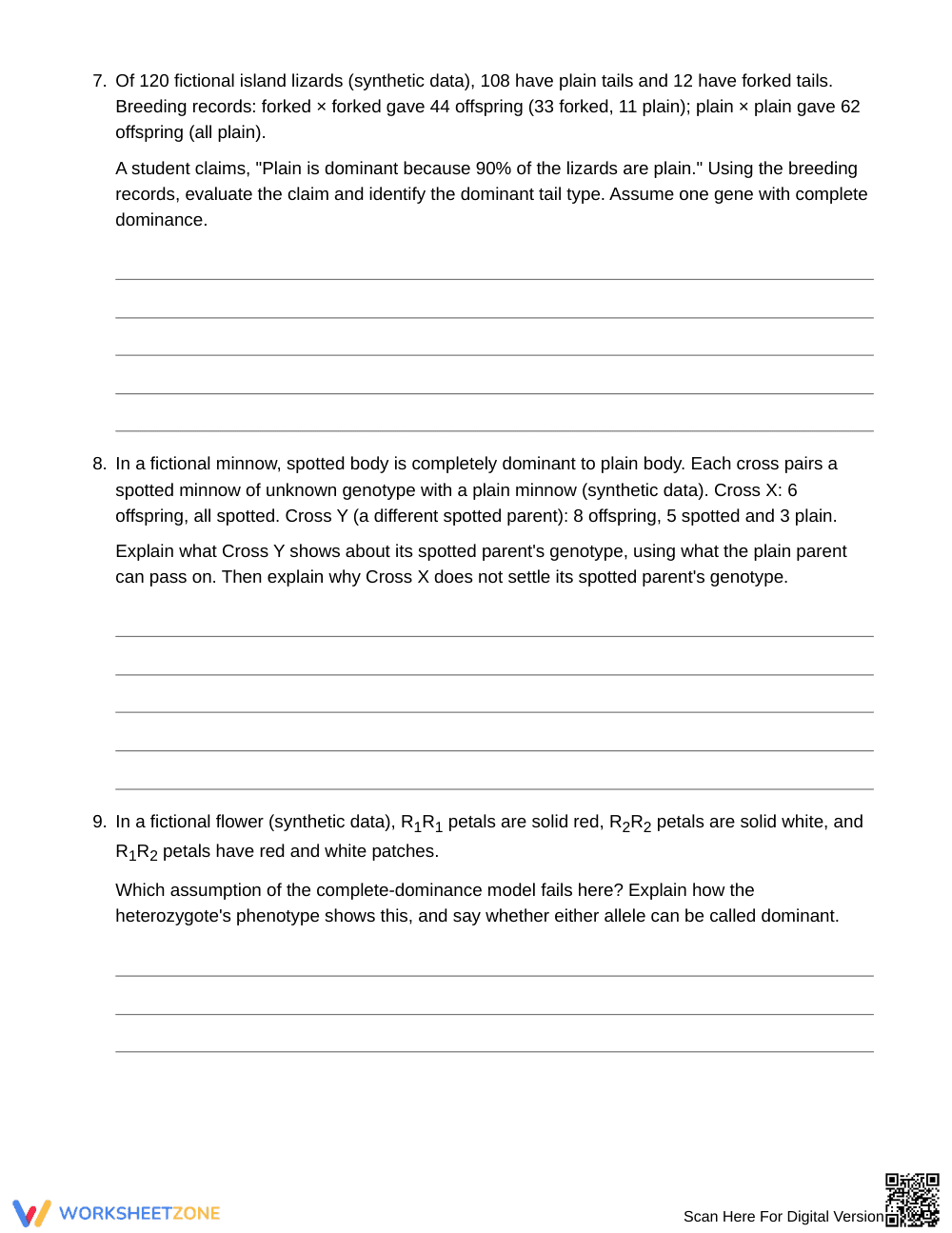
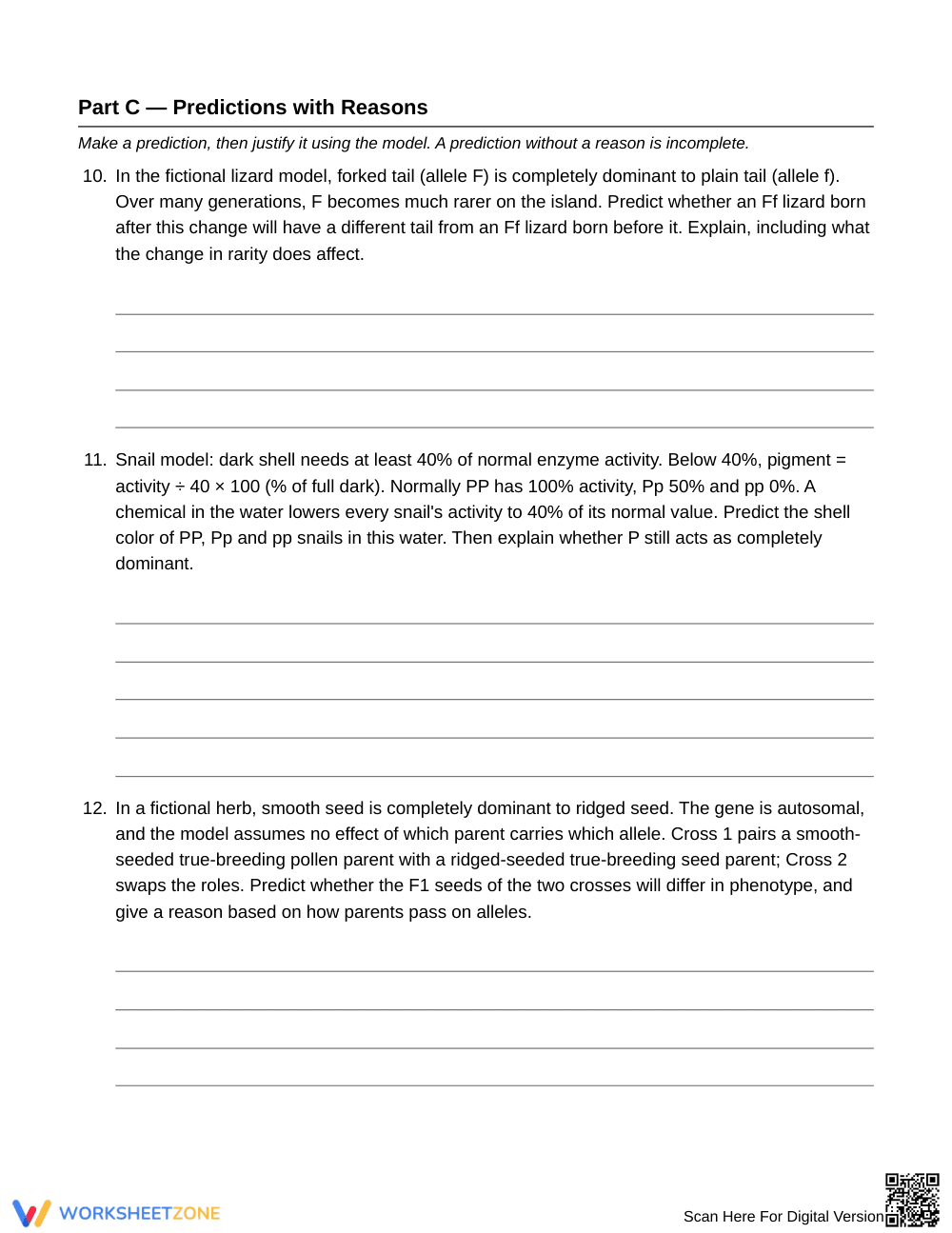
Twelve tasks run across 5 pages, with a 4-page answer key. Part A has three relationship items: multiple choice, a true/false table with a correction, and a misconception rewrite. Part B has six data problems using crosses, enzyme tables, and breeding records. Part C has three predictions that require reasons. A reminder box defines key terms and states the model assumptions.
Skill Progression
- Guided practice: Part A, 3 tasks, with the reminder box and model assumptions in view.
- Supported practice: Part B, 6 tasks, with data in every item and a demand to cite evidence.
- Independent practice: Part C, 3 tasks, applying the model to a rarer allele, a chemical change, and reciprocal crosses.
This follows gradual release: I Do (model one Part A item), We Do (work Part B together), You Do (students complete Part C alone).
Standards Alignment
No standard code is attached to this resource. It addresses the core high school idea that phenotypes result from how alleles are inherited and interact. Add your state or district code when copying it into lesson plans or curriculum mapping tools.
How to Use It
- After direct instruction on single-gene crosses: assign as in-class practice.
- Before a unit quiz: use Parts B and C as review.
Observation tip: listen for students equating dominant with common, then ask them to point to evidence in the item. Expect 35–45 minutes.
Who It's For
Grade 9 biology students in a first genetics unit. Students who need support can complete Part A with the reminder box open, while others can extend Part C into full written explanations. Pair it with a Punnett square anchor chart or a lesson on Mendel's pea crosses.
Explaining Dominance Without Frequency Assumptions is a Grade 9 Biology worksheet for the Genetics & Heredity unit. Students practice one skill: explaining that complete dominance describes how two alleles interact in a heterozygote, not how common an allele is or whether it is helpful. Twelve tasks across 5 pages move from definitions and true/false checks to enzyme-activity data, breeding records, test crosses and predictions with reasons, and a 4-page answer key is included. The structure follows the gradual release of responsibility model described by Fisher & Frey (2014), in which learners shift from guided work to independent application. Because each item uses fictional organisms and synthetic numbers, students must reason from the evidence given rather than recall textbook examples. The worksheet targets the common misconception that dominant alleles are stronger or more frequent, and it also tests where the model's assumptions fail, such as with patchy flower phenotypes. It suits instruction, review, and formative assessment.


