




























Views
Downloads



Printable Decimals to Fractions Worksheet | Grade 6 Math

Paste this activity's link or code into your existing LMS (Google Classroom, Canvas, Teams, Schoology, Moodle, etc.).
Students can open and work on the activity right away, with no student login required.
You'll still be able to track student progress and results from your teacher account.
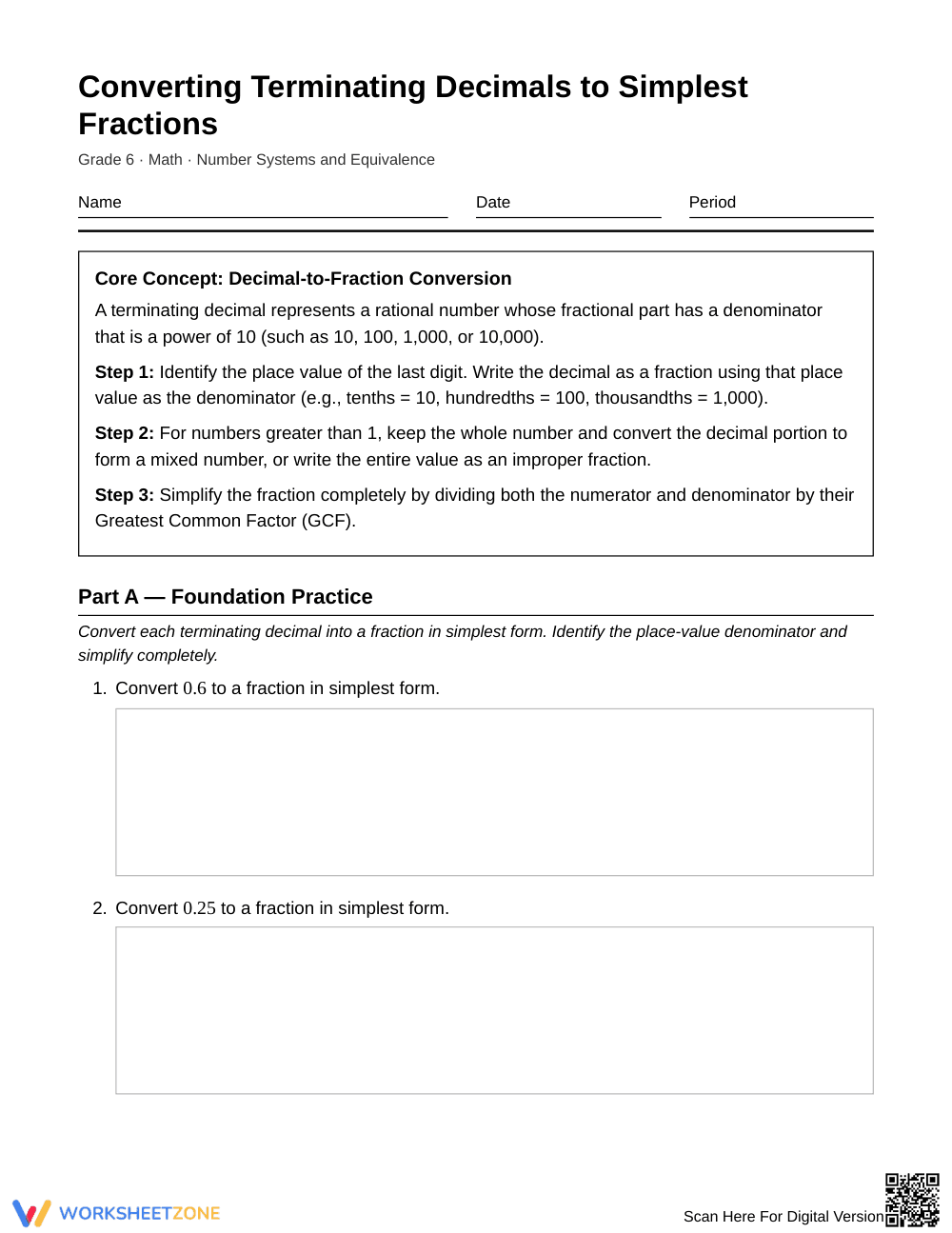
This printable Grade 6 worksheet builds fluency in converting terminating decimals to fractions in simplest form across 18 carefully sequenced problems. Students practice identifying place-value denominators, applying the Greatest Common Factor (GCF), and expressing results as proper fractions, improper fractions, and mixed numbers.
At a Glance
- Grade: 6 · Subject: Math
- Standard: Number Systems & Equivalence — Convert terminating decimals to equivalent fractions in simplest form
- Skill Focus: Decimal-to-fraction conversion using place value and GCF
- Format: 5 pages · 18 problems · Answer key included · PDF
- Best For: Guided practice and independent skill reinforcement
- Time: 30–45 minutes
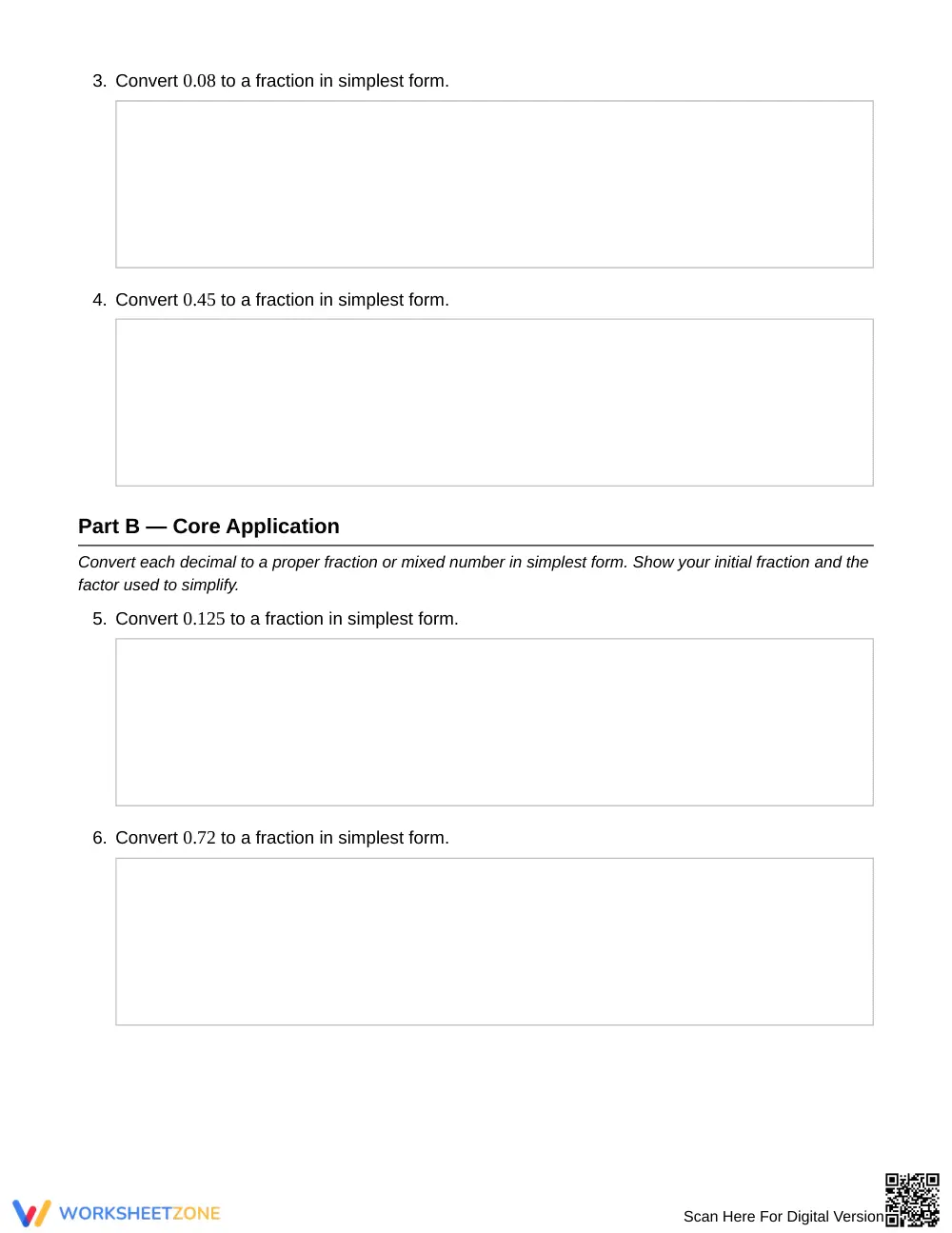
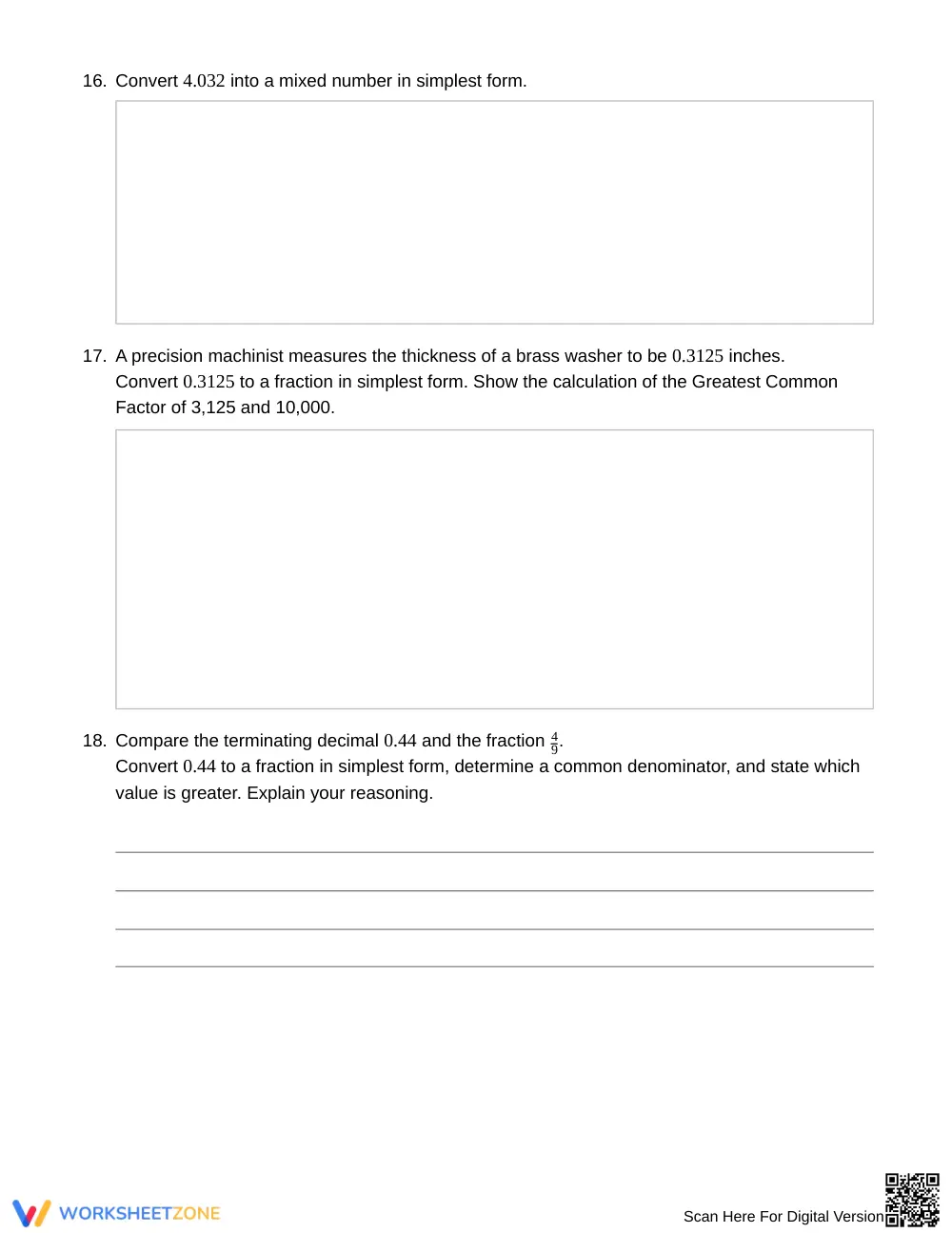
The worksheet is organized into three labeled parts. Part A (Foundation Practice) contains 4 problems with straightforward tenths and hundredths decimals such as 0.6 and 0.25. Part B (Core Application) includes 10 problems featuring mixed numbers and two real-world contexts — a track athlete's split time and a laboratory specimen mass. Part C (Challenge & Extension) presents 4 multi-step problems, including a ten-thousandths conversion and a comparison task requiring students to find a common denominator and justify their reasoning. A full answer key covers all 18 items.
- Guided practice (Part A, 4 problems): Students convert simple decimals with a Core Concept rule box visible above, fully modeling the three-step conversion process.
- Supported practice (Part B, 10 problems): Students show their initial fraction and the factor used to simplify, providing a structured workspace. Thousandths and mixed numbers appear here.
- Independent practice (Part C, 4 problems): Multi-step challenges with no additional scaffolding, mirroring the gradual-release (I Do, We Do, You Do) model.
How to Use It
Assign Part A as a warm-up after direct instruction on place value and GCF review. Use Parts B and C to gauge depth of understanding. As a formative-assessment tip: scan Part B problem 9 (2.375) — students who correctly identify thousandths and apply GCF = 125 are ready for Part C; those who stall need GCF reteaching. Expected completion time is 30–45 minutes for a full session, or Parts A–B alone in 20–25 minutes.
Who It's For
This worksheet suits Grade 6 students within a fractions-and-decimals unit and also serves as review for Grade 7 students consolidating rational number fluency. Students needing support benefit from pairing it with a place-value anchor chart; those ready for extension will find the Part C comparison task a natural bridge to ordering rational numbers on a number line.
Fluency with decimal-to-fraction conversion is a foundational rational number skill for Grade 6 students. This worksheet addresses the core understanding that terminating decimals have exact fractional equivalents determined by place value, simplified through the Greatest Common Factor. According to Fisher & Frey (2014), structured gradual-release frameworks — in which modeled examples precede supported and then independent practice — significantly improve procedural accuracy and conceptual retention in middle-grades mathematics. This 18-problem resource applies that framework directly: a rule box models the process, Part B requires intermediate steps, and Part C demands multi-step reasoning. The included answer key supports immediate corrective feedback, a practice consistently linked to stronger skill retention. Teachers can use this worksheet for in-class practice, homework, or sub-plan assignments without additional preparation.


