




























Views
Downloads


Printable Cosmic History Word Search | Grades 7–8 Science

Paste this activity's link or code into your existing LMS (Google Classroom, Canvas, Teams, Schoology, Moodle, etc.).
Students can open and work on the activity right away, with no student login required.
You'll still be able to track student progress and results from your teacher account.
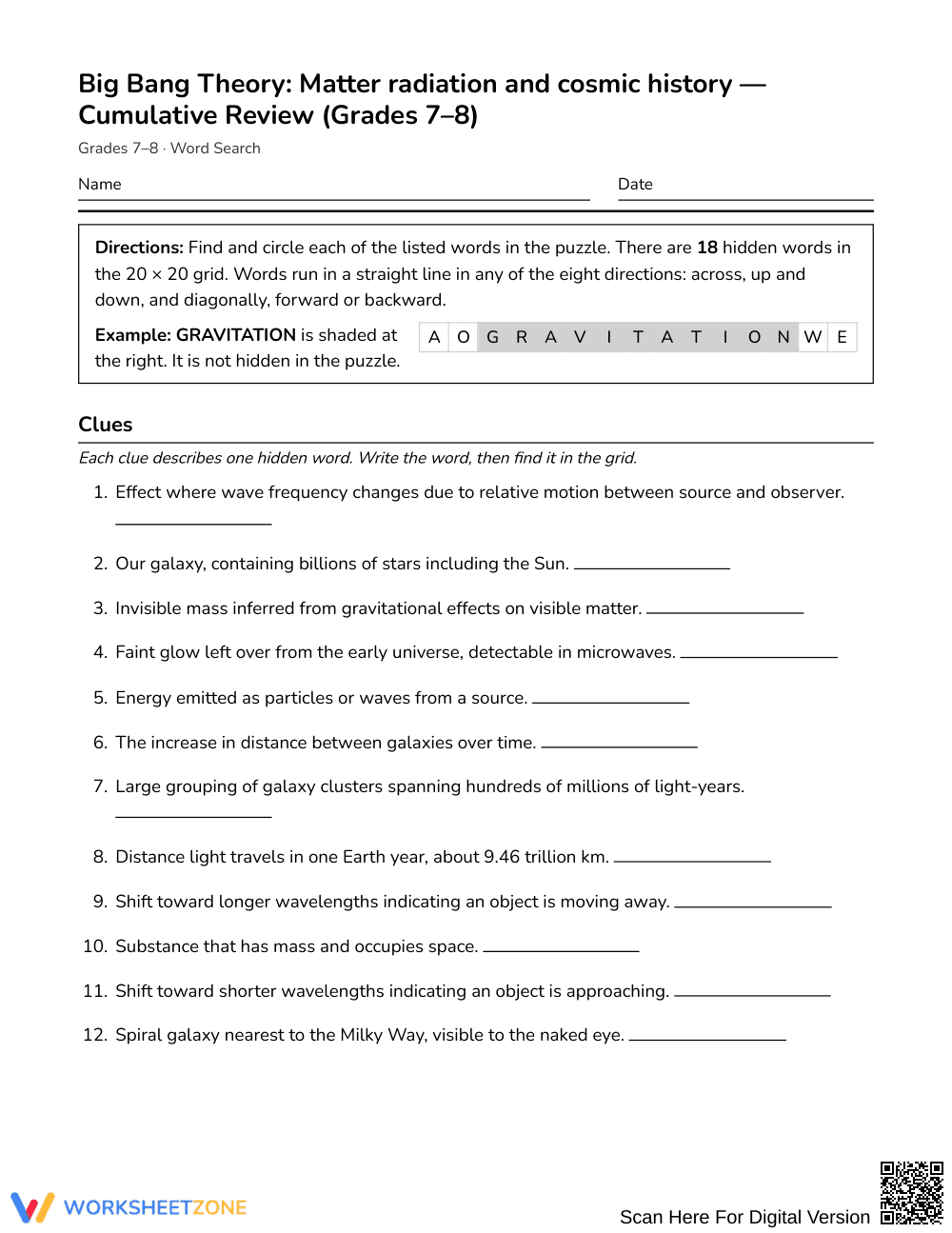
This astronomy word search reinforces essential vocabulary covering matter, radiation, and cosmic history for middle school science students. Learners identify 18 critical terms connected to the Big Bang Theory and galactic expansion while matching each term to its scientific definition. The activity strengthens domain-specific literacy, consolidates core astronomical concepts, and provides an engaging, low-stakes cumulative review.
At a Glance
- Grade: Grades 7–8 · Subject: Science (Astronomy Unit)
- Standard: Not standards-assessed — vocabulary enrichment and content review
- Skill Focus: Matter, radiation, and cosmic history vocabulary retention
- Format: 3 pages · 18 words · Complete answer key included · PDF printable
- Best For: Mid-unit vocabulary practice and cumulative review
- Time: 20–30 minutes of independent student work
What's Inside
This 3-page printable science resource contains a complete 18-word puzzle alongside content-rich definition clues. Students read scientific descriptions for phenomena such as nucleosynthesis, redshift, cosmic background radiation, and dark matter before identifying each term within the grid. The shuffled word bank challenges learners to connect concepts to definitions rather than relying on rote memorization. A full 3-page solution set with circled letter locations is included for rapid evaluation.
Puzzle Structure and Mechanics
The word search is designed around a dense 20 x 20 letter grid that provides an authentic cognitive challenge for middle school students. The 18 target vocabulary words are hidden across all eight compass directions: north, northeast, east, southeast, south, southwest, west, and northwest. Forward and backward diagonal placements require careful visual scanning and pattern recognition. Because the accompanying word bank is presented with clear content clues, students must actively recall astronomical terminology to complete the puzzle successfully.
Standards Alignment
This supplementary science resource serves strictly as vocabulary enrichment and cumulative content review. It is not aligned to a formal state standard or Common Core code. Instead, it provides focused reinforcement of domain-specific terminology that supports broader middle school astronomy and space science curricula.
How to Use It
Deploy this word search immediately after direct instruction on cosmic expansion and the Big Bang Theory to consolidate academic vocabulary. Alternatively, assign it as a collaborative warm-up during review week before a summative unit assessment. During completion, circulate to monitor whether students utilize the definition clues or search purely by spelling patterns, prompting learners to explain terms like redshift and Doppler effect aloud. The expected completion time is 20 to 30 minutes.
Who It's For
This activity is created for students in Grades 7–8 studying earth and space science. It offers structured vocabulary support for emerging bilingual learners and students who benefit from visual word reinforcement. For an integrated lesson sequence, pair this puzzle with an introductory reading passage on cosmic microwave background radiation or an astronomy anchor chart outlining the life cycle of galaxies.
Academic vocabulary acquisition is foundational to conceptual understanding in secondary science disciplines. According to Fisher & Frey (2014), intentional exposure to domain-specific terminology through varied literacy tasks enhances students' ability to access complex informational texts and engage in scientific discourse. This 18-word astronomy search targets critical concepts in matter, radiation, and cosmic history within a 20 x 20 spatial grid. While this activity is designated as non-standard vocabulary enrichment rather than a standard-assessed instrument, it directly supports comprehension of universal expansion, nucleosynthesis, and electromagnetic radiation. Providing contextual definition clues alongside a shuffled word bank compels students to retrieve conceptual knowledge rather than merely scanning for letter sequences. Integrating targeted vocabulary activities into middle school science instruction bridges the gap between passive recognition and active academic communication, establishing the cognitive groundwork necessary for advanced high school astrophysics coursework.


