


























Views
Downloads
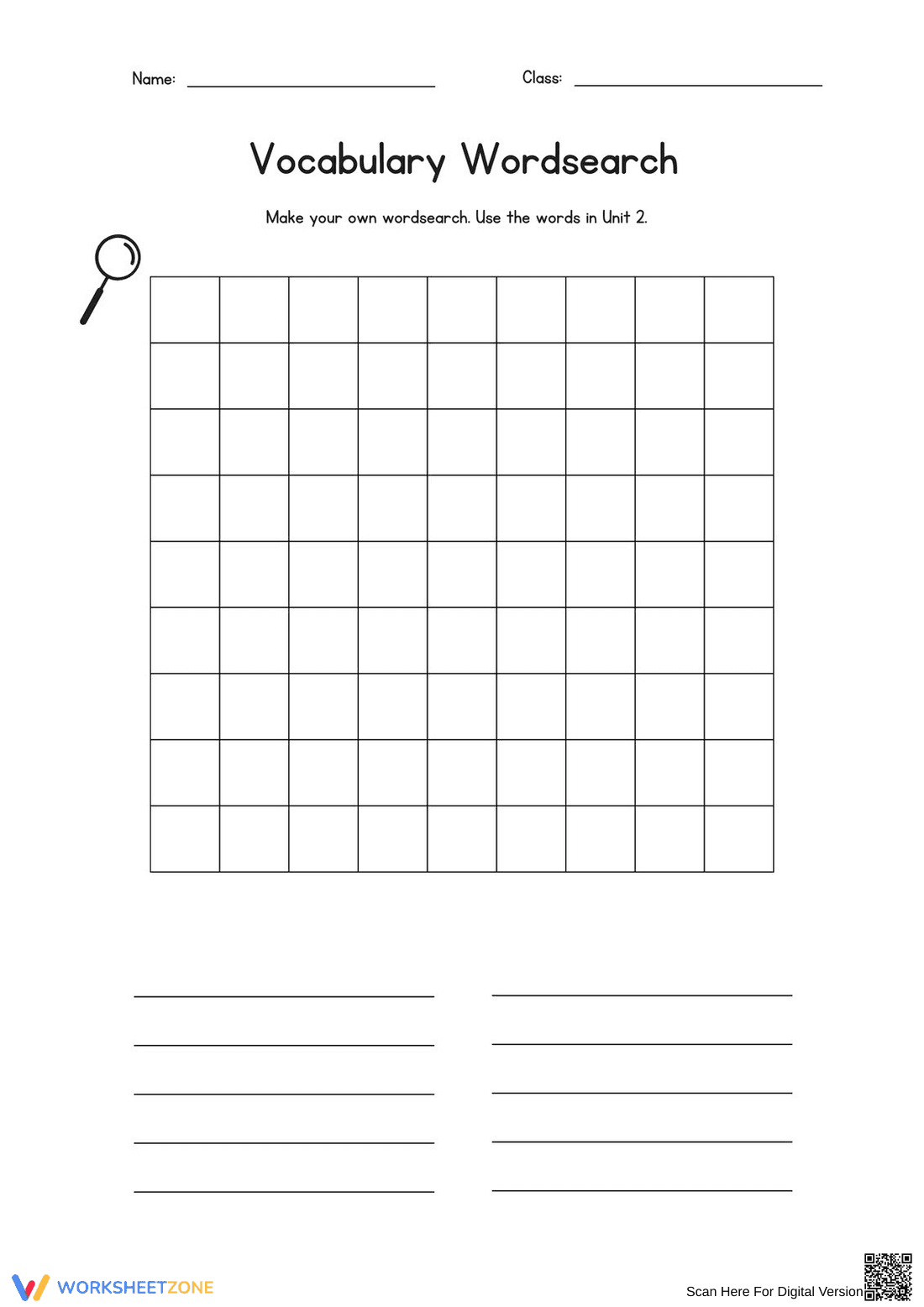

Grade 3 Vocabulary Word Search — Printable Blank Worksheet
Paste this activity's link or code into your existing LMS (Google Classroom, Canvas, Teams, Schoology, Moodle, etc.).
Students can open and work on the activity right away, with no student login required.
You'll still be able to track student progress and results from your teacher account.
This Grade 3 vocabulary worksheet empowers students to take ownership of their learning by creating their own word search puzzles. By selecting and writing ten target words from their current unit, learners actively reinforce spelling patterns and domain-specific terminology before challenging a peer to solve their custom grid.
At a Glance
- Grade: 3 · Subject: ELA
- Standard:
CCSS.ELA-LITERACY.L.3.6— Acquire and use grade-appropriate vocabulary words- Skill Focus: Spelling and Vocabulary Acquisition
- Format: 1 page · 10 words · No answer key required · PDF
- Best For: Independent practice and peer review
- Time: 15–20 minutes
Inside this single-page PDF, educators will find a clean blank word search template. The layout features a 10x10 grid where students hide their selected terms, accompanied by ten blank lines for the word bank. Because students supply their own unit vocabulary, no answer key is needed, making it a versatile tool for any subject.
Zero-Prep Workflow
This resource offers a streamlined three-step process:
- Print (1 min): Generate copies directly from the PDF. No special formatting required.
- Distribute (1 min): Hand out templates with the week's vocabulary list.
- Review (0 min): Students self-direct the creation, and peer-swapping acts as review.
With teacher prep under two minutes, this is an excellent addition to sub plans.
Standards Alignment
This activity aligns directly with CCSS.ELA-LITERACY.L.3.6, requiring students to acquire and use accurately grade-appropriate conversational, general academic, and domain-specific words and phrases. As a supporting standard, it also reinforces basic spelling conventions as students must correctly write their chosen terms in the grid and word bank. Both standard codes can be copied directly into lesson plans, IEP goals, or district curriculum mapping tools.
How to Use It
This template shines during independent centers or as a Friday review. Assign students to select ten critical terms from a recent unit to embed in their puzzle. Once completed, have students swap papers to solve each other's word searches. For a quick formative assessment, observe students writing their word banks to check for accurate spelling. Expected completion time is 15 to 20 minutes.
Who It's For
Ideal for third-grade students, this open-ended resource adapts easily for older students reviewing complex terminology or younger learners practicing sight words. To differentiate, provide a pre-selected list of five words instead of ten. Pair this template with a classroom anchor chart to help students identify high-value vocabulary.
Engaging students in the creation of their own learning materials significantly boosts retention and active processing across all subject areas. According to Fisher & Frey (2014), instructional routines that transfer cognitive load to the student through generative tasks dramatically improve long-term vocabulary acquisition and spelling accuracy. By utilizing this interactive template aligned directly to CCSS.ELA-LITERACY.L.3.6, educators ensure students actively acquire and use grade-appropriate vocabulary words rather than passively memorizing them from a static list. The physical act of writing the target words in the bottom bank and strategically placing each letter within the blank grid forces learners to analyze spelling patterns, phonics rules, and word structures multiple times. This repeated, intentional exposure within a single, student-directed activity solidifies foundational literacy skills while fostering a strong sense of ownership over the academic content. It transforms routine spelling practice into a highly engaging, peer-collaborative challenge.


