


























Views
Downloads
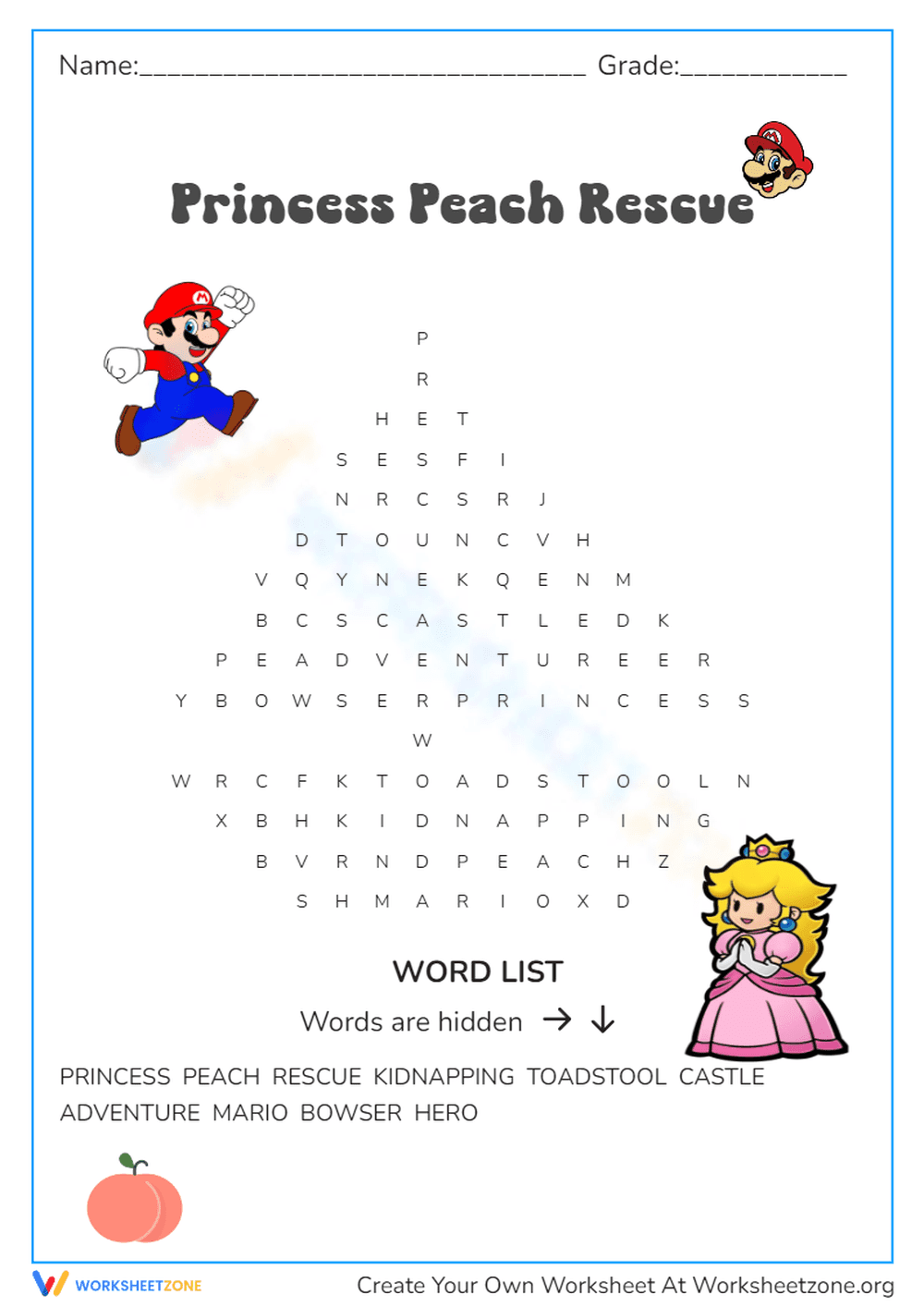

Princess Peach Word Search | Printable Grade 3
Paste this activity's link or code into your existing LMS (Google Classroom, Canvas, Teams, Schoology, Moodle, etc.).
Students can open and work on the activity right away, with no student login required.
You'll still be able to track student progress and results from your teacher account.
This engaging Princess Peach word search worksheet helps students build foundational vocabulary and spelling skills through visual scanning. By searching for ten themed words hidden in the puzzle, learners reinforce letter recognition and word patterns. It provides a fun, focused activity that keeps students on task while developing essential literacy abilities.
At a Glance
- Grade: 3 · Subject: ELA
- Standard:
CCSS.ELA-LITERACY.L.3.2— Spell words correctly and recognize patterns- Skill Focus: Vocabulary and Spelling
- Format: 1 page · 10 problems · Answer key included · PDF
- Best For: Morning work or sub plans
- Time: 10–15 minutes
Inside this single-page resource, educators will find a visually appealing word search puzzle. The worksheet features a clear word bank containing ten adventure-themed terms, such as "rescue" and "hero." Words are hidden horizontally and vertically, making it accessible for early readers. A complete answer key ensures quick grading.
Zero-Prep Workflow
This resource is designed for immediate classroom implementation with absolutely no teacher setup required.
- Print (1 minute): Simply download the PDF and print a class set. The design ensures minimal ink usage.
- Distribute (1 minute): Hand out the puzzle during morning arrival, literacy centers, or transition periods. The instructions are entirely self-explanatory.
- Review (1 minute): Use the included answer key to quickly check student work or project it on the smartboard for self-correction.
With a total teacher prep time of under two minutes, this worksheet is an ideal, stress-free addition to any emergency sub plan.
Standards Alignment
This activity aligns directly with CCSS.ELA-LITERACY.L.3.2, requiring students to demonstrate command of the conventions of standard English spelling. As they scan for specific letter sequences, learners reinforce their orthographic mapping skills. A supporting standard includes CCSS.ELA-LITERACY.RF.3.3, focusing on word analysis and decoding. Both standard codes can be copied directly into lesson plans, IEP goals, or district curriculum mapping tools.
How to Use It
This versatile worksheet fits perfectly into multiple instructional moments. Assign it as morning work before direct instruction begins, or use it as a fast-finisher activity. As a formative assessment observation tip, watch how students search for words: do they scan row by row, or look for the first letter of the target word? This can provide insight into their visual tracking strategies. Expected completion time ranges from 10 to 15 minutes.
Who It's For
This resource is primarily designed for third-grade students, though it serves as excellent review for fourth graders or an engaging challenge for advanced second graders. To support differentiation, teachers can highlight the first letter of each hidden word for students who need extra scaffolding. It pairs naturally with a creative writing prompt about video game adventures or a direct instruction lesson on narrative story elements.
Integrating thematic puzzles into literacy routines offers measurable benefits for student engagement and word recognition. According to Fisher & Frey (2014), providing students with low-stakes, high-interest vocabulary tasks significantly increases their time on task and willingness to interact with text. This specific activity targets CCSS.ELA-LITERACY.L.3.2, helping students spell words correctly and recognize patterns through repeated visual exposure. When learners actively scan for terms like "adventure" and "castle," they strengthen the neural pathways associated with orthographic mapping. This process is critical for developing fluent readers who automatically recognize vocabulary. By utilizing familiar, culturally relevant themes, educators can lower the affective filter, making rigorous spelling practice feel like an enjoyable game rather than a chore. This approach ensures that foundational literacy skills are reinforced effectively and consistently.


