


























Views
Downloads

Essential Prime Factorization Practice | Grade 6 Math
Paste this activity's link or code into your existing LMS (Google Classroom, Canvas, Teams, Schoology, Moodle, etc.).
Students can open and work on the activity right away, with no student login required.
You'll still be able to track student progress and results from your teacher account.
This Essential Prime Factorization practice resource enables students to systematically break down composite numbers into their fundamental building blocks. Mastering prime and composite values builds numerical fluency for advanced algebraic concepts and fraction operations. This worksheet offers a clear path to mastery through visual scaffolding and direct computation.
At a Glance
- Grade: 6 · Subject: Math
- Standard:
6.NS.B.4— Find the greatest common factor of two whole numbers less than or equal to 100- Skill Focus: Prime Factorization using Factor Trees
- Format: 3 pages · 6 problems · Answer key included · PDF
- Best For: Small group instruction and independent practice
- Time: 20–30 minutes
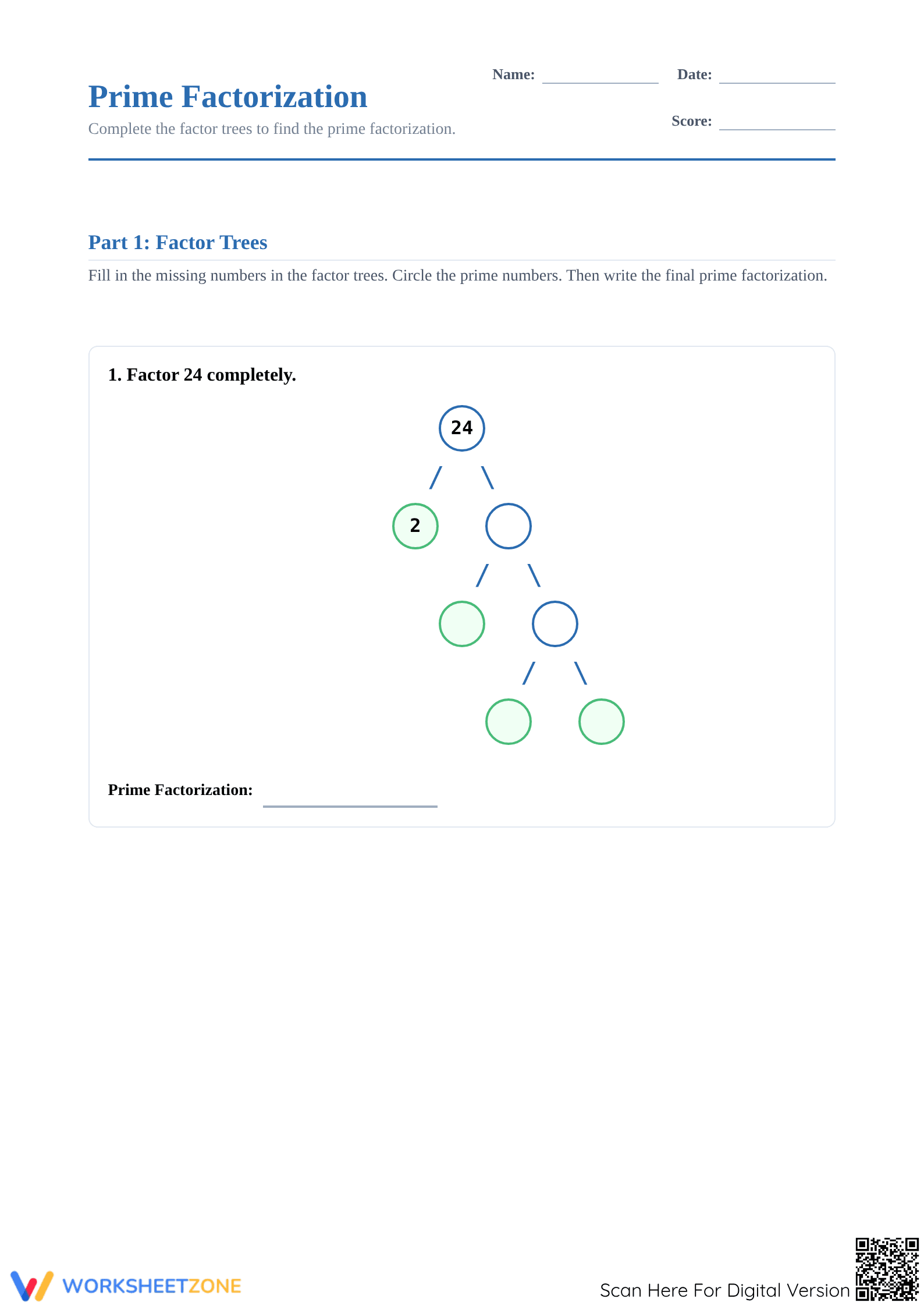
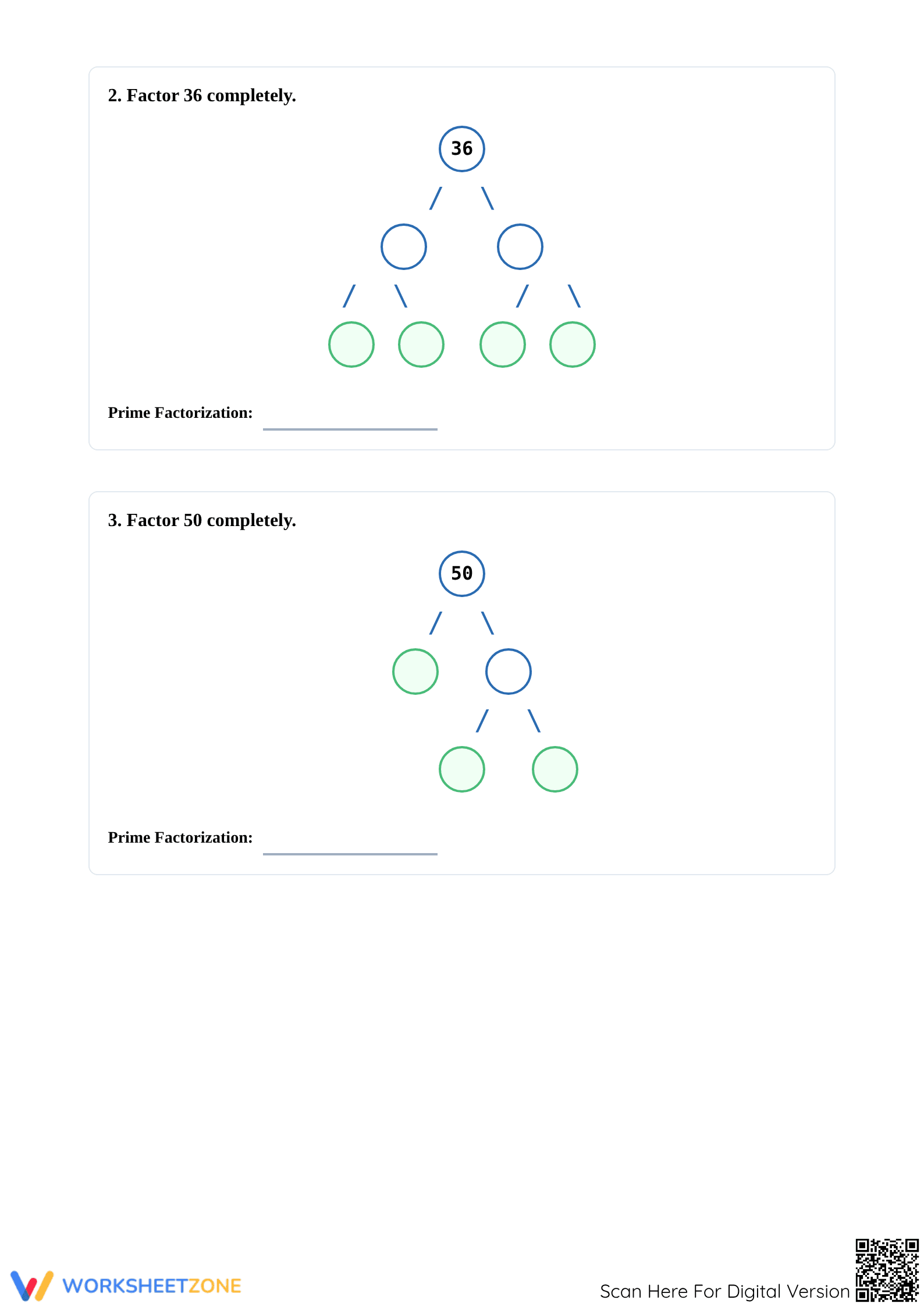
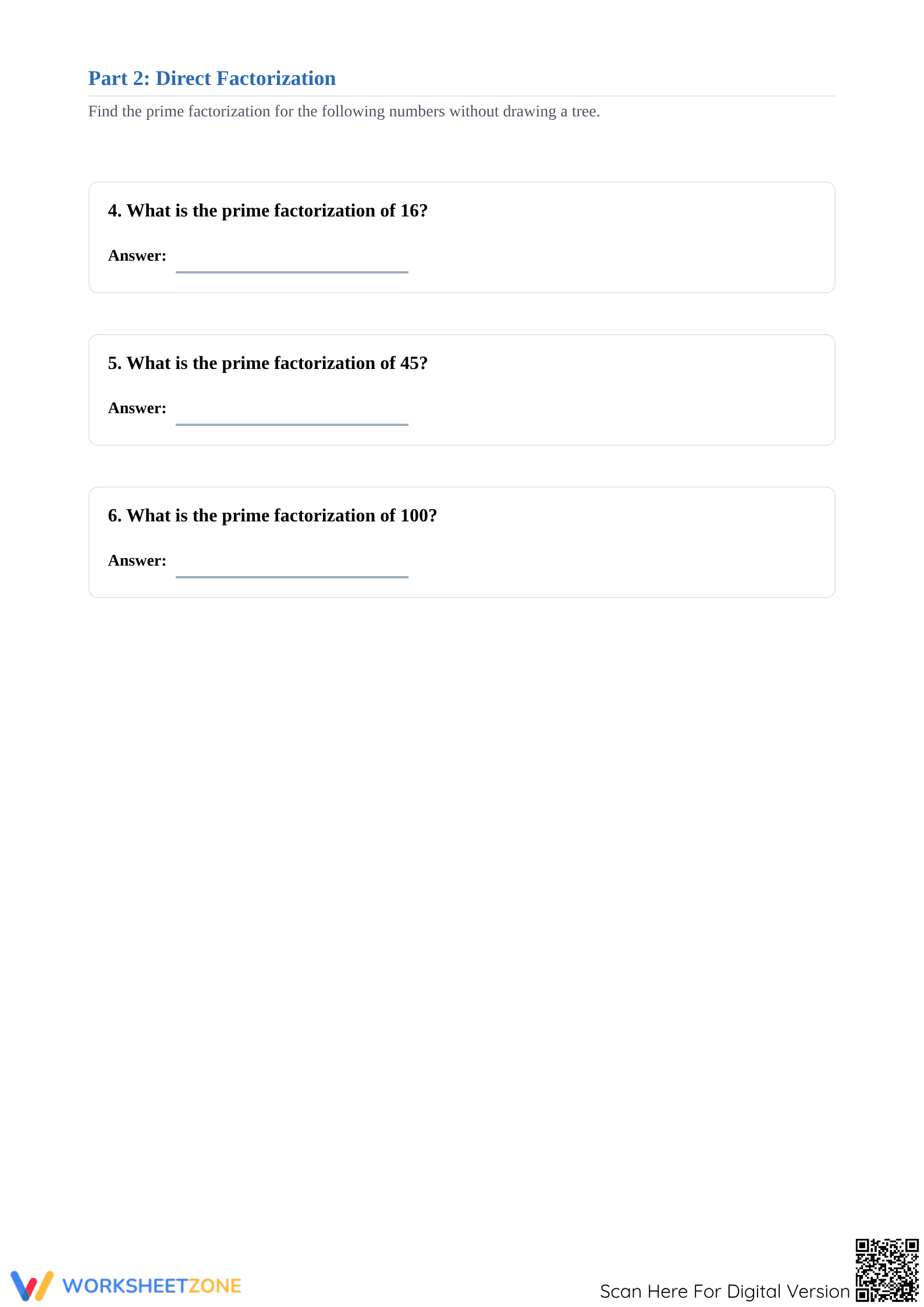
This comprehensive 3-page PDF focuses on two methods for prime factors. The first two pages feature three large-format factor trees (for 24, 36, and 50), providing visual cues for guided calculation. The final page challenges students with three direct factorization tasks (for 16, 45, and 100), requiring them to apply knowledge without visual aids. A full answer key facilitates rapid grading and self-correction.
Skill Progression
- Guided Practice: The first page features a partially completed factor tree for 24. Students fill missing nodes, understanding branching logic and stopping at prime numbers.
- Supported Practice: Problems 2 and 3 provide root numbers and tree structures for 36 and 50. Students identify factor pairs and continue breakdown independently, circling primes for complete factorization.
- Independent Practice: The final section removes tree diagrams. Students determine prime factors for 16, 45, and 100 using their preferred strategy, transitioning from visual support to abstract numerical reasoning.
This sequence follows a gradual-release model, moving from scaffolded "I Do" and "We Do" moments to independent "You Do" assessment.
Standards Alignment
Primary Standard: `CCSS.MATH.CONTENT.6.NS.B.4` — Find the greatest common factor of two whole numbers less than or equal to 100 and the least common multiple of two whole numbers less than or equal to 12. This worksheet specifically addresses the prerequisite skill of identifying prime factors, essential for finding GCF and LCM efficiently. Both standard codes can be copied into lesson plans, IEP goals, or curriculum mapping tools.
How to Use It
This resource is highly effective during the "during instruction" phase of a number theory unit. Project the first page to complete the tree for 24 as a class. Assign remaining factor trees for individual practice. Use the final direct factorization page as a formative assessment exit ticket to gauge internalization. Expected completion time is 15-30 minutes.
Who It's For
Designed for 6th-grade students beginning number system study, it also serves as a remedial tool for 7th and 8th graders struggling with fractions. Differentiation is built-in: factor tree pages support visual learners, while direct factorization challenges abstract thinkers. It pairs well with prime number anchor charts or a lesson on the Sieve of Eratosthenes.
Mastery of prime factorization is a critical gateway skill in middle school mathematics, foundational for simplifying complex fractions and solving algebraic equations. This resource targets CCSS.MATH.CONTENT.6.NS.B.4 by ensuring students can reliably decompose numbers up to 100 into prime components. Moving from scaffolded trees to direct identification helps translate procedural knowledge into conceptual understanding. Educators can use these problems to identify misconceptions early, preventing errors in later GCF and LCM applications.


