


























Views
Downloads


Kindergarten Counting 1-10 — Printable No-Prep Worksheet
Paste this activity's link or code into your existing LMS (Google Classroom, Canvas, Teams, Schoology, Moodle, etc.).
Students can open and work on the activity right away, with no student login required.
You'll still be able to track student progress and results from your teacher account.
This Number Skills 1-10 worksheet is designed to help kindergarten students master the foundational concepts of counting and cardinality. By engaging with both abstract numerals and concrete objects, learners build the essential one-to-one correspondence needed for early mathematical success. Students will identify, count, and represent numbers through a variety of intuitive tasks.
At a Glance
- Grade: Kindergarten · Subject: Math
- Standard:
CCSS.MATH.CONTENT.K.CC.B.5— Count to answer "how many?" questions about as many as 20 things- Skill Focus: Counting and representing numbers 1-10
- Format: 2 pages · 7 tasks · Answer key included · PDF
- Best For: Daily math centers and morning work
- Time: 10–15 minutes
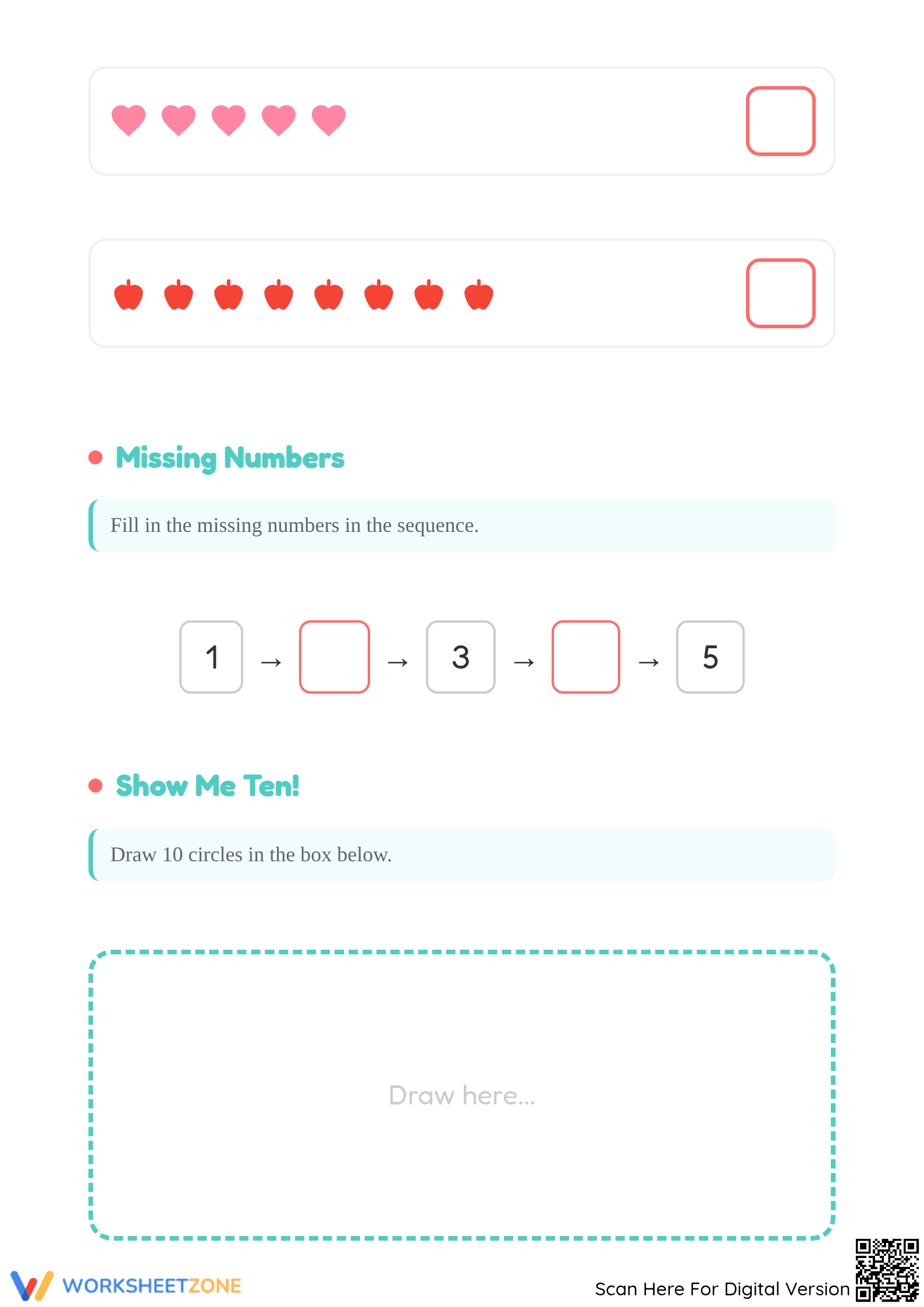
This two-page resource features a structured progression of number tasks. The first page includes a visual number chart from 1 to 10 for reference and vocal practice, followed by "Count and Write" activities featuring recognizable stars. The second page continues with object counting (hearts and apples), a "Missing Numbers" sequence to reinforce numerical order, and a "Show Me Ten!" drawing space for artistic representation.
Zero-Prep Workflow
Implementing this worksheet takes less than two minutes of teacher preparation. Step 1: Print the two-page PDF (30 seconds). Step 2: Distribute to students as a "do now" or center activity (30 seconds). Step 3: Review the completed work using the provided answer key for immediate feedback (1 minute). This streamlined workflow makes it an ideal resource for substitute teacher plans or quick morning transitions.
Standards Alignment
The primary alignment is CCSS.MATH.CONTENT.K.CC.B.5, which requires students to count to answer "how many?" questions about objects arranged in a line, a rectangular array, or a circle. It also supports CCSS.MATH.CONTENT.K.CC.A.3 by providing opportunities to write numbers from 0 to 10. Both standard codes can be copied directly into lesson plans, IEP goals, or district curriculum mapping tools.
How to Use It
Use this worksheet as a formative assessment after introducing numbers 1-10 through direct instruction. Teachers should observe students during the "Missing Numbers" task to identify any gaps in sequence recognition. It also works well as a quiet activity during transition times. Students typically complete the exercises within 15 minutes, making it a flexible addition to any math block.
Who It's For
This resource is specifically crafted for kindergarten students and early first graders who are solidifying their number sense. It is also suitable for preschool learners ready for more formal paper-and-pencil tasks. The visual supports and clear instructions make it a great pairing with physical manipulatives or anchor charts displayed in the classroom for extra scaffolding.
According to research by Fisher & Frey (2014), the use of scaffolds like visual number charts and structured practice supports the gradual release of responsibility in early childhood education. This worksheet applies these principles by providing a clear reference point before asking students to perform independent counting and writing tasks. Mastery of the CCSS.MATH.CONTENT.K.CC.B.5 standard is a critical milestone, as it moves beyond rote counting to a deeper understanding of cardinality and the relationship between a number and a specific quantity. By integrating multiple modalities—visual, vocal, and motor—the worksheet ensures that learners develop a robust mental model of the numbers 1 through 10. This foundational skill is a strong predictor of later academic success in measurement, data analysis, and algebraic thinking. Educators can confidently use this tool as part of a research-based instructional strategy for building early mathematical fluency.


